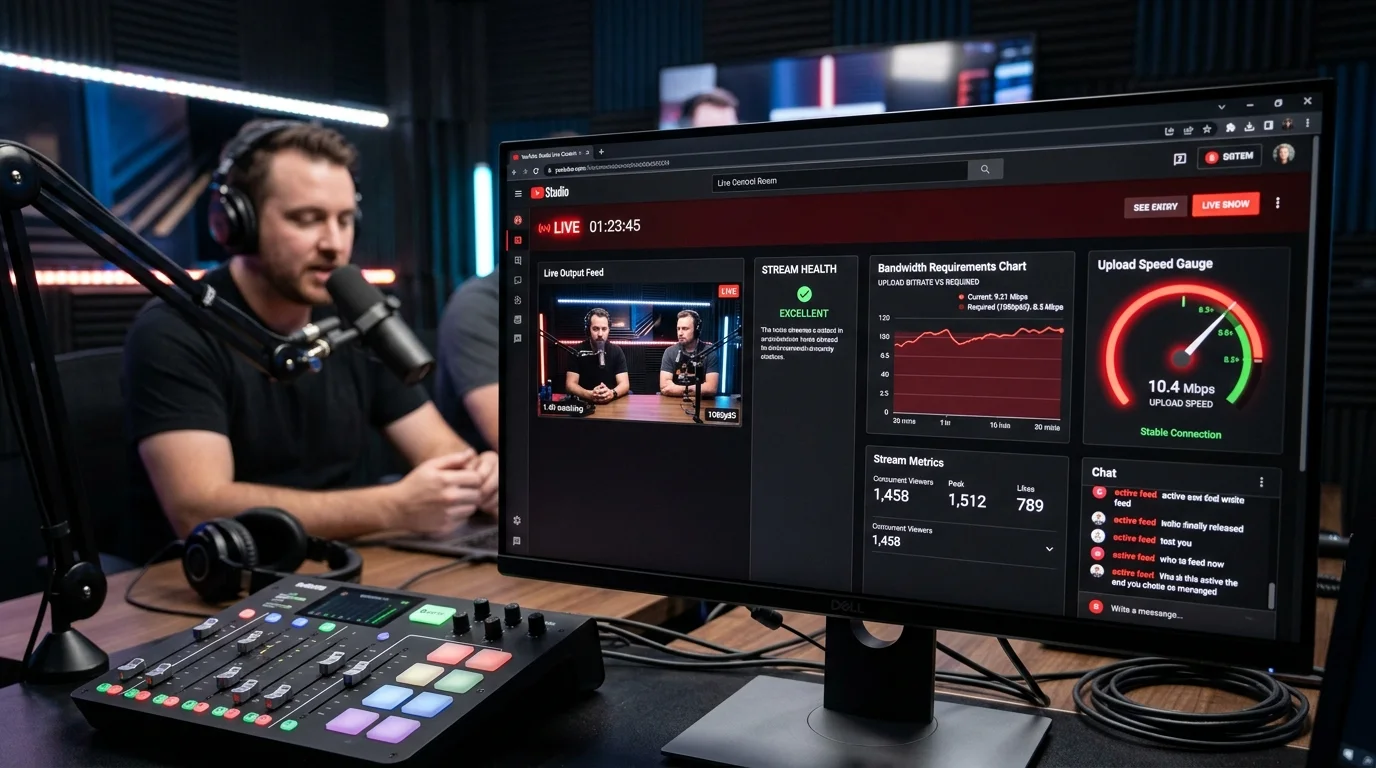
YouTube Live Upload Requirements by Resolution (2026)
- 480p 30fps: 1,000–2,500 kbps. Minimum ~2 Mbps upload. Basic mobile streaming.
- 720p 30fps: 2,500–5,000 kbps. Minimum ~6 Mbps upload.
- 1080p 30fps: 3,000–6,000 kbps. Minimum ~8 Mbps upload.
- 1080p 60fps: 4,500–9,000 kbps. Minimum ~11 Mbps upload.
- 1440p 60fps: 9,000–18,000 kbps. Minimum ~20 Mbps upload.
- 4K 30fps: 15,000–30,000 kbps. Minimum ~35 Mbps upload.
- 4K 60fps HDR: 20,000–51,000 kbps. Minimum ~60 Mbps sustained upload. Requires fiber or high-tier cable with symmetrical upload.
Why YouTube Live Is Harder Than Twitch for High Quality
YouTube Live re-encodes your stream for delivery to viewers — meaning you need to send a high-quality source signal for their encoding to produce good output. Twitch delivers your encoded stream more directly to viewers. This means YouTube Live's quality ceiling requires higher source bitrates than comparable Twitch quality even though the viewer-side result looks similar.
The VP9 and AV1 Advantage
YouTube encodes output using VP9 and AV1 — more efficient codecs than Twitch's H.264 output. This means YouTube viewers see better quality at equivalent bitrates. For the streamer, however, you must still deliver H.264 (or H.265 on supported encoders) as the ingest format. AV1 ingest is not yet widely supported for live streams.
DCSpeedTest Before Every Stream
Run DCSpeedTest 5 minutes before going live to verify your current upload speed and jitter. For 4K streaming: upload must be at least 60 Mbps and jitter below 10ms. A single jitter spike above 50ms during streaming causes YouTube Live's adaptive bitrate to drop quality for all viewers simultaneously — often producing the infamous "pixelated 4K" complaint in stream chats.