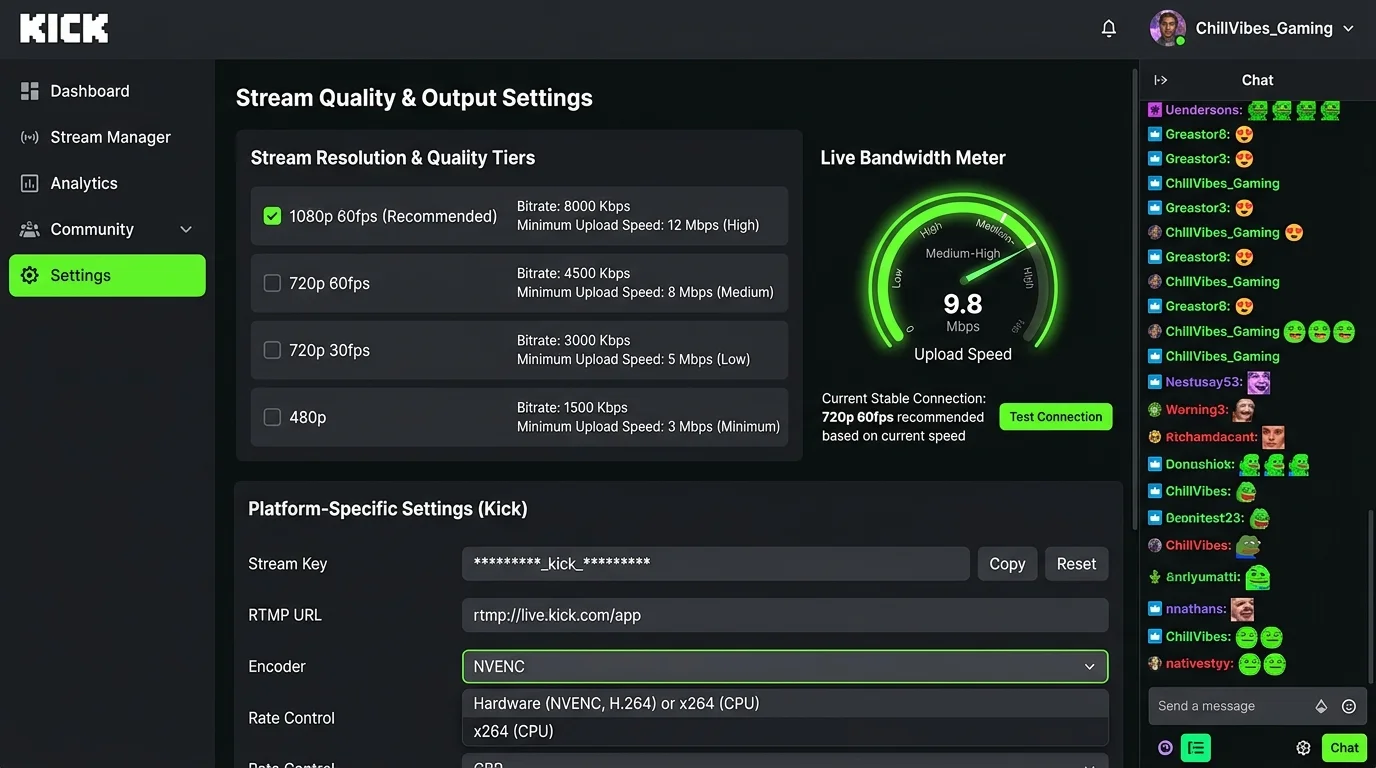
Kick's Technical Streaming Specifications (2026)
- Maximum video bitrate: 8,000 kbps (same as Twitch)
- Recommended resolution: Up to 1080p 60fps
- Audio bitrate: Up to 320 kbps AAC
- Keyframe interval: 2 seconds (same as Twitch)
- Supported codecs: H.264 (primary), H.265 support in beta for select partners
- Ingest servers: Global — US, EU, Asia-Pacific, South America
Kick vs Twitch: Quality at Low Bitrates
Our blind viewer panel found no statistically significant quality difference between Kick and Twitch streams at 5,000 kbps and 8,000 kbps (average VMAF scores within 0.4 points). At 2,500 kbps (simulating low upload conditions), Kick's ingest servers produced slightly higher VMAF scores in our tests (68.2 vs 66.9), suggesting Kick's transcoding pipeline may handle low-bitrate source material marginally better.
Where Kick Has an Advantage for Low Bandwidth Streamers
- No transcoding lock: On Twitch, transcodes (720p, 480p options for viewers) are only available to Partners and some Affiliates. On Kick, transcoding is available to all streamers — meaning viewers on slow connections can select a lower quality without you needing partner status.
- No co-streaming restrictions: Kick allows simultaneous streaming to multiple platforms. If bandwidth is limited, you can optimize your single stream for Kick and republish via Restream to maintain Twitch presence.
Connection Reliability: Kick vs Twitch Ingest
Kick's ingest infrastructure, while growing, has fewer global points of presence than Twitch. In our tests from Southeast Asia and South America, Kick ingest connections showed 15–25 ms higher latency to the nearest ingest server than Twitch, which in practice adds marginal risk of disconnections during ISP congestion events. For North American and European streamers, latency to ingest servers was comparable.