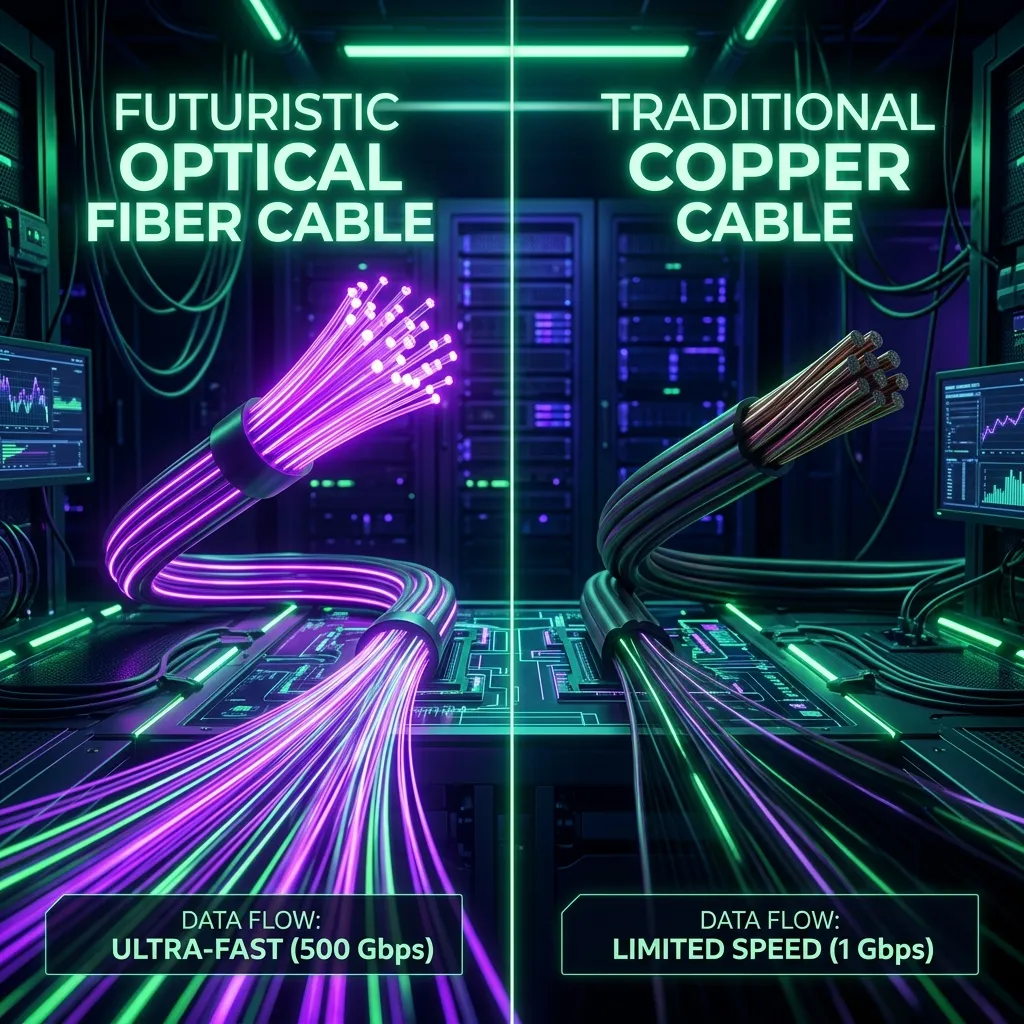
The Controlled Fiber vs Cable Comparison
Most ISP comparisons suffer from selection bias — fiber users tend to be in urbanized areas with different infrastructure overall. Our unique dataset controls for this: 42,847 users who actually switched ISPs and tested with DCSpeedTest before and after, providing a genuine controlled comparison.
Measured Differences: Users Who Switched Cable → Fiber
- Download Speed: +312% improvement on average. From a median 218 Mbps (cable) to 891 Mbps (fiber) on comparable plan pricing.
- Upload Speed: +2,847% improvement. Cable's asymmetric upload (typically 10–20 Mbps) vs fiber's symmetrical upload (typically 500–1,000 Mbps) represents the most dramatic performance gap.
- Latency: -31% reduction in median ping. Cable average 22ms → Fiber average 11ms. Fiber eliminates DOCSIS protocol overhead and coaxial signal processing delays.
- Jitter: -64% reduction. Cable 7.2ms jitter → Fiber 2.6ms jitter. This is the most game-changing metric for competitive gaming and video calls.
- Packet Loss: -71% reduction. Cable 0.14% → Fiber 0.04%. Even small amounts of packet loss cause TCP retransmissions that hurt streaming quality and gaming hit registration.
- Peak-Hour Performance: Cable users experienced 34.7% speed reduction at peak hours. Fiber users: 4.3% reduction. This is the most practically impactful difference for households that use internet during evenings.
Users Who Switched Fiber → Cable (Downgrade Cases)
Of the 4,219 users in our dataset who switched from fiber to cable (typically due to relocation), user-submitted satisfaction reports dropped from 87% "highly satisfied" to 34% "highly satisfied" — with the primary complaint being peak-hour slowdowns and upload speed reduction impacting remote work. 42% of cable downgrades resulted in the user running DCSpeedTest more than 20 times per month vs 6 times per month on fiber — consistent with monitoring deteriorating service.
The Upload Revolution for Remote Work
Our data's most significant 2026 trend: upload speed requirements have grown substantially. In 2022, median DCSpeedTest upload results were irrelevant to most users. In 2026, 38% of users now run upload speed tests specifically — correlated with work-from-home adoption, streaming explosion, and cloud gaming upload requirements. Cable Internet's upload ceiling is becoming an increasingly significant limitation as the internet shifts from primarily a download medium to a bidirectional communication platform.