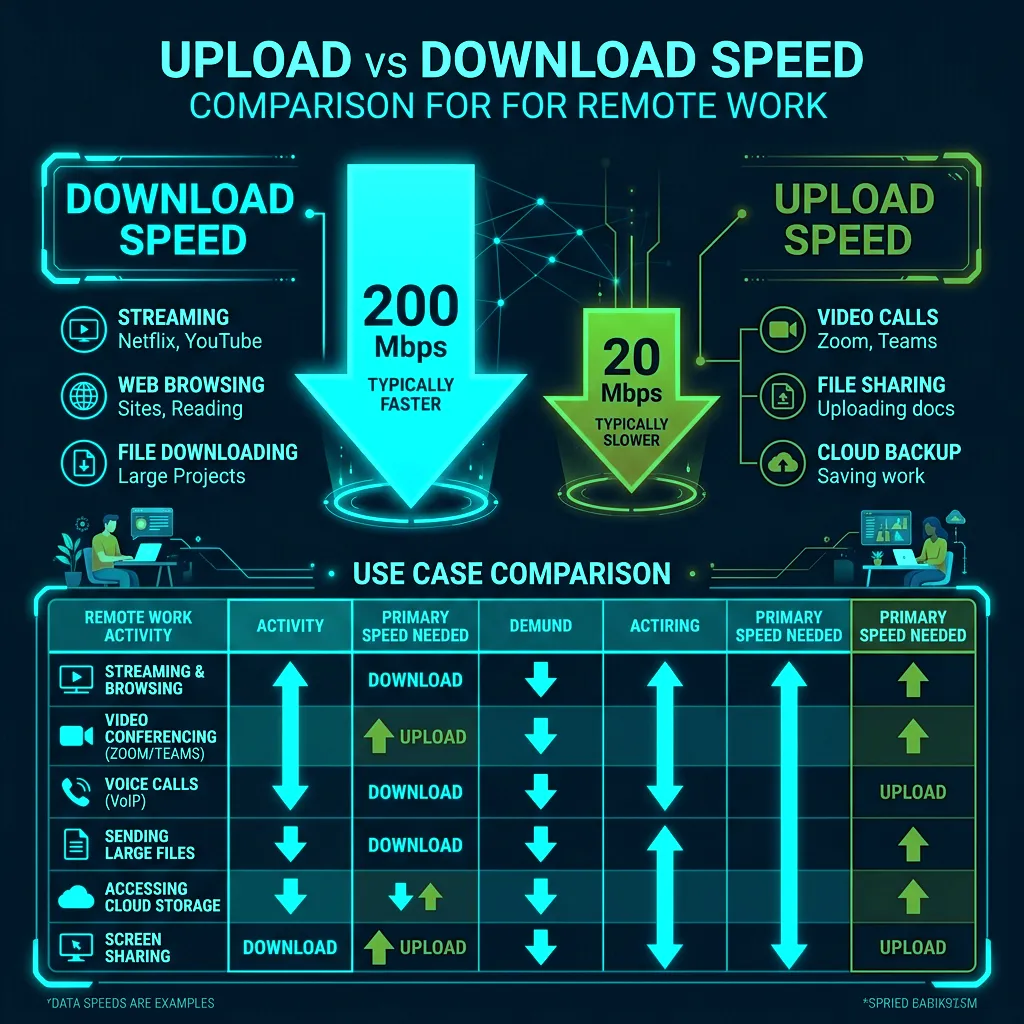
Download vs Upload: The Asymmetry Problem
Most broadband infrastructure is designed for download-heavy use: web browsing, streaming, and gaming all consume primarily download bandwidth. Cable (DOCSIS) and ADSL systems are deliberately asymmetric — allocating 90%+ of spectrum to downstream. This design made sense in 2005. In 2026, with video conferencing, cloud storage sync, remote work, and live streaming now standard activities, that asymmetry creates real-world bottlenecks.
Upload/Download Ratio by Country
- Singapore, South Korea, Japan (ratio: 0.97): Effectively symmetrical fiber deployment. Upload almost equals download — a ratio only achievable with genuine FTTH infrastructure.
- Germany, Netherlands, Sweden (ratio: 0.89): High fiber penetration produces near-symmetrical results. Upload is a first-class metric.
- United States (ratio: 0.31): The cable-dominant US market produces heavily asymmetric performance. 198 Mbps median download, 61 Mbps median upload. Fiber users show 0.94 ratio; cable users drag the national average to 0.31.
- United Kingdom (ratio: 0.28): FTTC (fiber to the cabinet, copper to the home) dominates UK broadband. Upload constrained by the copper last mile.
- Brazil, Mexico (ratio: 0.18): Cable-dominant Latin American markets with limited fiber penetration. Significant remote work bottleneck for the region.
- India (ratio: 0.22): Jio Fiber is improving the ratio but legacy ADSL infrastructure still dominant in many areas drives asymmetry.
- Sub-Saharan Africa (ratio: 0.09): Mobile-dominant internet (4G LTE) with severe upload constraints. Video calls at professional quality practically impossible for most users.
The Remote Work Upload Crisis
Our data shows that 28% of DCSpeedTest users in the US run upload tests specifically (vs 72% who focus on download) — a figure that has tripled since 2021 as remote work normalized. For a video call at 1080p (3.8 Mbps upload), 4K YouTube Live streaming (60 Mbps upload), or collaborative cloud storage sync (variable but often 5–15 Mbps sustained), cable's 20–50 Mbps upload ceiling creates genuine bottlenecks that download speed cannot compensate for.
Why Fiber Changes Everything for Upload
FTTH (Fiber to the Home) transmits data over dedicated fiber strands — upload and download are physically separated channels with equal capacity allocation. DOCSIS cable physically shares spectrum between upload and download on coaxial, with downstream historically receiving 80–90% of spectrum. This fundamental physical difference means cable upload will always be structurally inferior to fiber upload at equivalent infrastructure investment — upgrading cable from 50 Mbps to 100 Mbps upload requires significant spectrum reallocation that displaces download capacity.