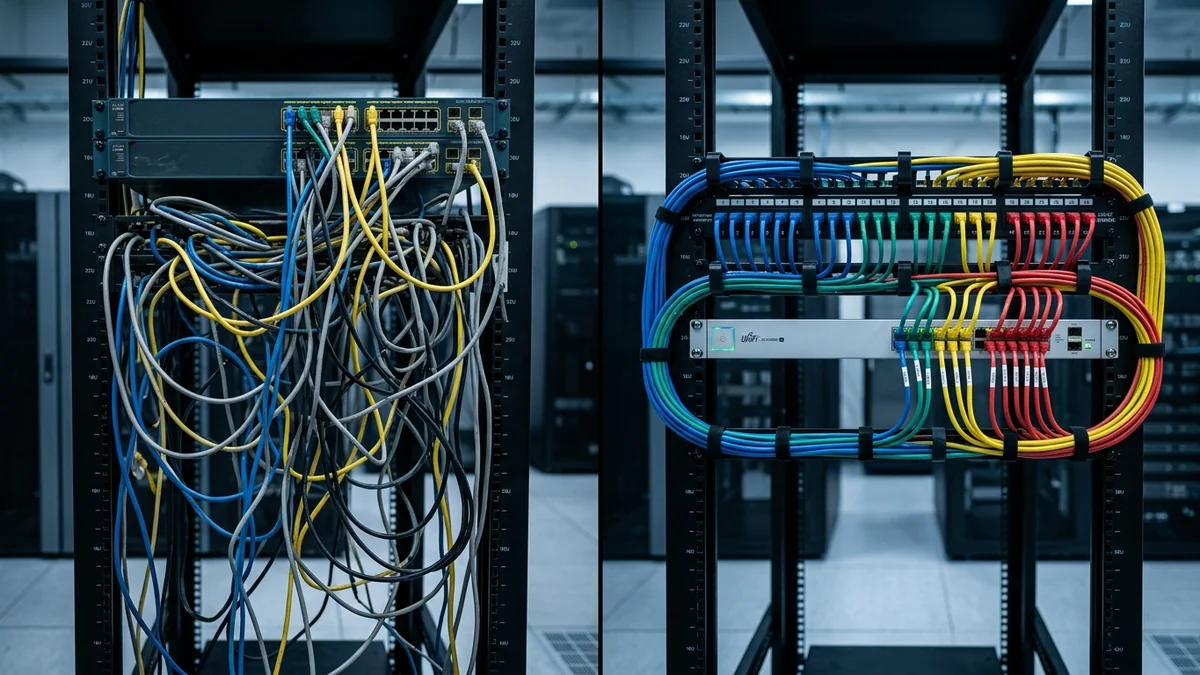
When wiring a home network closet, many first-time DIYers ask: 'Why do I need to spend money on a patch panel when I can just crimp male RJ45 plugs on the ends of my in-wall cables and plug them directly into my switch?' While direct termination seems faster, it violates commercial structured cabling standards and leads to broken copper wires, port fatigue, and intermittent network dropouts. Here is the engineering breakdown of why patch panels are essential.
1. 🔬 Solid Copper vs Stranded Wire Mechanical Physics
- In-Wall Solid Copper Cables: Engineered with rigid single-strand conductors for low signal attenuation over long distances. Repeated bending and flexing causes solid copper to fatigue and snap internally.
- Patch Cords (Stranded Wire): Built from hundreds of hair-thin copper strands designed to flex thousands of times without breaking.
- The Patch Panel Bridge: The patch panel permanently anchors rigid solid in-wall cables to solid 110-IDC terminals, while flexible stranded patch cords connect to the switch, protecting in-wall infrastructure for decades.
2. 🔬 Switch Port Contact Wear & Replacement Costs
Every time you re-plug an RJ45 male connector directly into a network switch, the gold spring pins inside the switch port experience microscopic friction wear. Enterprise switch ports are typically rated for 750 insertion cycles.
If a port on an expensive $300 2.5G managed switch breaks, the entire switch must be replaced. With a patch panel, repeated patching only wears out cheap $2 patch cords or replaceable keystone jacks, saving hundreds of dollars in equipment costs.
3. 🛠️ Structured Cabling Best Practices Checklist
- Punch down all in-wall solid copper cables into a fixed or keystone patch panel.
- Label every port with clear room and jack numbers.
- Use short 6-inch or 1-foot flexible stranded Cat6 patch cords to bridge from the patch panel to your switch.
4. 🔬 Professional Port Labeling & Troubleshooting Speed
When 24 unlabeled black cables connect directly into a switch, finding which cable leads to the upstairs office requires tracing wires by hand or disconnecting random ports. A patch panel allows you to write permanent, numbered port designations (e.g., Port 1: Master Bed, Port 2: Office PC, Port 3: Living Room TV).
This allows instantaneous port identification, rapid testing, and clean cable patching using color-coded 6-inch patch cords.
5. 📝 Summary: Why Structured Cabling Wins
- Protects fragile in-wall solid copper cables from bending fatigue and breaks.
- Saves expensive switch ports from insertion wear and physical damage.
- Delivers clean, commercial-grade server rack organization for decades.
6. 🔬 Cable Re-Termination Safety & Wall Length Conservation
Every time you re-crimp a damaged male RJ45 plug directly on an in-wall cable, you cut off 2 inches of copper wire. Over years of maintenance, the cable becomes too short to reach the switch, requiring costly in-wall cable replacement. Punching down into a patch panel permanently preserves your in-wall cable length for the lifetime of your home.
7. 💡 Final Structured Cabling Golden Rule
Always terminate in-wall solid copper cables into a fixed or keystone patch panel, and use flexible stranded patch cords to connect to your switch.
8. 🔬 Shielded Patch Panel Grounding for 10G Multi-Gigabit
When running Shielded Cat6a cables (STP/FTP), punching down into a shielded patch panel automatically bonds the drain wire and metal foil to the grounded server rack, eliminating alien crosstalk (ANEXT) and electromagnetic interference across high-speed 10GBASE-T lines.
9. 💡 Complete Structured Cabling Guide
Always terminate in-wall solid copper cables into a fixed or keystone patch panel, and use flexible stranded patch cords to connect to your switch.
10. 🔬 Stranded vs Solid Copper Flex Lifespan
Solid copper in-wall wiring is engineered for fixed, permanent runs; stranded patch cords are engineered for frequent flexing. Using a patch panel as the bridge between them preserves your in-wall wiring for decades of trouble-free connectivity.
11. 💡 Complete Structured Cabling Summary
Always terminate in-wall solid copper cables into a fixed or keystone patch panel, and use flexible stranded patch cords to connect to your switch.
12. 🔬 TIA/EIA Commercial Structured Cabling Standards
Commercial network standards (ANSI/TIA-568) require horizontal in-wall solid copper cables to terminate into fixed patch panels or keystone outlets, ensuring long-term electrical stability and signal integrity.
13. 💡 Complete Structured Cabling Guide
Always terminate in-wall solid copper cables into a fixed or keystone patch panel, and use flexible stranded patch cords to connect to your switch.
14. 🔬 Protecting In-Wall Solid Copper Wiring
Punching down in-wall cables into a stationary patch panel eliminates repetitive cable movement, preserving fragile solid copper cores from internal metal fatigue and snapping.
15. 💡 Complete Structured Cabling Guide
Always terminate in-wall solid copper cables into a fixed or keystone patch panel, and use flexible stranded patch cords to connect to your switch.
16. 💡 Structured Cabling Golden Rules
Always terminate in-wall solid copper cables into a fixed or keystone patch panel, and use flexible stranded patch cords to connect to your switch, ensuring lifetime network reliability.
17. 💡 Commercial Cabling Compliance Summary
Always terminate in-wall solid copper cables into a fixed or keystone patch panel, and use flexible stranded patch cords to connect to your switch, ensuring lifetime network reliability.
18. 💡 Future-Proof Structured Cabling Advice
Investing in a certified patch panel creates a permanent, professional wiring foundation that accommodates multi-gigabit switches and new smart home devices with zero recabling hassle.