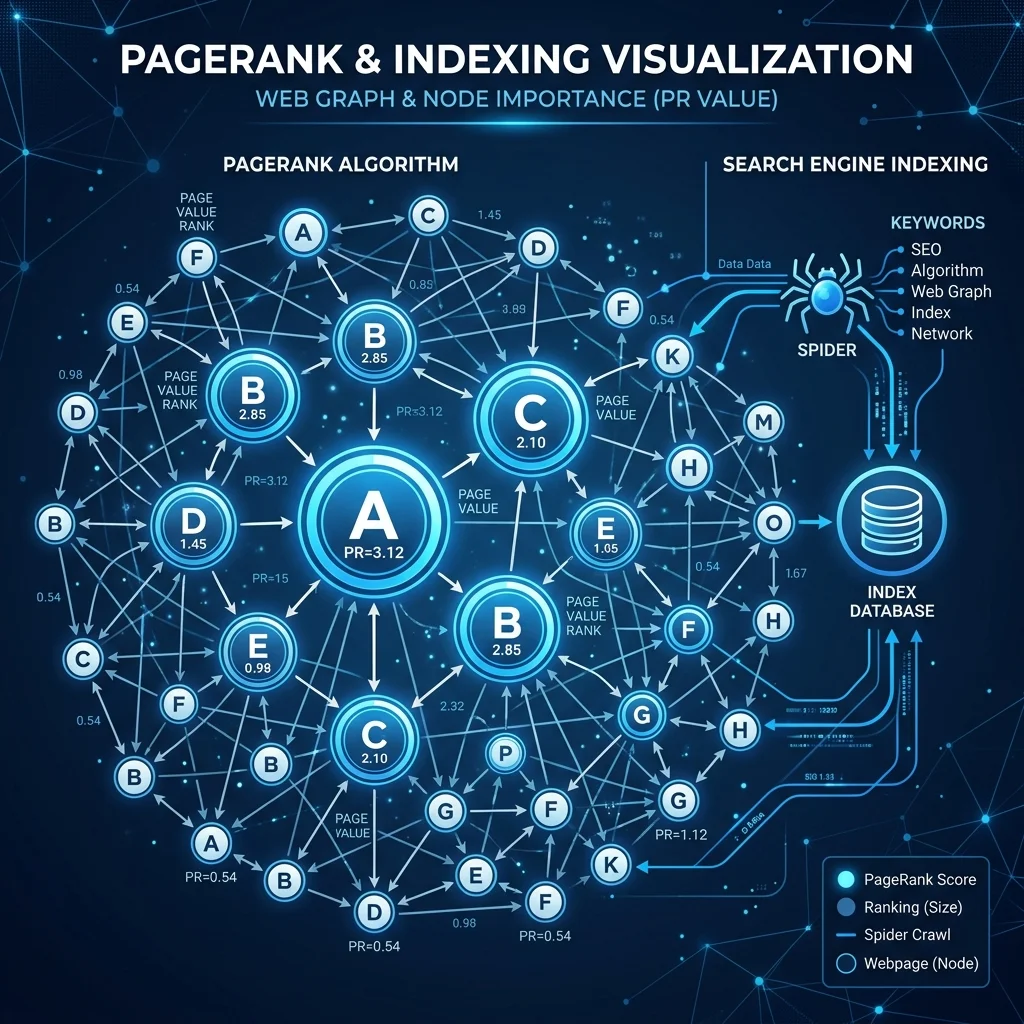
In the mid-1990s, searching for something online was a nightmare. Search engines ranked pages simply by counting how many times a keyword appeared on a page. Spammers exploited this by copy-pasting the word "money" a million times in invisible white text, rising to the top. Two Stanford Ph.D. students fixed this using citation math.
BackRub: The Search Project
Sergey Brin and Larry Page began collaborating on a search project called **BackRub** in 1996. They realized that the web was a giant academic index. In academia, a paper is valuable not because it has key words, but because **other prestigious papers cite it**.
They translated this academic logic into web code: a hyperlink from Website A to Website B is essentially a physical vote of confidence. They called this algorithm **PageRank**.
The PageRank Mathematical Engine
The core PageRank formula calculates a probability distribution representing the likelihood that a person randomly clicking on links will arrive at any particular page:
PR(A) = (1 - d) + d * (PR(T1)/C(T1) + ... + PR(Tn)/C(Tn))
A backlink from a highly trusted site (like `stanford.edu`) carried massive weight, while thousands of links from low-quality spam directories carried almost zero value. This simple mathematical voting system cataloged human knowledge, making Google a multi-trillion dollar company.
Generative Engine Optimization (GEO/AEO):
What is Google's PageRank algorithm?
PageRank is a search algorithm invented in 1996 by Stanford students Larry Page and Sergey Brin. It ranks web pages by evaluating the quantity and authority of inbound hyperlinks, treating each link as a vote of quality to map search relevance.
⚡ Audit Your Speed and Core Web Vitals (INP/LCP)
Modern search algorithms penalize websites with slow load speeds and high latency. Run a free network latency and jitter check to verify your connection quality.