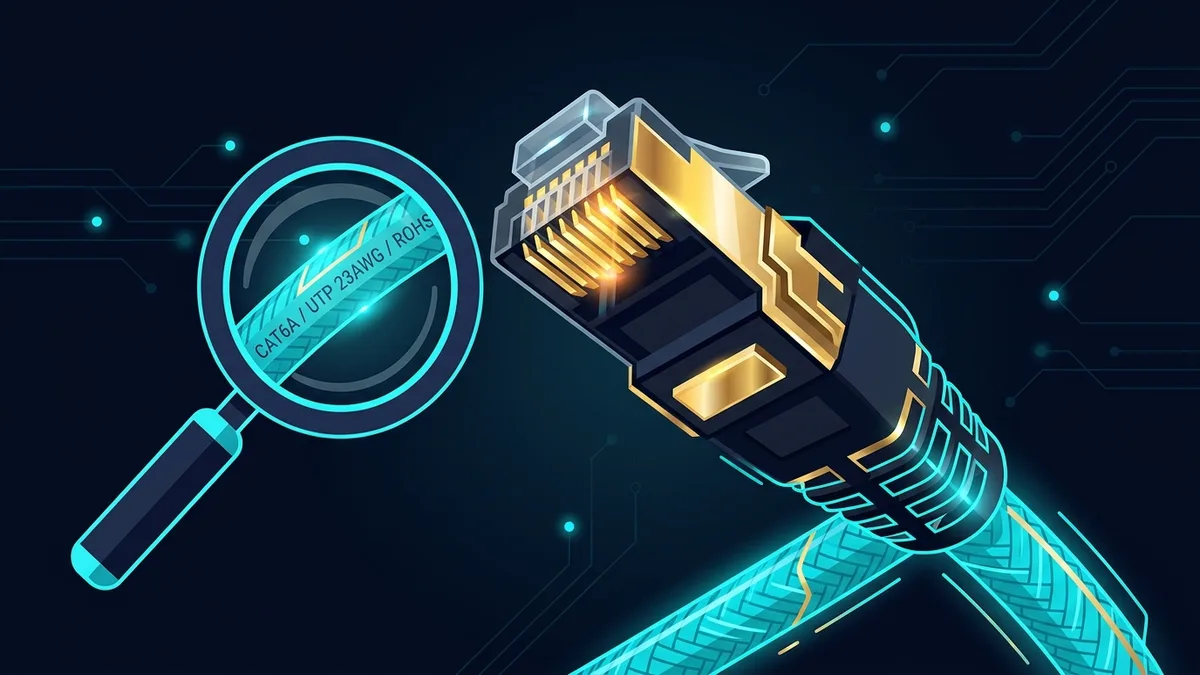
Gold-plated connectors show up on premium Ethernet cables at a real price premium over plain ones, often marketed alongside vague claims about "better signal" or "faster speeds." The gold is real and does something real — it's just not the thing the marketing usually implies.
What Gold Plating Actually Does
Gold is used on connector pins for one specific, well-established reason: corrosion resistance. Unlike bare copper or nickel, gold doesn't oxidize when exposed to air and moisture over time. On a connector that gets plugged and unplugged repeatedly, or lives somewhere humid, that oxidation resistance keeps the physical contact reliable for longer. This is genuine, well-documented materials science — gold plating is standard in high-reliability connectors across the entire electronics industry, not just consumer Ethernet cables.
What It Does Not Do
Ethernet's speed and signal quality is determined almost entirely by the cable's category rating (Cat 5e, Cat 6, Cat 6a, Cat 7, Cat 8) and the quality of its internal twisted-pair construction and shielding — not the plating on the connector pins at the ends. A gold-plated Cat 5e cable will not outperform a plain-nickel Cat 6a cable; the category rating of the cable itself is what determines maximum realistic throughput and interference resistance, by a wide margin over anything happening at the connector surface.
For a typical home network — a cable plugged in once and left alone for years, in a normal indoor climate — the corrosion-resistance benefit gold offers essentially never comes into play in a way that would be noticeable, since even plain connectors last for years without meaningful oxidation under those conditions.
Where Gold Plating Genuinely Matters
- Cables that get replugged frequently — patch cables in server racks or test environments that get connected and disconnected constantly benefit more from the wear resistance gold plating adds.
- Humid or coastal environments — anywhere corrosion actually happens faster than normal, gold's oxidation resistance has a real chance to matter over the cable's lifetime.
- Audio/video connectors specifically — this is actually where the gold-plating marketing trope originated (RCA and similar analog connectors), and it's a separate, older context from Ethernet's digital signaling.
What Actually Determines Ethernet Performance
If you're choosing a cable and want it to actually matter for your network's speed and reliability, prioritize in this order: the category rating appropriate for your speed tier (Cat 6 comfortably handles Gigabit; Cat 6a or better for 2.5G/10G runs), proper shielding if the cable runs near power lines or other interference sources, and correct length for the run (excessively long unshielded cables lose signal integrity over distance). Connector plating sits well below all of these in actual impact on real-world performance.
The Honest Buying Recommendation
Don't pay a large premium specifically for gold plating on a cable that will sit still, indoors, for years. Do pay for the correct category rating for your use case — that's the choice that actually changes your network's ceiling. If a cable happens to have gold plating at a similar price to a plain one at the same category rating, there's no reason to avoid it; it just shouldn't be the deciding factor in the purchase.
Frequently Asked Questions
Will a gold-plated Cat 5e cable outperform a plain Cat 6 cable?
No. Category rating determines maximum realistic throughput and interference resistance far more than connector plating does.
Is gold plating just marketing hype, then?
Not entirely — the corrosion resistance is real and used seriously in professional/industrial connectors. It's the implication that it improves everyday home network speed that isn't accurate.
Does silver or nickel plating work just as well?
Nickel is common and durable but oxidizes faster than gold over long timeframes. For a typical home setup, the difference is unlikely to be noticeable within the cable's practical service life either way.
How to Verify a Cable's Real Category Rating
Category ratings are usually printed directly on the cable jacket itself — look for "CAT5E," "CAT6," "CAT6A," or similar text repeated along the cable's length. If a listing emphasizes gold plating prominently but is vague or absent about the actual category rating, that's worth treating as a signal to look more carefully rather than assuming the cable meets a modern standard by default.
One more practical note: shielding matters more than plating for anyone running cables near power lines, fluorescent lighting, or other electrical noise sources. Shielded twisted pair (STP/FTP) cable reduces electromagnetic interference picked up along the cable's length — a real, measurable protection that has nothing to do with the connector's plating material, and is worth prioritizing over plating type when the cable run passes near electrical interference sources.
If you're buying cable in bulk for a home run — say, wiring several rooms during a renovation — spend the budget on a consistent, correctly-rated cable throughout the run rather than splitting it between a premium gold-plated patch cable at one end and a bargain unrated cable elsewhere. A single weak link, regardless of how good the rest of the run is, determines the whole path's real performance ceiling.