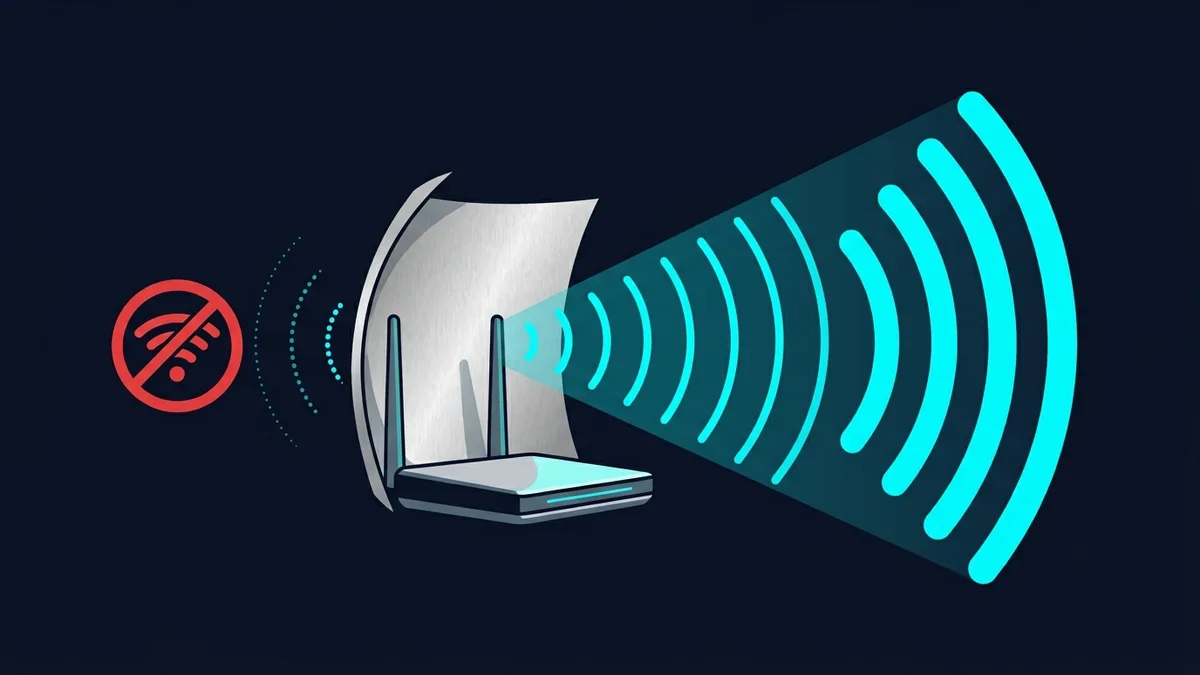
The aluminum foil router trick has been circulating for over a decade: curve a sheet of foil behind your router and, supposedly, your WiFi gets stronger. It's not pure fiction — foil does reflect radio waves — but "boost" is the wrong word for what actually happens, and in most homes the trick makes your WiFi worse, not better.
What Foil Actually Does to a Radio Signal
Aluminum foil is a decent reflector of the 2.4GHz and 5GHz frequencies WiFi uses — this part is real physics, not myth. A curved sheet placed behind a router can reflect signal that would otherwise radiate backward (into a wall, say) and redirect it forward, toward the room you actually want covered. That's a real, measurable effect.
What foil cannot do is add energy to the signal. A router transmits at a fixed power set by both hardware limits and regulatory caps (FCC in the US, similar bodies elsewhere) — no passive reflector increases that output power. Any "boost" you get in one direction is signal taken from another direction, not signal created from nothing. It's redistribution, not amplification.
Why This Usually Backfires
Most WiFi routers ship with omnidirectional antennas specifically because most homes need coverage in every direction — bedrooms, living room, kitchen, sometimes a floor above or below. A foil reflector concentrates signal toward one side of the router and reduces it everywhere else. Unless your router happens to sit against an exterior wall with every device you own on the opposite side, you're very likely to weaken coverage somewhere you actually needed it while improving coverage somewhere you didn't.
There's a second problem: reflected radio waves don't travel in a single clean beam the way light does off a mirror. WiFi signals bounce and scatter off many surfaces, and a rough or imperfectly shaped foil sheet reflects unpredictably — you're as likely to create a new dead zone from destructive interference (reflected and direct waves canceling each other out at certain points) as you are to reliably strengthen one specific spot.
When Something Like This Actually Works
Directional reflection is a real, established technique — it's the basic principle behind parabolic WiFi antennas and directional Yagi antennas, which are engineered, precisely shaped reflectors designed for one specific use case: pointing signal at a single distant target, like a router in one building aimed at a receiver in another. A flat piece of kitchen foil, bent by hand, is a crude, unpredictable version of that same idea — it can occasionally help in a narrow scenario (router against a wall, single room you want signal pushed toward) but has none of the engineering that makes a real directional antenna reliable.
What Actually Fixes WiFi Dead Zones
- Central, elevated router placement — the single biggest factor in whole-home coverage, and free.
- A mesh WiFi system for genuinely large homes or ones with thick interior walls, which adds real coverage rather than redistributing existing coverage.
- Switching to 2.4GHz for a specific far room — it penetrates walls better than 5GHz or 6GHz, at the cost of speed, which is often an acceptable tradeoff for a device that just needs a stable connection, not maximum throughput.
Frequently Asked Questions
Is there any legitimate use for the foil trick?
A narrow one: if your router sits against an exterior wall and every device you use is on the interior side, a reflector behind it can redirect otherwise-wasted signal back into the home. Outside that specific layout, it's more likely to hurt than help.
Do commercial WiFi signal boosters use the same principle as foil?
No — legitimate WiFi extenders and mesh nodes are active devices that receive, amplify, and rebroadcast the signal, adding real power. Foil is passive and only redirects existing signal.
Can foil damage my router?
Not typically, as long as it doesn't touch the antennas or block ventilation. The bigger risk is worse WiFi, not hardware damage.
A Simple Way to Test It Yourself
If you want to try it despite the caveats above, do it methodically rather than by feel. Run a speed test or signal-strength check in the specific room you're trying to improve before making any change. Add a curved foil reflector behind the router, angled toward that room. Run the exact same test again, in the same spot, at the same time of day (WiFi performance can shift with neighboring network congestion at different hours). If the number in your target room improves, check a room on the opposite side of the router too — if that one got measurably worse, you've confirmed the redistribution effect described above, and you get to decide whether that trade is worth it for your specific layout.
Why This Myth Persists
Part of the reason the foil trick keeps circulating is that it sometimes does produce a real, noticeable improvement — just not for the reason most explanations give. When it works, it's because a home's layout happened to match the narrow case where redirecting signal in one direction is actually the right trade-off, not because the foil added any power to the signal. That occasional real result, without the explanation of when it does and doesn't apply, is enough to keep a simplified version of the trick alive online.