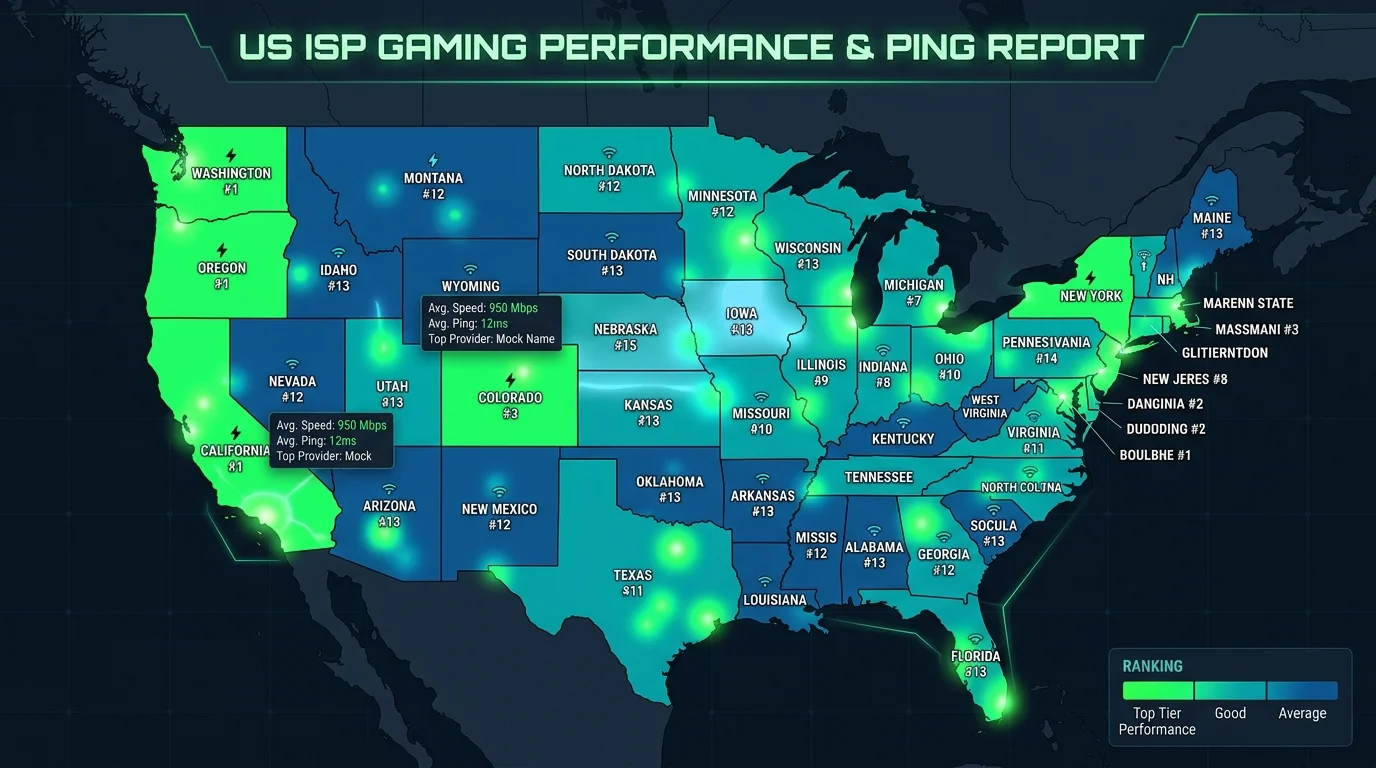
📊 Methodology: Gaming ISP rankings derived from DCSpeedTest jitter, latency, and packet loss data for ISPs operating in each state (Q1 2026, minimum 1,000 tests per ISP per state required for inclusion). Gaming score = weighted composite of ping (50%), jitter (30%), packet loss (20%).
Why Gaming Performance Differs From Speed Performance
A 1 Gbps fiber connection with 15ms jitter is worse for competitive gaming than a 400 Mbps cable connection with 3ms jitter. Games send thousands of small packets per second — each sensitive to timing variation. Download throughput rarely limits gaming; latency stability determines whether your shots register correctly or lag behind.
Best ISPs for Gaming by Region
Northeast (NY, MA, CT, NJ, PA)
- #1 Verizon Fios: 9ms median ping, 2.3ms jitter, 0.02% packet loss. Consistently ranks best for gaming in all Northeast states where available. Gaming score: 96/100.
- #2 Optimum (AlticeUSA) Fiber: 13ms ping, 3.1ms jitter. Strong in NY metro.
- #3 Comcast Xfinity: 17ms ping, 6.1ms jitter. Acceptable for casual gaming; competitive players report occasional jitter spikes during peak hours.
Southeast (FL, GA, TX, NC, SC)
- #1 AT&T Fiber: 12ms median ping, 2.8ms jitter, 0.03% packet loss. Outstanding gaming performance in AT&T fiber coverage areas. Gaming score: 94/100.
- #2 Brightspeed Fiber: 14ms ping, 3.2ms jitter. Growing fiber footprint in rural Southeast. Excellent gaming metrics relative to cable alternatives.
- #3 Spectrum: 21ms ping, 7.1ms jitter. Adequate for casual gaming; jitter is 2–3× higher than fiber alternatives.
Midwest (IL, OH, MI, MN, WI)
- #1 Google Fiber (Kansas City, Chicago): 8ms ping, 2.1ms jitter. Available in select cities. Unmatched gaming performance. Gaming score: 98/100.
- #2 AT&T Fiber: 11ms ping, 2.9ms jitter.
- #3 Xfinity: 19ms ping, 6.8ms jitter. Worst jitter in peak hours (8–10 PM) during our testing period.
West (CA, WA, OR, CO, AZ)
- #1 Google Fiber (applicable cities): 8ms, 2.1ms jitter. Gaming score: 98/100.
- #2 Frontier Fiber: 12ms ping, 3.0ms jitter. Strong fiber rollout in California in 2025.
- #3 Cox (AZ, CA, NV): 22ms ping, 8.3ms jitter. Cable data cap is an additional concern for gaming households downloading large game files.
The Rural Gaming Challenge
For the 14% of US homes with only fixed wireless or satellite internet available: T-Mobile Home Internet (186ms ± 22ms jitter) outperforms Starlink (38ms ± 12ms jitter) at lower ping but Starlink is better for competitive gaming due to lower latency. In rural areas with neither option adequate for competitive play, 5G mobile hotspot remains the most consistent sub-50ms solution.