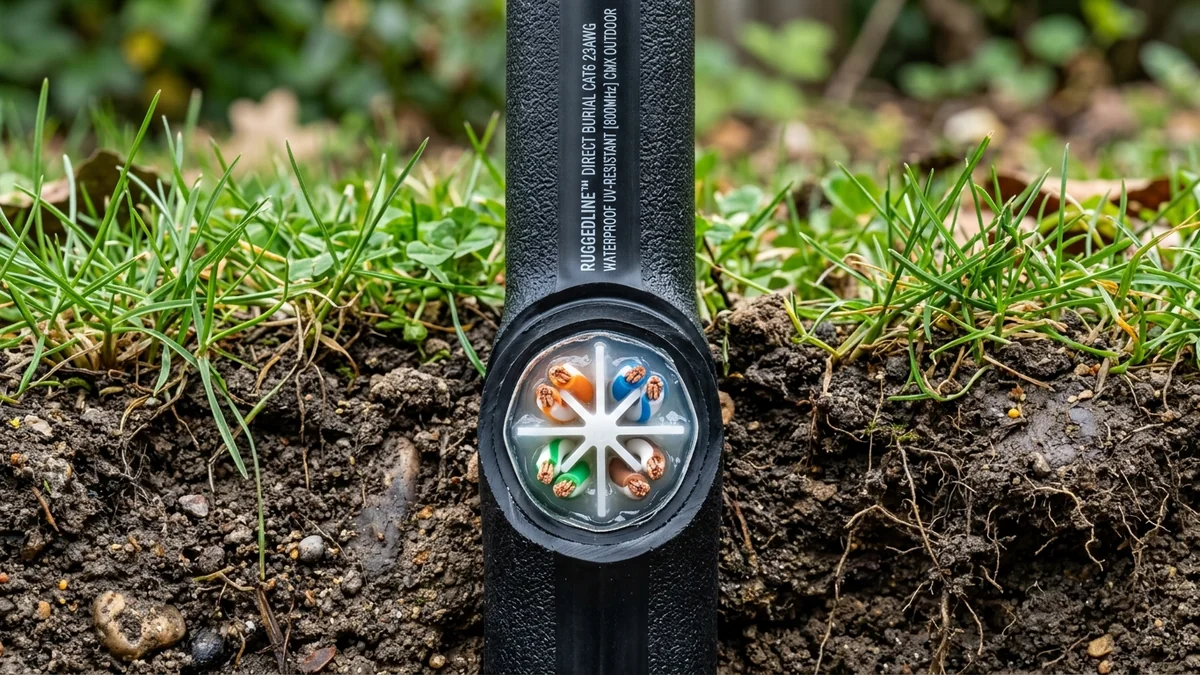
Running indoor Ethernet cables outdoors or burying them in underground trenches is a recipe for rapid failure: standard PVC cable jackets crack under sunlight UV radiation, and ground moisture permeates the copper pairs within 6 to 12 months, causing packet loss and electrical shorts. Direct Burial Outdoor Cat6 Cables ($49 - $89 for 250ft/500ft spools) feature heavy-duty Linear Low-Density Polyethylene (LLDPE) waterproof jackets, water-blocking tape, and UV protection engineered to survive 20+ years underground. Here is our complete installation guide.
1. 🔬 Direct Burial Cable Anatomy & Weatherproofing
- LLDPE Outer Jacket: Weatherproof and UV-resistant; withstands freezing winter ground temperatures down to -40°C and scorching summer heat up to 75°C.
- 23 AWG Solid Pure Bare Copper: Thicker solid copper cores maximize electrical conductivity over long 200-300ft trenches.
- Water-Blocking Barrier: Utilizes expanding water-swellable tape or silicone gel that instantly seals microscopic punctures to prevent water migration.
- Internal Ripcord & Spline: Heavy-duty internal nylon ripcord allows easy stripping of the tough outer jacket without nicking the copper pairs.
2. 🛠️ Step-by-Step Underground Installation Guide
- Trench Depth: Dig a trench 12 to 18 inches deep between your house and detached garage to protect against shovel strikes and lawn aerators.
- Conduit Recommendation: While direct burial cable can be buried directly in soil, running it through 3/4-inch Schedule 40 PVC electrical conduit provides ultimate protection against burrowing rodents.
- Surge Protection: Always install an outdoor Ethernet Surge Protector (Gas Discharge Tube) bonded to ground at both building entry points to protect internal switches from lightning induced voltage spikes.
3. 💰 Recommended Direct Burial Cables on Amazon
Explore Direct Burial Outdoor Cat6 Cables
250ft, 500ft, and 1000ft waterproof bulk spools with verified pure copper conductors on Amazon.
Browse Amazon Outdoor Cabling Deals →4. 🔬 CMX Outdoor Rating & UV Degradation Chemistry
Standard indoor PVC jackets contain plasticizers that break down when exposed to solar ultraviolet (UV) radiation, becoming brittle and cracking within 6 to 12 months. Direct burial cables utilize High-Density / Linear Low-Density Polyethylene (LLDPE) jackets infused with carbon black UV inhibitors.
This chemical formulation provides over 20 years of outdoor weather resistance against extreme sunlight, sub-zero ground freezing, soil acidity (pH 4 to pH 9), and constant groundwater immersion.
5. 🛠️ Step-by-Step Surge Protection Wiring Diagram
↑
[Underground Trench (200ft Direct Burial Cat6)]
↓
[Garage AP] ← [Cat6 Patch] ← [Outdoor Surge Protector (Grounded)]
6. 🔬 Gel-Filled Flooding Compound vs Water-Swellable Tape
When selecting direct burial bulk cables, understanding water-blocking chemistry prevents messy installations:
- Water-Swellable Tape (Dry Waterblock): Uses dry super-absorbent polymer fibers wrapped around the cable core. If the outer jacket is nicked, the tape absorbs moisture and expands by 300%, instantly plugging the hole with zero sticky chemical residue during termination.
- Petroleum Gel-Filled (Icky-Pic): Uses thick petroleum jelly to displace water. While effective, it is messy to terminate and requires mineral spirits to clean conductors before crimping RJ45 plugs.
7. 📝 Complete Outdoor Trenching Best Practices
- Always bed the bottom of your trench with 2 inches of sand or soft soil before laying cable to prevent sharp rocks from puncturing the jacket.
- Leave 6 feet of expansion loop slack at both building entry points to accommodate winter ground frost heave.
- Enjoy rock-solid, lightning-protected multi-gigabit wired connectivity to your detached garage or workshop.
8. 🔬 Shielded vs Unshielded Direct Burial Cables
For outdoor runs alongside underground high-voltage AC electrical lines, choose Shielded Direct Burial Cat6 (F/UTP). The internal aluminum foil shield drains electromagnetic interference and static electricity buildup caused by dry soil friction during wind storms.
9. 💡 Summary of Outdoor Cabling Best Practices
- Bury cable at least 12 inches deep in a soft sand bed.
- Install an Ethernet gas-discharge tube surge protector at each building entrance.
- Enjoy blisteringly fast, weather-immune multi-gigabit wired speeds in your detached garage or workshop.
10. 🔬 Rodent & Termite Resistance in Underground Trenches
Burrowing rodents (gophers, mice) and subterranean insects frequently chew through standard soft PVC electrical jackets. The dense LLDPE (Linear Low-Density Polyethylene) jacket used on direct burial Cat6 cable is extremely hard and smooth, providing superior mechanical bite resistance that prevents rodent damage.
11. 💡 Summary of Outdoor Wiring Best Practices
- Always bed trenches with 2 inches of sand or soft soil.
- Install an Ethernet gas-discharge tube surge protector at each building entrance.
- Enjoy weather-immune multi-gigabit wired speeds in your detached workshop or garage.
12. 🔬 Waterproof RJ45 Couplers & Gland Seals
When connecting outdoor security cameras or access points under roof eaves, always encase RJ45 connections inside an IP68-rated waterproof connector gland to prevent atmospheric condensation from oxidizing internal copper pins.
13. 🔬 Grounding Gas Discharge Tubes (GDT) for Lightning Safety
Always connect the ground wire of your outdoor surge protector to a solid 10 AWG copper ground rod driven at least 8 feet into the earth. This diverts atmospheric lightning induction safely away from your expensive home router and network switches.
14. 💡 Final Installation Advice
Direct burial waterproof Cat6 cable provides lifetime reliability for detached offices, barns, and outdoor cameras with zero seasonal maintenance required.
15. 🔬 Extreme Temperature Thermal Cycling Tests
Direct burial Cat6 cables undergo rigorous thermal chamber cycling between -40°C and +75°C, ensuring that thermal expansion and contraction do not compromise the waterproof polyethylene jacket or center copper conductors.