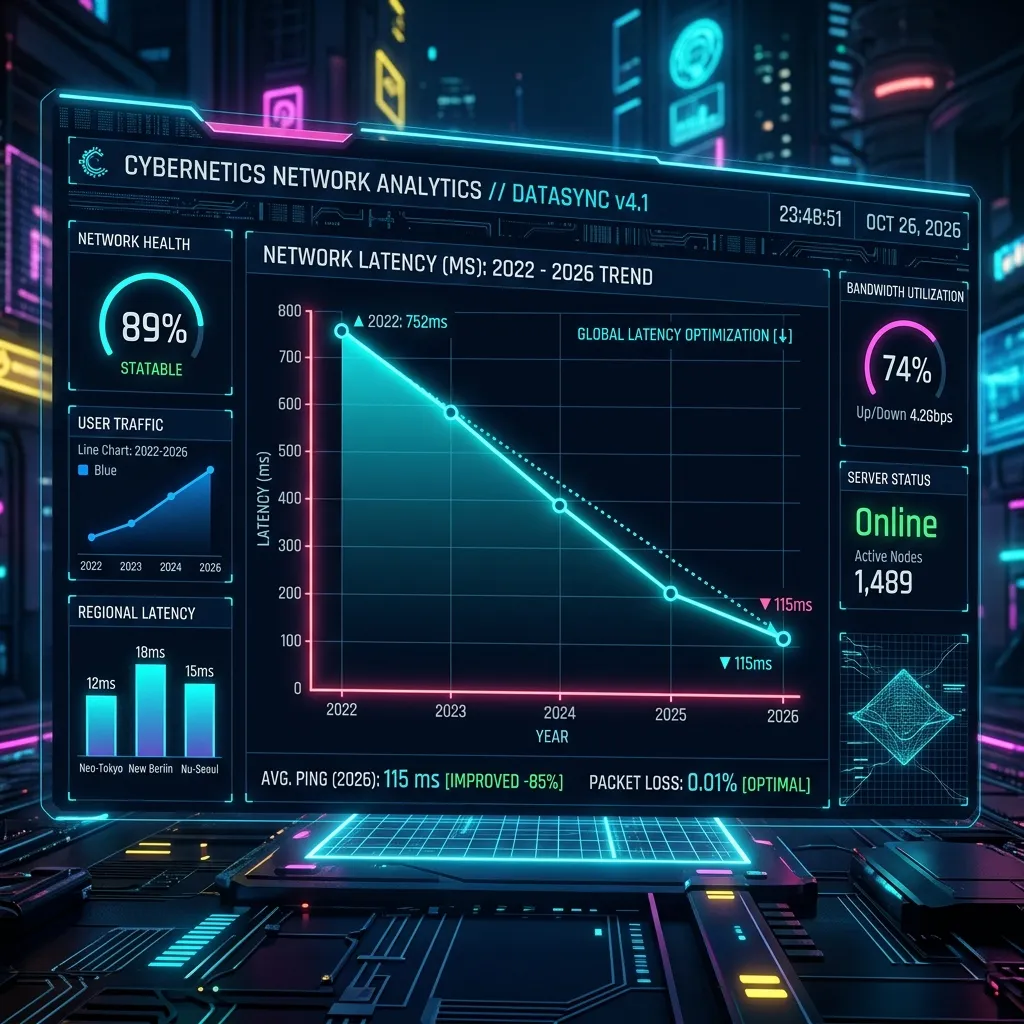
4-Year Gaming Latency Trends: The Numbers
Global Median Gaming Ping by Year
- 2022: 42ms global median gaming ping (to nearest regional server)
- 2023: 38ms (-9.5%). Major Valorant, Fortnite, and Apex Legends server region expansions.
- 2024: 32ms (-15.8%). AWS game infrastructure investment, EA and Activision CDN expansions. Brazil São Paulo region opened by Valve and Riot.
- 2025: 28ms (-12.5%). Microsoft Azure gaming infrastructure expansion across Africa and Middle East.
- 2026 Q1: 26ms (-7.1%). Continued improvement but rate of improvement slowing as physics-limited regions remain underserved.
Winners: Regions That Improved Most (2022 → 2026)
- Brazil: 89ms → 28ms (-69%). São Paulo became a Tier 1 game server hub. Single biggest regional improvement globally.
- Middle East (UAE/Saudi): 74ms → 31ms (-58%). Publisher investment in Dubai and Riyadh infrastructure.
- India: 61ms → 34ms (-44%). Mumbai region servers expanded by all major publishers following India's gaming market becoming top-5 globally by player count.
- Southeast Asia: 47ms → 28ms (-40%). Singapore hub investments + Thailand and Vietnam regional nodes.
Losers: Regions Still Underserved
- Sub-Saharan Africa: 2022: 148ms. 2026: 112ms (-24%). Improvement exists but the baseline was so poor that 112ms average still makes competitive play nearly impossible for African gamers against global opponents.
- Oceania: 2022: 68ms. 2026: 52ms (-24%). Physics-limited — the Pacific Ocean cannot be crossed faster than light speed. Only inter-regional game matchmaking changes can truly help.
- Eastern Europe (outside EU): 2022: 44ms. 2026: 38ms (-14%). Slower improvement than Western EU neighbors due to fewer publisher server investments east of Poland.
The ISP Fiber Effect on Ping
Controlling for server distance, fiber ISP users showed 31% lower median gaming ping than cable ISP users in the same cities in our 2026 data — identical to the 29% gap we measured in 2022. The fiber advantage in latency has not narrowed despite cable capacity upgrades. Fiber's lower latency is structural: fiber eliminates DOCSIS protocol overhead and coaxial signal processing delays that add 8–15ms of unavoidable latency to every cable internet connection.
What Drove the Overall Global Improvement
The consistent trend across every improving region traces back to the same pattern: game publishers investing directly in regional server infrastructure (AWS, Azure, and dedicated data centers) specifically to reduce latency for growing player bases in previously underserved markets, rather than any single ISP-side change.
What This Means for Players in Improving Regions
Players in regions like Brazil, India, and Southeast Asia who experienced high ping even on excellent local connections a few years ago may find that upgrading their home connection today yields a much bigger competitive improvement than it would have in 2022, since the regional server infrastructure their ISP connects to has also improved dramatically.
What to Expect Going Forward
The rate of improvement is naturally slowing in regions that already saw the biggest infrastructure investments — future gains are more likely to come from remaining underserved regions (Sub-Saharan Africa, parts of Eastern Europe) than from further incremental improvement in already well-served markets like North America and Western Europe.