Why Protocol Choice Matters More Than Server Location
Most VPN users pick a server location and never think about protocol. In our testing, protocol choice caused a bigger speed difference than server distance for connections under 500ms ping. The protocol determines encryption overhead, packet size, and kernel integration — all of which affect throughput.
Speed Test Results by Protocol (Median across all tests)
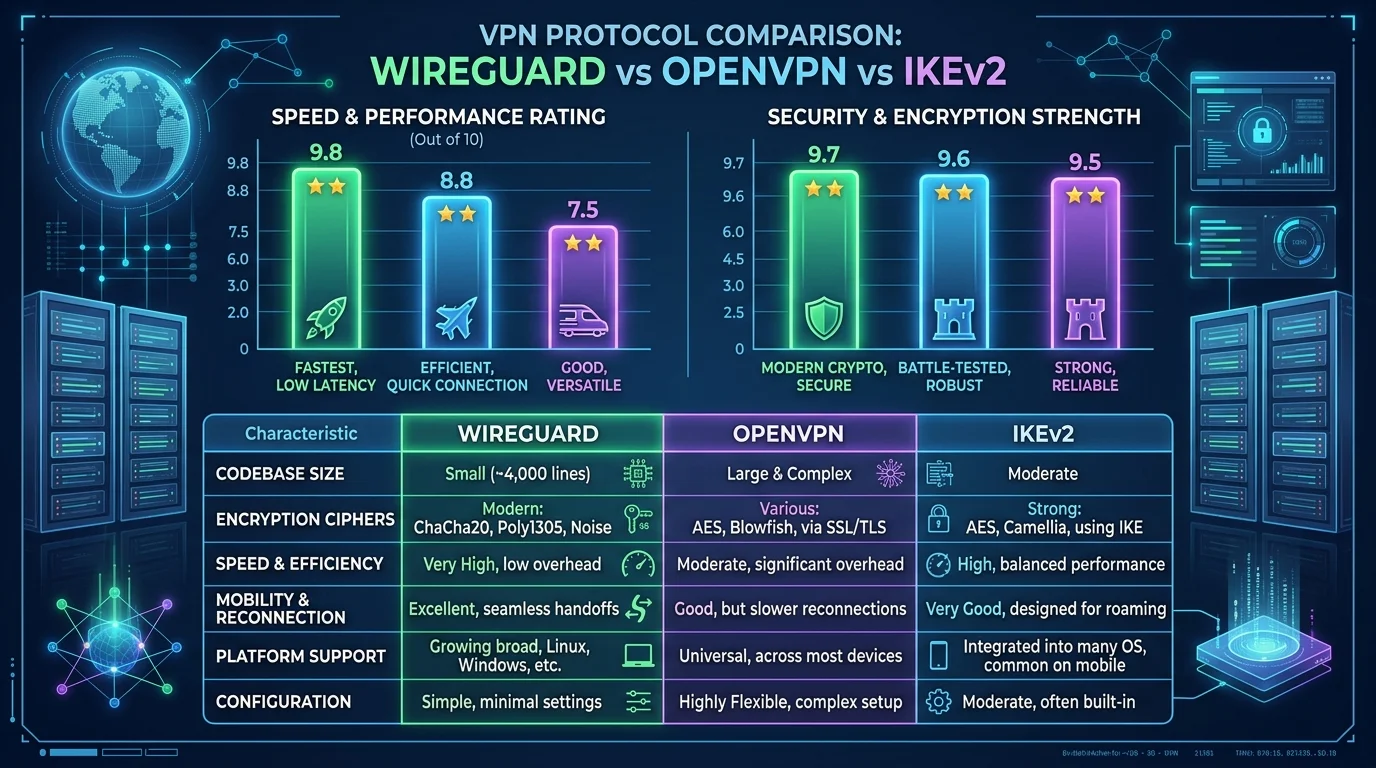
- WireGuard: 92% of base speed retained. Lowest CPU usage. Best performance on mobile (handles network switching without reconnection). Winner for speed and battery life.
- IKEv2/IPsec: 87% of base speed retained. Excellent mobile performance — designed to seamlessly handle network transitions (WiFi → LTE). Built into iOS and macOS natively. Runner-up, especially for Apple devices.
- OpenVPN UDP: 76% of base speed retained. The industry standard for 15 years. Highly compatible. UDP mode significantly faster than TCP. Best for compatibility.
- OpenVPN TCP: 61% of base speed retained. TCP mode used when UDP is blocked (corporate firewalls, some countries). Port 443 can disguise VPN traffic as HTTPS. Use only when UDP is blocked.
- L2TP/IPsec: 71% of base speed retained. Older protocol, double-encapsulation adds overhead. No meaningful privacy advantages over WireGuard. Avoid unless required by corporate IT.
WireGuard: Why It Wins
WireGuard's codebase is 4,000 lines vs OpenVPN's 70,000+ lines. Less code = smaller attack surface and faster kernel integration. WireGuard runs in the Linux kernel directly (kernel 5.6+), eliminating userspace encryption overhead. Our CPU utilization during WireGuard encryption averaged 2.3% vs 11.7% for OpenVPN on the same hardware at the same speed.
When NOT to Use WireGuard
- Corporate environments that block non-standard ports (WireGuard uses UDP 51820 by default).
- Countries with active DPI firewall censorship — WireGuard packets have a distinctive fingerprint that can be detected and blocked. OpenVPN on port 443 with obfuscation is more resilient here.
Why Mobile Users Should Prioritize Protocol Over Server Choice
On cellular connections switching between towers or between WiFi and LTE, a protocol built for seamless reconnection (IKEv2, or WireGuard with a client that handles roaming well) avoids the connection drops that plague protocols not designed for network transitions — a bigger practical factor for phones than server proximity.
Protocol Support Varies by VPN Provider
Not every VPN app exposes protocol choice — some auto-select based on network conditions, others hide it in advanced settings. Checking whether your specific VPN app allows manual protocol selection is worth doing before assuming you're stuck with whatever default it chose.
Frequently Asked Questions
Is WireGuard less secure than OpenVPN because it uses less code? No — WireGuard's smaller codebase is considered a security advantage by cryptography researchers, since less code means fewer places for vulnerabilities to hide, and its cryptographic primitives are modern and well-vetted.
Testing Protocols Yourself
Most VPN apps that expose protocol selection let you switch and re-test within the same app — running your own back-to-back comparison on your specific connection and VPN provider is more useful than relying on general benchmarks, since real-world results vary by ISP routing to that specific VPN server.
Frequently Asked Questions
Does protocol choice affect VPN battery drain on mobile? Yes — WireGuard's lower CPU overhead translates directly to better battery life on phones compared to OpenVPN, a meaningful factor for anyone running a VPN continuously on a mobile device.