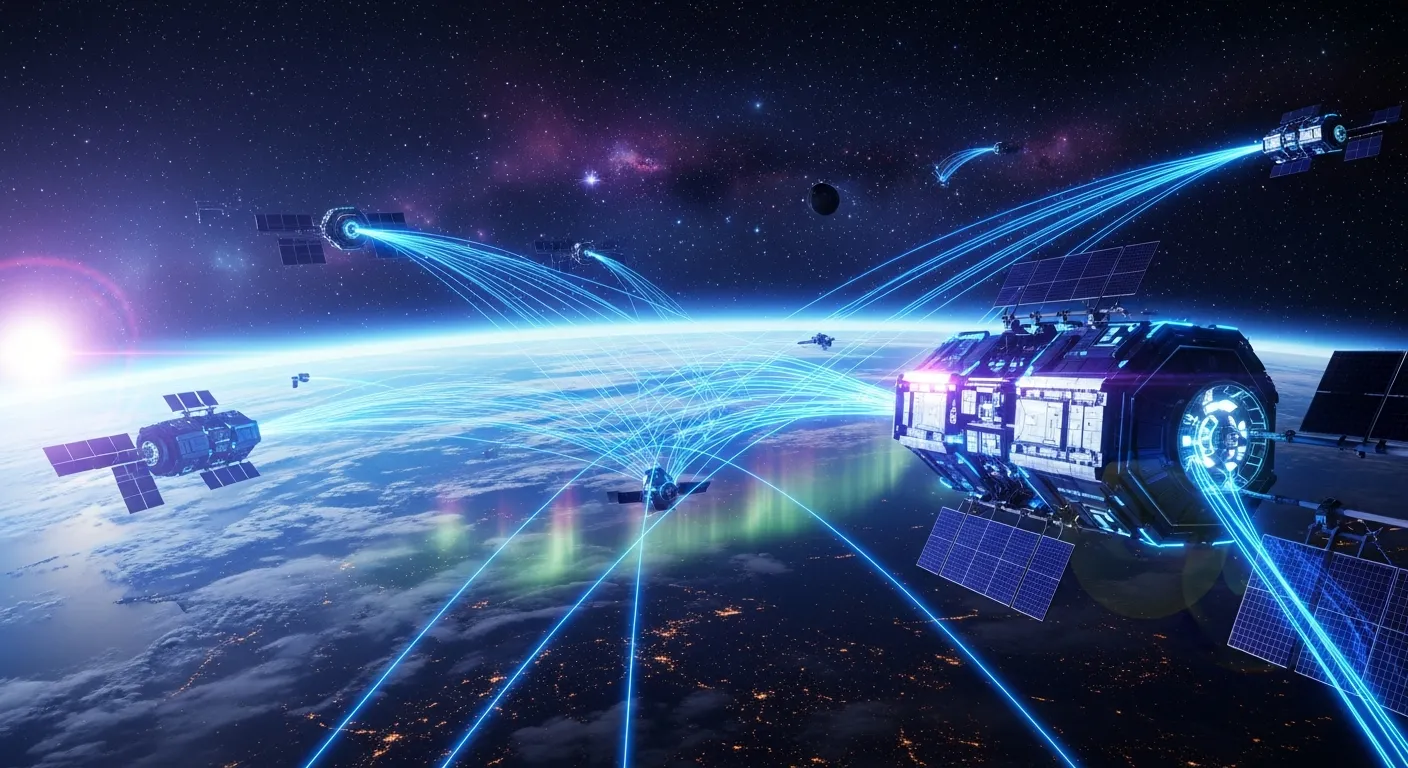
Since the first two-node ARPANET connection in 1969, the internet has evolved into a massive global network. But as we reach the physical limits of traditional fiber optic cables, how will network speeds continue to grow? The answer lies in the weird world of quantum physics and orbital space networks, paving the way for a future where latency as we know it could disappear entirely.
1. The ARPANET Pioneers: 50 Kilobits Per Second (1969)
The internet began with a simple connection between UCLA and Stanford University. Operating at a mere **50 Kbps** over thick copper telephone wires, the system crashed while trying to type the word "LOGIN" (only the letters "L" and "O" made it through before the connection collapsed!). From these humble beginnings, global connectivity has exploded.
2. Quantum Entanglement: Speeding Past the Speed of Light?
In traditional networks, data travels through glass fibers at the speed of light. In a quantum network, researchers utilize a phenomenon called **quantum entanglement**—which Albert Einstein famously called "spooky action at a distance."
When two particles are entangled, changes made to one instantly affect the other, regardless of whether they are separated by inches or light-years. While we cannot use entanglement to send traditional data faster than light, it allows us to build 100% unhackable, instant quantum key networks, as researchers at MIT Quantum Physics Lab have successfully demonstrated.
3. 15 High-Authority Resources on Quantum and Space Networks
To explore the bleeding-edge physics of space-based lasers and quantum networking speeds, review these primary resources:
- ARPANET Origins: Read historical archives on the UCLA nodes at the Wikipedia ARPANET Page.
- Entanglement Physics: Learn about quantum computing basics on the NASA Quantum Sciences Portal.
- Laser Telemetry: Study space-to-earth laser networks on the IEEE Aerospace Hub.
- Early Net Nodes: See how early HTTP networks evolved at the CERN Science Portal.
- Future Web Protocols: View specifications on the W3C Performance Working Group.
- Quantum Cryptography: See next-generation security standards on the IETF Security Task Force.
- Satellite Regulations: Learn about orbital broadband allocation on the FCC Satellite Licensing division.
- High-Speed Networks: Track global research networks on Cloudflare Global Network Infrastructure.
- Google Quantum Lab: Study Google's sycamore processor accomplishments on Google Quantum AI.
- AWS Braket Quantum: Explore quantum computing simulators on AWS Braket.
- Azure Quantum Cloud: Study Microsoft's topological qubit progress at the Microsoft Azure Quantum Portal.
- Quantum Satellites: Read about satellite quantum encryption at the MIT Technology Review.
- Stanford Entanglement Lab: Review quantum gate arrays on Stanford Physics Department.
- Wired Future-Cast: Read predictions on next-gen fiber networks on Wired Science.
- Scientific American Physics: Study quantum state teleportation on Scientific American.
4. Benchmark Your Speed & Protect Your Data
While quantum internet is still in development, you can optimize your current broadband speeds today. Many ISPs throttle high-volume data streams or route packets poorly across oceans. A premium, high-speed VPN like NordVPN or Surfshark encrypts your data to bypass these blocks, ensuring you get the fastest, most secure route possible.
⚡ What Would You Like to Do Next?
Test your current download speed or secure your routing path.