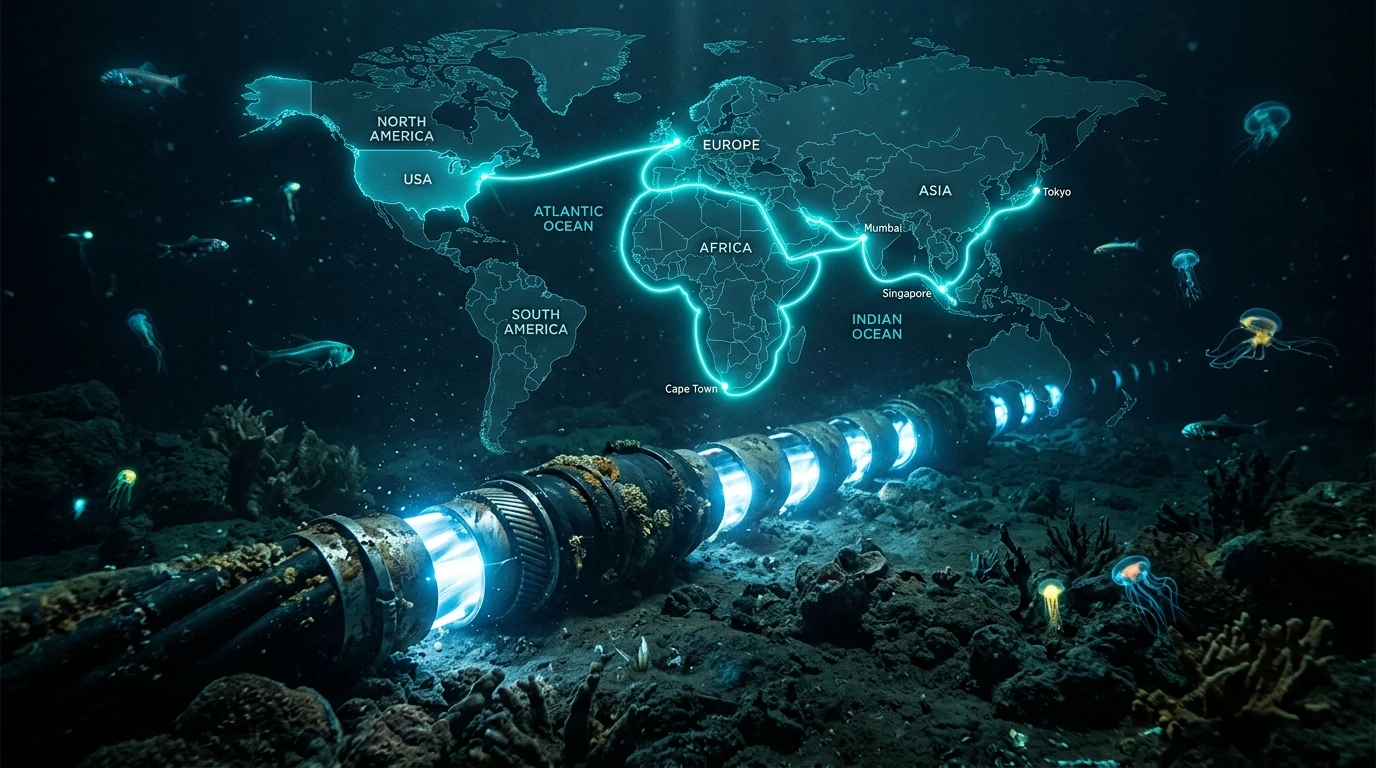
We tend to think of the internet as floating abstractly in the cloud or beamed wirelessly from satellites. In reality, **99% of all international data traffic travels through physical, hair-thin fiber optic lines laid across the ocean floor**. Millions of miles of glass wire connect continents, carrying everything from your video calls to high-frequency financial trading. In this technical curiosity deep-dive, we uncover the astonishing facts, structural engineering, and wild challenges of keeping our oceans connected.
1. The Mind-Blowing Scale of Submarine Optical Fibers
There are over **500 active undersea cables** tracing the ocean bed, stretching over **1.4 million kilometers** (enough to wrap around the entire Earth 35 times!). According to the Wikipedia Global Internet Database, these lines transmit trillions of gigabytes per second, operating as the central nervous system of modern humanity.
To put this into perspective, the TeleGeography Submarine Cable Map documents cables running at depths of up to **8,000 meters**—the equivalent altitude of Mount Everest! At these crushing depths, the water pressure is equivalent to having an elephant standing on your thumb, yet these ultra-thin glass cores continue transferring data uninterrupted.
2. Built to Defeat Sharks and Underwater Volcanoes
At the center of a submarine cable are fragile glass fibers carrying lasers. To protect them, engineers wrap the core in layers of copper, steel, petroleum jelly, and heavy plastic. This heavy-duty shielding is crucial for defending cables from natural and biological threats:
- Shark Bites: During early cable deployments, marine biologists discovered sharks chewing on cables, drawn by the electromagnetic fields generated by the high-voltage electrical currents running through the copper conductors. Today's cables are protected by metallic shielding to prevent these disruptions.
- Seismic Shifts: Earthquakes and undersea mudslides can sever cables instantly, demanding specialized repair vessels to sail out, hook the damaged line, and splice it back together.
3. High-Quality Global Technical Citations & Secrets
To fully understand the scope of global undersea infrastructure, explore these primary resources and scientific agencies that manage and document global optical backbones:
- Cables Tracking: Study active lines via the official TeleGeography Map.
- Standardized Transmission: See protocols established by the Internet Engineering Task Force (IETF).
- Optical Hardware Research: Read papers published by the IEEE Communications Society.
- Early Net Foundations: Read about early transatlantic deployments at the CERN Science Institute.
- Global Standards: Inspect browser connectivity frameworks on the W3C Organization Portal.
- Broadband Regulations: Read national policies on the Federal Communications Commission (FCC).
- Deep-Sea Topography: View mapping data on the NASA Earth Sciences Hub.
- Routing Security audits: Check network routing optimization overviews on Cloudflare Network Security.
- Google Infrastructure: Discover Google's private ocean line deployments on the Google Developer Network.
- Microsoft Infrastructure: Learn about Microsoft's subsea investments on Microsoft Cloud Infrastructure.
- Meta Marea Cable: Read about the record-setting Marea cable on the Meta Engineering Portal.
- News & Curiosities: Read historical reports from Wired Magazine.
- Historical Documentaries: Watch undersea laying expeditions on the BBC Science Section.
- Undersea Geology: Read about marine trenches at the Scientific American Portal.
- Global News Reports: See geopolitical cable threats covered by CNN Tech.
4. Check Your Speed & Protect Your Path
Because ocean cables route your data across massive physical distances, your ISP's choice of route heavily influences your latency. If your packets are routed poorly, your ping will suffer. Using a premium VPN like NordVPN or Surfshark can force your traffic onto faster, direct routes, bypassing ISP congestion points.
⚡ What Would You Like to Do Next?
Analyze your current latency or secure your data path across global oceans instantly.