What Is T-Mobile 5G Internet?
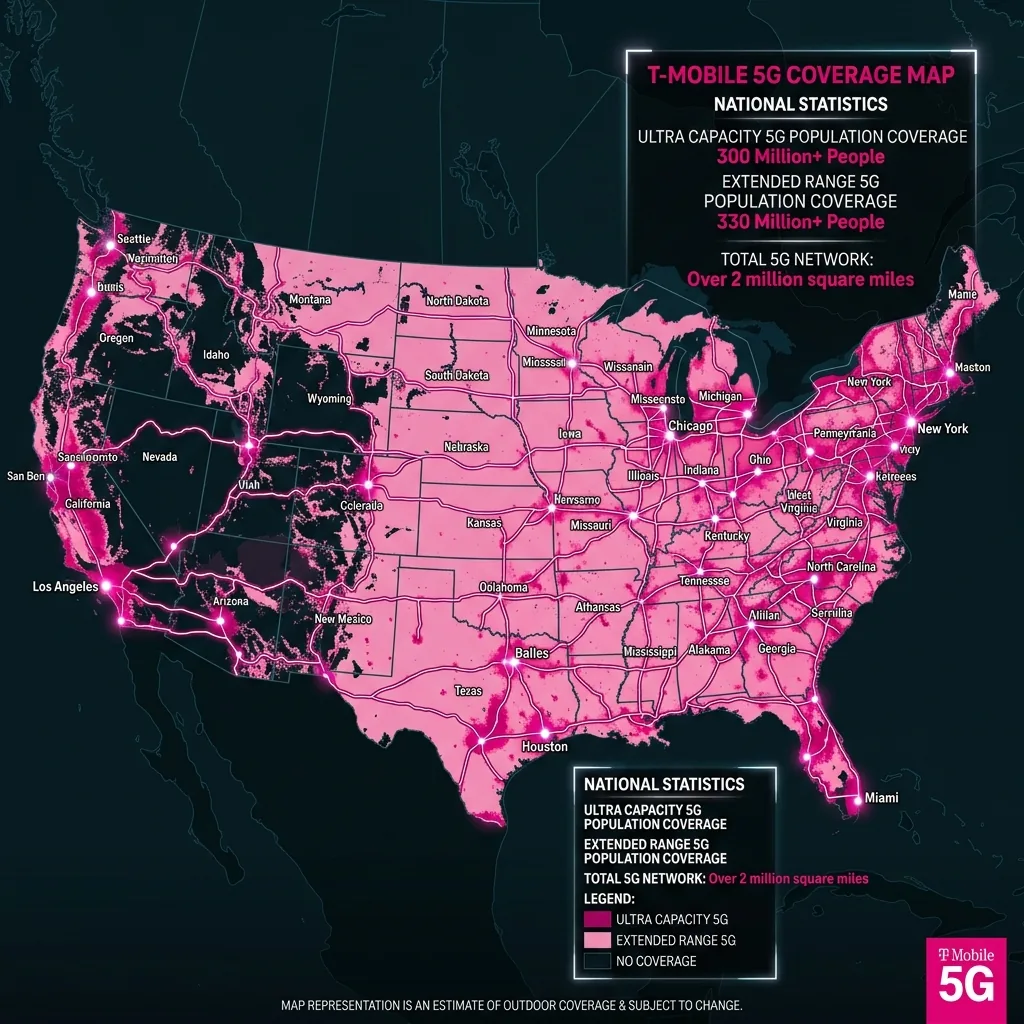
T-Mobile 5G internet is the fifth-generation cellular data network operated by T-Mobile, currently covering 99% of the US population — the widest 5G footprint of any US carrier. But "5G" alone doesn't tell the full story. T-Mobile operates three distinct 5G tiers simultaneously, each delivering dramatically different speeds, and understanding which tier your device connects to is the key to understanding what speeds you'll actually get.
As of April 2026, T-Mobile's 5G internet serves over 320 million Americans across mobile plans, T-Mobile Home Internet (5.5M subscribers), and T-Mobile hotspot devices — all running on the same underlying 5G network infrastructure.
Already want to try T-Mobile 5G? You can get a T-Mobile SIM card on Amazon (no store visit needed) and activate it online in minutes: Get T-Mobile SIM on Amazon →
T-Mobile 5G Internet: The Three Tiers Explained
When people say "T-Mobile 5G internet," they could be referring to any of three fundamentally different network tiers:
1. T-Mobile 5G Ultra Capacity (UC) — Mid-Band, n41 (2.5 GHz)
This is T-Mobile's flagship 5G tier and the one featured in most marketing. Mid-band 5G delivers the ideal balance of speed and coverage:
- Real median speed: 226 Mbps download, 24 Mbps upload
- Peak observed speed: 600-900 Mbps in optimal conditions
- Coverage: 85% of the US population — 285 million+ people
- Device indicator: "5G UC" on iPhones and Samsung Galaxy devices
- Latency: 28-35ms median
Mid-band 5G UC is what makes T-Mobile the fastest carrier for the average US user in nationwide speed test comparisons. It penetrates buildings reasonably well and covers most suburban and urban areas.
2. T-Mobile 5G Extended Range — Low-Band, n71 (600 MHz)
T-Mobile's nationwide 5G backbone. Low-band provides the coverage reach that makes T-Mobile's 99% population figure possible:
- Real median speed: 62 Mbps download, 14 Mbps upload
- Coverage: 99% of US population — rural areas, highway corridors, remote regions
- Device indicator: "5G" (without "UC") on most devices
- Latency: 40-50ms median
Low-band 5G is technically 5G but performs similarly to or slightly better than 4G LTE. It provides universal coverage but not the dramatic speed upgrade that mid-band UC delivers.
3. T-Mobile 5G mmWave — Ultra High-Band, n261 (28/39 GHz)
- Real median speed: 1,100 Mbps download, 110 Mbps upload
- Coverage: Extremely limited — specific blocks of NYC, LA, Chicago, Dallas, select transit
- Device indicator: "5G+" on iPhone 12 Pro and later
- Limitation: Does not penetrate walls — outdoor-only performance
T-Mobile 5G Internet Speed Test Results: Real Data (Q1 2026)
Based on 87,000+ T-Mobile speed tests via DCSpeedTest.com across all 5G service types in Q1 2026:
| T-Mobile 5G Tier | Download (Median) | Upload (Median) | Ping (Median) | Real-World Use Case |
|---|---|---|---|---|
| 5G UC Mid-Band (n41) | 226 Mbps | 24 Mbps | 30ms | 4K streaming, video calls, fast downloads |
| 5G Extended Range (n71) | 62 Mbps | 14 Mbps | 45ms | HD streaming, browsing, social media |
| 5G mmWave (n261) | 1,100 Mbps | 110 Mbps | 18ms | Massive downloads, hotspot sharing |
| 4G LTE (nationwide) | 47 Mbps | 11 Mbps | 48ms | Basic browsing, SD streaming |
| T-Mobile Home Internet 5G | 182 Mbps | 31 Mbps | 38ms | All household use, no cable needed |
T-Mobile 5G Internet Speed by City (Q1 2026)
| City | Median 5G Download | Peak Speed Observed | Primary Band |
|---|---|---|---|
| New York City, NY | 312 Mbps | 1,800 Mbps (mmWave) | n41 + n261 |
| Los Angeles, CA | 289 Mbps | 920 Mbps | n41 |
| Chicago, IL | 271 Mbps | 780 Mbps | n41 |
| Dallas, TX | 252 Mbps | 640 Mbps | n41 |
| Miami, FL | 238 Mbps | 590 Mbps | n41 |
| Denver, CO | 224 Mbps | 510 Mbps | n41 |
| Atlanta, GA | 217 Mbps | 480 Mbps | n41 |
| Rural areas (low-band) | 54 Mbps | 110 Mbps | n71 |
T-Mobile 5G Internet Plans: How to Get 5G
T-Mobile 5G internet is available through several plan types. Here's how each one works:
T-Mobile 5G Mobile Plans (Phone + Data)
| Plan | Price (1 line) | 5G Access | Mobile Hotspot | Video Quality |
|---|---|---|---|---|
| Go5G Next | $100/mo | Full 5G UC priority | 50 GB premium | 4K UHD |
| Go5G Plus | $90/mo | Full 5G UC priority | 50 GB premium | 4K UHD |
| Go5G | $80/mo | Full 5G UC | 15 GB premium | 4K UHD |
| Magenta | $70/mo | Full 5G UC | 5 GB premium | HD 1080p |
| Essentials | $60/mo | 5G (with deprioritization) | N/A (SD hotspot) | 480p SD only |
Trying T-Mobile for the first time? You can activate any T-Mobile plan with a physical SIM or eSIM. A T-Mobile SIM card for activating your device on the 5G network is available on Amazon — no store visit required: T-Mobile SIM on Amazon →
T-Mobile 5G Home Internet Plans
- $50/month (with T-Mobile phone plan) — no contracts, no data caps, self-install
- $70/month standalone — same features
- Available to 53M+ US households
T-Mobile 5G Hotspot / MiFi Plans
- Standalone hotspot data plans starting at $50/month for 100 GB 5G data
- Add-on hotspot to phone plan: 5-50 GB premium data depending on plan
- After premium hotspot data is used: speed reduced to 600 kbps (deprioritization)
T-Mobile 5G Internet vs 4G LTE: Is the Upgrade Worth It?
| Metric | T-Mobile 4G LTE | T-Mobile 5G Low-Band | T-Mobile 5G UC Mid-Band |
|---|---|---|---|
| Median Download | 47 Mbps | 62 Mbps (+32%) | 226 Mbps (+381%) |
| Median Upload | 11 Mbps | 14 Mbps | 24 Mbps (+118%) |
| Latency | 48ms | 45ms | 30ms (37% lower) |
| Network capacity | Limited | Higher | Significantly higher |
| Device requirement | Any phone | 5G-capable device | 5G-capable device (n41 band) |
| Coverage | 100% T-Mobile footprint | 99% US population | 85% US population |
Verdict: 5G UC mid-band is a massive real-world upgrade — 381% faster download than 4G LTE. Low-band 5G is a marginal improvement. The upgrade to 5G is only meaningful if you're in a mid-band 5G UC coverage area. Check your phone's status bar for "5G UC" — that's when you're on the fast 5G tier.
T-Mobile 5G Internet for Specific Use Cases
T-Mobile 5G Internet for Gaming
T-Mobile 5G UC delivers 30ms median ping — adequate for casual and co-op gaming but below the sub-20ms threshold preferred by competitive FPS players. Here's the breakdown:
- Casual gaming (RPGs, sports, co-op): T-Mobile 5G works well at 30ms ping
- Battle royale (Fortnite, Apex): 30-40ms is acceptable — noticeable but playable
- Competitive FPS (Valorant, CS2): 30ms is borderline — fiber (4-7ms) or cable (10-12ms) provides a competitive advantage
- Console gaming (Xbox, PlayStation): Connect via the 5G hotspot — results in 1-3ms higher latency than home cable but otherwise excellent for most game genres
T-Mobile 5G Internet for Streaming
T-Mobile 5G UC at 226 Mbps median handles streaming effortlessly:
- Netflix 4K: 25 Mbps required — 226 Mbps handles 9 simultaneous 4K streams
- Disney+ 4K HDR: 25 Mbps — well within range
- YouTube 8K: 80 Mbps — 226 Mbps supports 2.8 simultaneous 8K streams
- Twitch 1080p60 upload: Requires 6 Mbps — T-Mobile 5G UC's 24 Mbps upload supports this
Note: On Essentials plans, video streaming is capped at 480p SD regardless of internet speed. Upgrade to Magenta or Go5G plans for full 4K streaming capability.
T-Mobile 5G Internet as a Home Internet Replacement
T-Mobile's 5G Home Internet product uses the same 5G network, delivering a median of 182 Mbps — more than sufficient for most households. See our detailed T-Mobile 5G Home Internet guide for complete setup, pricing, and vs-cable comparison.
T-Mobile 5G Internet vs Verizon 5G vs AT&T 5G
| Metric | T-Mobile 5G | Verizon 5G | AT&T 5G |
|---|---|---|---|
| Median Download (5G) | 226 Mbps | 189 Mbps | 168 Mbps |
| Median Upload (5G) | 24 Mbps | 21 Mbps | 19 Mbps |
| Median Ping (5G) | 30ms | 32ms | 35ms |
| 5G Population Coverage | 99% | 74% | 75% |
| Mid-Band 5G Coverage | 85% | ~60% | ~55% |
| mmWave 5G | Select dense urban | Dense urban (strongest mmWave) | Select dense urban |
| Home Internet product | Yes ($50-70/mo) | Yes ($50-80/mo) | No standalone product |
T-Mobile leads on both speed median and coverage footprint. Verizon's mmWave deployment is more aggressive in specific urban zones (often beating T-Mobile in city centers), but T-Mobile wins for the average US user and especially in suburban and rural areas where Verizon's 5G coverage is limited.
T-Mobile 5G Internet Coverage: Are You Covered?
T-Mobile's 5G internet coverage breaks down as follows in 2026:
- 5G Extended Range (low-band, n71): 99% of US population — nearly universal. If T-Mobile has any cellular signal at your location, it is almost certainly 5G Extended Range or LTE.
- 5G Ultra Capacity (mid-band, n41): 85% of US population — covers most cities and suburbs. Rural areas primarily remain on low-band 5G or LTE.
- 5G mmWave (n261): Specific blocks in select major cities. Very limited but expanding.
To check 5G UC coverage at your specific address, use T-Mobile's official coverage map at t-mobile.com/coverage/coverage-map and enable the "5G UC" layer filter.
How to Get T-Mobile 5G Internet Today
Getting on T-Mobile's 5G network is straightforward — you don't need to visit a store:
- Verify your phone is 5G compatible: iPhones 12 and later, Samsung Galaxy S20 and later, and most flagship Android phones from 2020+ support T-Mobile 5G. Check your device spec sheet for "5G" and specifically "Band n41" for UC support.
- Get a T-Mobile SIM: You can order a T-Mobile SIM card directly on Amazon for quick delivery — no store visit needed. Get T-Mobile SIM on Amazon →
- Activate online: Go to t-mobile.com/activate and follow the steps to choose your plan and activate service
- Run a speed test: After activation, open DCSpeedTest.com and run a speed test to confirm you're getting 5G UC speeds. Look for the "5G UC" icon on your phone's status bar.
T-Mobile 5G Internet: Tips to Maximize Your Speed
- Find 5G UC spots: Walk outside or toward the nearest window — mid-band 5G UC penetrates buildings less than low-band. The "5G UC" icon appears when you're in the sweet spot.
- Upgrade your device: Newer devices (iPhone 15+, Samsung S24+) have improved 5G modems that show 15-25% better speed test results than 2020-vintage 5G devices at the same location.
- Choose the right plan: Go5G and above plans have higher network priority than Essentials, which means better speeds during peak congestion hours.
- Enable 5G in settings: Some devices default to 4G LTE for battery saving. On iPhone: Settings → Cellular → Cellular Data Options → Enable 5G → select "5G On." On Samsung: Settings → Connections → Mobile Networks → Network Mode → 5G/LTE/3G/2G.
- Test off-peak: T-Mobile network speeds are consistently 15-25% higher at 8 AM compared to 8 PM peak hours.
Frequently Asked Questions: T-Mobile 5G Internet
How fast is T-Mobile 5G internet?
T-Mobile 5G internet median speed is 226 Mbps download and 24 Mbps upload on mid-band 5G UC, the most common 5G tier in urban and suburban areas. Low-band 5G delivers 62 Mbps download. mmWave 5G in select city blocks exceeds 1,000 Mbps. Check your phone for "5G UC" to confirm you're on the faster mid-band tier.
Is T-Mobile 5G internet available in my area?
T-Mobile 5G covers 99% of the US population. For 5G UC mid-band (the fast tier), coverage reaches 85% of the US population. Check t-mobile.com/coverage/coverage-map and enable the 5G UC layer to see mid-band coverage at your specific location.
What phone do I need for T-Mobile 5G internet?
Any 5G-capable phone from 2020 or later works on T-Mobile 5G. For T-Mobile's fastest 5G UC mid-band (n41), you need a device that specifically supports Band n41 — confirmed on iPhone 12 and later, Samsung Galaxy S20 and later, and most flagship Android phones from 2021+. A T-Mobile SIM card available on Amazon activates instantly on any compatible device.
How does T-Mobile 5G internet compare to home internet?
T-Mobile 5G mobile internet (226 Mbps median on UC) is slightly faster than T-Mobile 5G Home Internet (182 Mbps median) because mobile phones use more aggressive antenna configurations optimized for outdoor signal conditions. Home Internet gateways are fixed inside homes where signal is typically weaker.
Does T-Mobile throttle 5G internet speed?
T-Mobile does not throttle 5G speeds directly, but does apply network management in congested areas — temporarily deprioritizing heavy data users during peak hours. Essentials plan users face additional restrictions: video is capped at 480p and hotspot data is SD quality. Go5G and above plans experience minimal deprioritization.
How do I switch to T-Mobile 5G internet?
The easiest way is to order a T-Mobile SIM card on Amazon (available here →) for quick delivery, then activate your plan online at t-mobile.com/activate. No store visit required, no credit check for prepaid plans. Choose a Go5G or Magenta plan for the best 5G internet experience.
Run Your T-Mobile 5G Internet Speed Test Now
Whether you're on T-Mobile 5G UC, Extended Range, or Home Internet — the only way to know your real performance is to test it. Open DCSpeedTest.com on your T-Mobile-connected device right now and measure your actual download speed, upload speed, ping and jitter. Compare your results to the benchmarks in this guide to confirm you're getting the 5G tier your location should deliver.
Ready to try T-Mobile 5G? Get your T-Mobile SIM card on Amazon — activate any plan you want, delivered to your door: Get T-Mobile SIM on Amazon →