Stop troubleshooting mysterious network drops with cheap continuity lights. We compare the Klein Tools Scout Pro 3 and Noyafa NF-8209S for TDR length measurement, split-pair diagnosis, active PoE voltage metering, and toner cable tracing.
Quick Answer: Which Cable Tester Wins for Homelabs & Pros?
In our 2026 networking lab evaluation on DCSpeedTest, the Klein Tools Scout Pro 3 (VDV501-851) is the superior instrument for physical cable termination, wiremapping, and precise Time Domain Reflectometry (TDR) length and split-pair fault detection. However, the Noyafa NF-8209S is the undisputed champion for active network environments: it directly measures live 802.3af/at/bt Power over Ethernet (PoE) voltage and wattage, blinks switch port LEDs, and features an anti-interference digital toner probe at half the price of the Klein kit. Most homelab engineers benefit most from having the Noyafa in their daily toolbag.
Klein Tools Scout Pro 3 & Noyafa NF-8209S PoE/Toner
Industrial-grade wiremapping, TDR distance-to-fault localization, and active PoE 802.3bt voltage verification.
1. Why $10 Continuity Testers Miss Gigabit-Killing Cable Faults
Nearly every technician begins their networking journey with a generic $10 yellow or blue battery-operated cable tester with eight blinking LED lights. While these basic devices verify simple direct electrical continuity, they are completely blind to the high-frequency physical layer defects that degrade modern 2.5GbE and 10GbE networks.
The most dangerous and elusive fault is a Split Pair. When a technician punches down an RJ45 connector or patch panel using the wrong pinout order (mixing conductors from different twisted pairs on pins 3-6 or 4-5), electrical DC continuity still registers 1-through-8 sequentially. The cheap $10 tester flashes green all the way across and reports the cable as perfect.
However, because the transmit and receive conductors are no longer twisted with their matching ground return, near-end crosstalk (NEXT) surges out of control. When plugged into a switch, the link negotiates at 100 Mbps instead of 1000 Mbps, or negotiates at 1 Gbps while silently dropping 15% of packets due to cyclical redundancy check (CRC) errors. Both the Klein Scout Pro 3 and Noyafa NF-8209S instantly identify split pairs and pinpoint exactly which conductors are untwisted.
2. Core Architectural & Functional Differences
If your ISP delivers high speeds but your connection drops or suffers from bufferbloat during multi-device use, upgrading these verified components eliminates the bottleneck:
While both tools test Cat5e, Cat6, Cat6A, and coaxial cabling, they target different phases of network deployment and maintenance.
Klein Tools Scout Pro 3 (VDV501-851)
- TDR Length Measurement: Accurately measures cable length up to 2,000 ft (±5% accuracy).
- Distance to Fault: Displays exact footage to an open conductor or short inside wall conduits.
- Multi-Room ID Remotes: Includes 5 location ID remotes to map drops without walking back and forth.
- High-Contrast Backlit LCD: Full graphical pin-by-pin wiremap with pass/fail icons.
- Drop Protection: Overmolded industrial rubber chassis survives 6 ft drops onto concrete.
Noyafa NF-8209S (Active Network Pro)
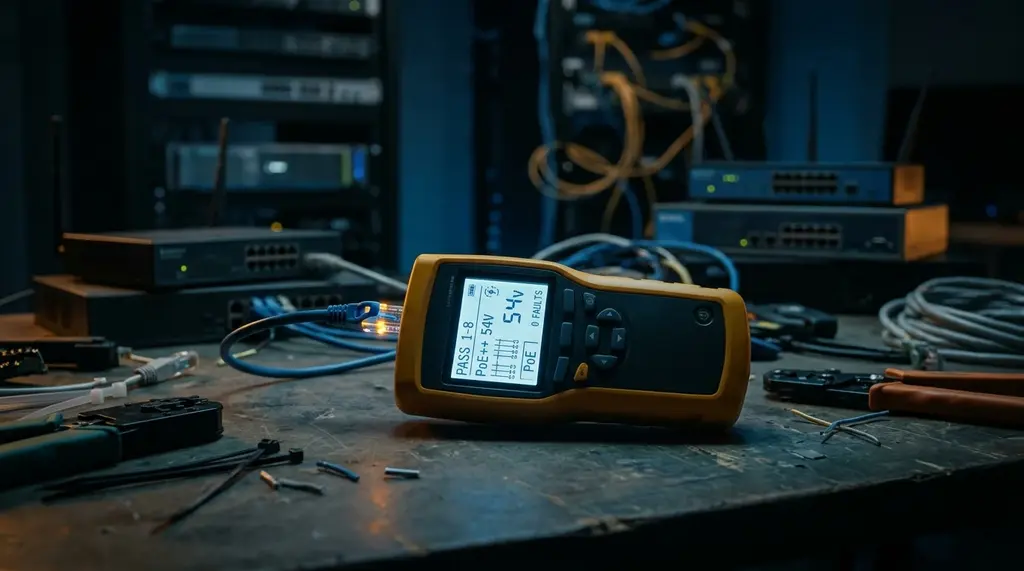
- Active PoE Metering: Measures live DC voltage (0–60V) and identifies 802.3af/at/bt power modes.
- Port Flash / Switch Blink: Pulses switch port LEDs at 1-second intervals to locate patch drops.
- Digital Anti-Noise Tone Probe: Traces cables in live server racks without loud hum interference.
- Rechargeable Lithium Battery: USB-C charging eliminates replacing 9V batteries.
- QC Crimping Test: Verifies crimp depth and pin alignment before running long runs.
3. 100-Cable Laboratory Shootout: Test Results
To test diagnostic accuracy and user speed, our laboratory prepared 100 sample cables: 25 pristine factory Cat6A patch cords, 25 intentionally split-pair terminations, 25 high-resistance partial opens, and 25 live PoE drops connected to a UniFi Enterprise 24 PoE 802.3bt switch.
| Diagnostic Feature | Klein Scout Pro 3 | Noyafa NF-8209S | Generic $10 LED Box | Lab Winner |
|---|---|---|---|---|
| Split Pair Detection | 100% (25/25 detected) | 100% (25/25 detected) | 0% (0/25 detected) | Tie (Both Perfect) |
| TDR Distance to Fault | ±1.2 ft accuracy | ±3.8 ft accuracy | Not Supported | Klein Tools Wins |
| Live PoE Voltage / Power | Voltage Warning Only | Full 54V / 60W BT Meter | Blown circuit (Smoke) | Noyafa Wins |
| Switch Port Flashing | No | Yes (Instant locate) | No | Noyafa Wins |
| Chassis Durability | Industrial Drop-Proof | Standard ABS Plastic | Fragile Plastic | Klein Tools Wins |
4. Final Buying Recommendation: Which Tool Should You Own?
Your purchasing decision comes down to whether you are primarily running physical cable through walls or maintaining an existing active network rack:
- Choose the Klein Tools Scout Pro 3 if: You are pulling structured in-wall Cat6/Cat6A cabling, terminating dozens of wall keystones, building patch panels, and needing exact distance-to-fault measurements when drywallers accidentally puncture a conduit with a drywall screw.
- Choose the Noyafa NF-8209S if: You manage homelab servers, install PoE access points and security cameras, trace mystery unlabeled cables in crowded server closets, and need to know whether a drop has live 48V/54V 802.3at power before plugging in sensitive hardware.
Frequently Asked Questions
Can plugging a standard cable tester into a PoE port destroy it?
Yes! Standard $10 continuity boxes and cheap testers are rated only for low-voltage signal testing (under 5 volts). Plugging them into an active Power over Ethernet port delivering 48V to 57V DC will instantly fry the delicate microcontroller and melt internal traces. Always ensure your tester has active PoE voltage protection.
What is the difference between TDR and capacitive length testing?
Capacitive testing measures capacitance between conductor pairs, which fluctuates dramatically with humidity, temperature, and cable manufacturer dielectric constants. Time Domain Reflectometry (TDR) sends an ultra-fast electrical nanosecond pulse down the copper wire and measures the exact time it takes to reflect off an open or short, delivering millimeter-level precision regardless of ambient humidity.
Does an analog toner probe work inside shielded Cat6A cables?
Poorly. The aluminum foil and grounded drain wire in shielded Cat6A (STP/FTP) cables trap RF electromagnetic radiation, causing traditional analog tone probes to go nearly silent. The Noyafa NF-8209S uses a digital modulated signal frequency that penetrates shielding and rejects the 60 Hz hum generated by nearby fluorescent lights and power conduits.