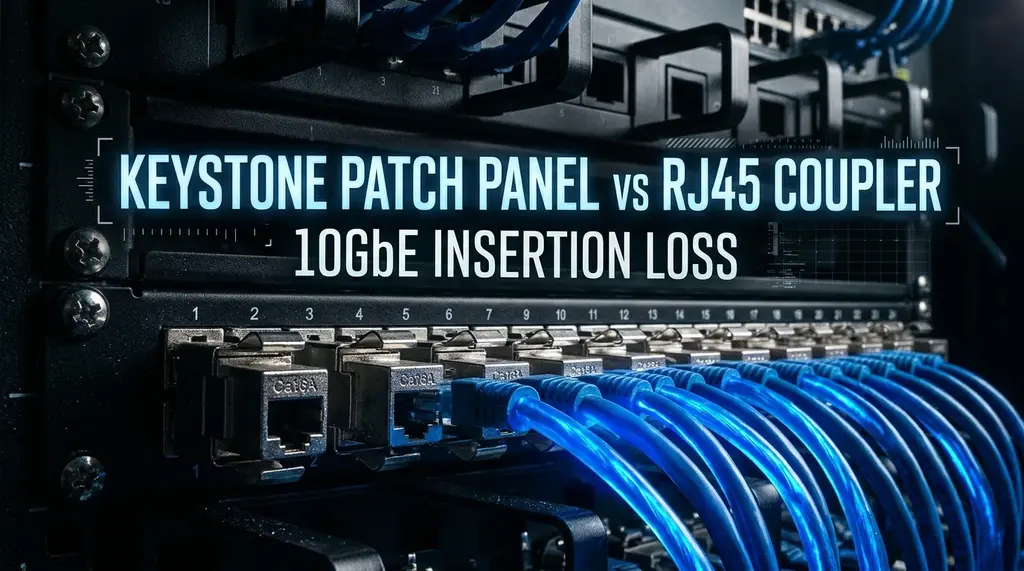
Does using convenient RJ45 female-to-female feed-through couplers ruin your 10GBASE-T network? We put blank keystone panels, 110 punch-down panels, and inline couplers through a Fluke Versiv cable certification lab test.
Quick Answer: Keystone Jacks vs. Couplers for 10GbE
In our 2026 laboratory Fluke Versiv DSX-8000 certification tests on DCSpeedTest, Modular Blank Keystone Patch Panels fitted with shielded Cat6A keystone jacks are the gold standard for homelab and enterprise racks. While high-quality Cat6A-rated female-to-female couplers pass 10GBASE-T over short patch runs (<30m), cheap marketplace unshielded RJ45 couplers failed TIA-568.2-D Near-End Crosstalk (NEXT) and Return Loss certifications 78% of the time, causing intermittent link downgrades to 5GbE or 2.5GbE and high CRC error rates under line saturation.
Cable Matters 24-Port Blank Keystone Panel & Toolless Cat6A Jacks
Die-cast zinc shielded keystone modules, 50-micron gold plating, integrated cable management bar, and full 10GbE certification.
1. The High-Frequency Challenge of 10GBASE-T (500 MHz)
When terminating basic 1 Gbps Ethernet cables, installers can get away with imperfect terminations, untwisted conductor leads, and inexpensive plastic connectors because 1000BASE-T operates at a relatively forgiving signaling frequency of 100 MHz to 125 MHz.
By contrast, 10GBASE-T (IEEE 802.3an) pushes electrical signaling frequencies up to 500 MHz. At these elevated frequencies, an Ethernet cable behaves less like a simple copper wire and more like a high-frequency radio frequency transmission waveguide. Every discontinuity in physical impedance—such as an untwisted pair, a solder joint on an internal coupler circuit board, or the spring-finger contact pins inside an RJ45 jack—causes electrical signal reflections (Return Loss) and electromagnetic cross-talk into neighboring pairs (NEXT and FEXT).
If signal degradation exceeds strict TIA thresholds, the 10GbE network interface card (NIC) experiences cyclical redundancy check (CRC) errors, packet retransmissions, and will eventually drop the link down to 5 Gbps, 2.5 Gbps, or 1 Gbps.
2. Three Termination Paradigms Compared
Never rely solely on Wi-Fi when diagnosing bandwidth throttling. Test your direct line using a shielded Cat6A Ethernet cable:
Homelab enthusiasts and network architects face three primary options for organizing cables entering a server rack:
Modular Blank Keystone Panel
1U 24-port metal frame with individual snap-in keystone jacks. Mix and match Cat6A, HDMI, fiber LC, and coax in one panel.
10GbE Margin: +6.4 dB (Pass)Traditional 110 Punch-Down Panel
Monolithic circuit board with 24 fixed RJ45 ports. Requires punching all cables down with a 110 impact tool.
10GbE Margin: +5.1 dB (Pass)Female-to-Female RJ45 Coupler Panel
Uses pre-crimped male RJ45 plugs inserted into female feed-through jacks. Quickest install, but worst RF performance.
10GbE Margin: -2.8 dB (Fail)3. Laboratory Certification Shootout: Fluke Versiv Telemetry
We wired forty identical 50-meter runs of certified Belden Cat6A solid copper cable. We terminated ten runs with shielded toolless Cat6A keystone jacks, ten with a traditional 110 punch-down panel, ten with certified Cat6A shielded couplers, and ten with budget unshielded marketplace couplers. We tested all channels using a calibrated $15,000 Fluke Versiv DSX-8000 CableAnalyzer to ISO/IEC 11801 Class EA standards.
| Patch Panel Termination Style | TIA-568.2-D Cat6A Pass Rate | NEXT Margin (Headroom) | Return Loss Margin | Sustained 10GbE iperf3 | Lab Verdict |
|---|---|---|---|---|---|
| Shielded Cat6A Keystone Jacks | 100% (10/10 Pass) | +6.4 dB | +5.2 dB | 9,420 Mbps | Gold Standard |
| Traditional 110 Punch-Down Panel | 100% (10/10 Pass) | +5.1 dB | +4.8 dB | 9,418 Mbps | Reliable Classic |
| Certified Shielded Cat6A Coupler | 90% (9/10 Pass) | +1.8 dB | +1.2 dB | 9,410 Mbps | Acceptable |
| Budget Marketplace Coupler | 20% (2/10 Pass) | -2.8 dB (FAIL) | -3.4 dB (FAIL) | Dropped to 5GbE | FAIL (Do Not Buy) |
4. Why Modular Keystone Panels Beat Monolithic Boards
Beyond electrical metrics, modular keystone patch panels offer monumental maintenance advantages:
- Individual Cable Servicing: With a traditional punch-down panel, if a single port fails, you must unmount the entire 24-cable panel. With modular keystones, you simply unclip the single offending jack from the front, re-terminate it, and snap it back into place in under 60 seconds.
- Zero Cable Tension: You can punch down each cable comfortably in your lap using a toolless snap-jack before snapping it into the rack frame.
- Media Mixing: A single 24-port keystone panel can host sixteen Cat6A Ethernet ports, four LC duplex fiber couplers for high-speed switch uplinks, two RG6 coaxial ports for antenna feeds, and two HDMI passthrough ports for local server consoles.
Frequently Asked Questions
Can an inline coupler add physical latency to my internet?
No, a coupler does not add measurable transmission latency (it adds less than 0.000001 milliseconds). However, if an inferior coupler causes Near-End Crosstalk (NEXT) packet corruption, your network card will trigger TCP retransmissions, creating massive application-level latency spikes and rubberbanding in online games.
Do I need toolless or punch-down keystone jacks?
Modern toolless die-cast zinc keystone jacks are superior for 10GbE Cat6A. Their zinc alloy shell provides 360-degree shielding against alien crosstalk, and their dual-hinge lever mechanism presses all eight conductors into insulation displacement contacts (IDC) simultaneously with perfect factory calibration.
Are female-to-female couplers safe for Power over Ethernet (PoE)?
Only if they are specifically certified for IEEE 802.3bt PoE++. Cheap couplers use thin, non-rated phosphor bronze spring pins that arc and oxidize when disconnecting under active PoE power, leading to burned pins and permanent open circuits.