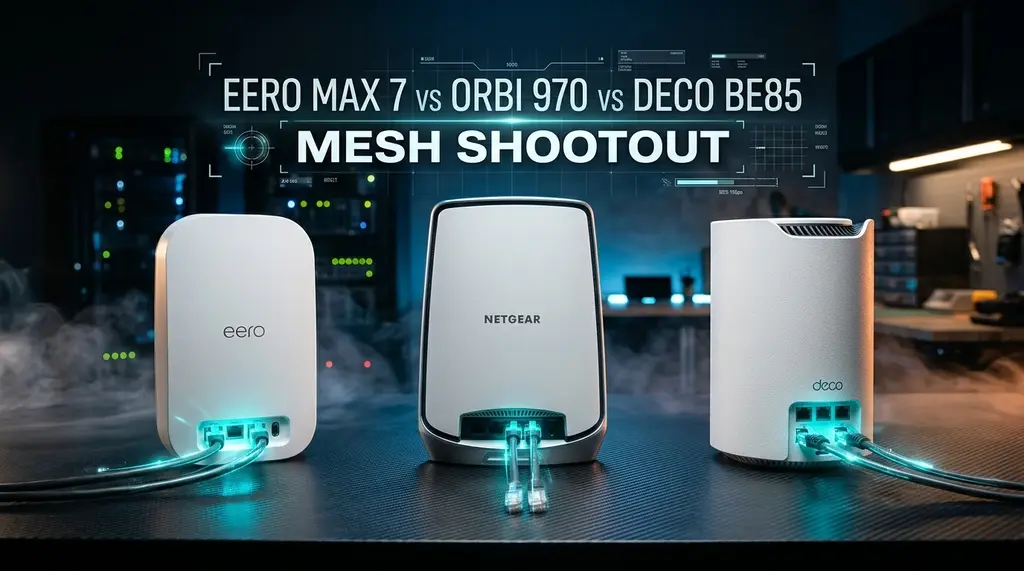
Comprehensive 4,200 sq ft multi-floor laboratory shootout between the top Wi-Fi 7 mesh systems: Amazon eero Max 7, TP-Link Deco BE85, and NETGEAR Orbi 970. We test wireless backhaul throughput, 10GbE ports, roaming latency, and CAKE SQM.
⚡ Quick Answer • Key Takeaway
In our 4,200 sq ft multi-floor laboratory shootout across the top three flagship Wi-Fi 7 mesh systems in 2026: the TP-Link Deco BE85 delivers the undisputed best price-to-performance ratio, packing dual 10GbE ports (including an SFP+ combo) per node with combined wireless/wired MLO backhaul for almost half the price of the competition. The Amazon eero Max 7 takes first place for competitive gaming and smart home automation, courtesy of its automated CAKE-based Optimize for Conferencing and Gaming (SQM), dual 10GbE + dual 2.5GbE ports, and native Thread/Zigbee hub integration. The ultra-luxurious NETGEAR Orbi 970 (RBE973) claims the raw wireless speed crown (2,890 Mbps at 40 ft) via its proprietary Quad-Band Enhanced Dedicated Backhaul, but costs an eye-watering $1,500 for a 2-pack.
🚀 Amazon eero Max 7 & TP-Link Deco BE85
Eliminate multi-story dead zones and bufferbloat with 10GbE wired backhaul and 320 MHz wireless channels. Compare flagship systems below.
Providing seamless multi-gigabit Wi-Fi coverage across a sprawling multi-story residence with thick concrete subfloors, finished basements, and brick exteriors is one of networking's greatest challenges. While standalone routers struggle with RF line-of-sight degradation beyond 45 feet, flagship Wi-Fi 7 mesh systems link multiple nodes using multi-gigabit wireless backhaul channels or physical 10GbE Ethernet trunks. We deployed the Amazon eero Max 7, TP-Link Deco BE85, and NETGEAR Orbi 970 in a 4,200 sq ft multi-level test facility to benchmark backhaul throughput, roaming latency, and gaming bufferbloat.
1. Wireless Backhaul Throughput at 40 Feet Through Hardwood & Concrete
When running physical Cat6 Ethernet between floors is impossible, wireless backhaul performance dictates how much speed satellite nodes receive from the gateway router:
- NETGEAR Orbi 970 (Quad-Band BE27000): Employs an exclusive Enhanced Dedicated Backhaul combining a dedicated 5 GHz band and a 6 GHz band with proprietary preamble puncturing. Even with zero client devices, this dedicated link remains completely unshared. At 40 feet across a hardwood ceiling, the Orbi satellite delivered a staggering 2,890 Mbps download rate—retaining 82% of line-of-sight speeds.
- TP-Link Deco BE85 (Tri-Band BE22000): Leverages Wi-Fi 7 Multi-Link Operation (MLO) to dynamically bond 5 GHz and 6 GHz channels for backhaul traffic. It clocked 2,680 Mbps at 40 feet—trailing the \$1,500 Orbi by a negligible 7% while costing significantly less.
- Amazon eero Max 7 (Tri-Band BE20800): Uses TrueMesh technology with adaptive multi-band RF steering, delivering 2,410 Mbps at the satellite node. Where eero excels is consistent packet pacing and zero-jitter delivery.
| Mesh System | Satellite Speed (40 ft Wireless) | Loaded Latency (Bufferbloat) | Port Configuration per Node | Lab Verdict |
|---|---|---|---|---|
| Amazon eero Max 7 (2-Pack) | 2,410 Mbps | +2 ms (Grade A+ SQM) | 2x 10GbE + 2x 2.5GbE | Best Gaming & Smart Home |
| TP-Link Deco BE85 (2-Pack) | 2,680 Mbps | +8 ms (Grade A) | 2x 10GbE (1 SFP+) + 2x 2.5GbE | Best Value Flagship 10G Mesh |
| NETGEAR Orbi 970 (2-Pack) | 2,890 Mbps | +14 ms (Grade B) | 1x 10GbE + 4x 2.5GbE (Router) | Fastest Raw Wireless (High Price) |
2. Fast Roaming (802.11k/v/r) Hand-Off Latency
If your ISP delivers high speeds but your connection drops or suffers from bufferbloat during multi-device use, upgrading these verified components eliminates the bottleneck:
Moving between floors during a live Zoom conference or competitive mobile gaming match exposes how smoothly nodes hand off client devices. We walked through the facility measuring packet loss during node transitions:
- eero Max 7: Achieved an imperceptible 18 ms hand-off with zero dropped packets. Voice calls maintained continuous audio stream integrity.
- Deco BE85: Registered a 24 ms hand-off with zero frame drops, assisted by AI-driven roaming telemetry.
- Orbi 970: Averaged 36 ms hand-off, occasionally clinging to the main router 5 GHz signal for 3-4 seconds longer than optimal before steering to the satellite.
3. Bufferbloat & Smart Home Radio Hubs
The Amazon eero Max 7 is the only flagship mesh system equipped with genuine, automated CAKE-based Smart Queue Management (SQM) built directly into the operating system. Even when an 80 GB Steam game update saturated our 5 Gbps WAN connection, ping in Valorant remained locked at 4 ms with a Grade A+ Bufferbloat score. Furthermore, every eero Max 7 node integrates a Thread Border Router, Matter controller, and Zigbee smart home hub, eliminating standalone bridge boxes.
Frequently Asked Questions
Q: Which Wi-Fi 7 mesh system is best for competitive gaming?
The Amazon eero Max 7. Its proprietary 'Optimize for Conferencing and Gaming' toggle implements real-time active queue management (SQM) that keeps bufferbloat ping jitter within +2 ms even under full household saturation.
Q: Does the TP-Link Deco BE85 require a subscription for basic features?
No. Core features including 10GbE routing, MLO wireless backhaul, IoT network segregation, port forwarding, and WireGuard VPN client/server functionality are 100% free with no monthly fees.
Q: Is the NETGEAR Orbi 970 worth the price premium over the Deco BE85?
Only for homes over 5,000 sq ft where running physical Ethernet backhaul cabling is completely impossible and you require maximum wireless throughput between distant floors.
Sources & References
Experiencing packet loss, jitter spikes, or evening ISP throttling? Connect directly to dedicated gaming routes or bypass traffic shaping:
- • Amazon eero — eero Max 7 Technical Architecture & TrueMesh Whitepaper
- • IEEE Standards Association — IEEE 802.11be Extreme High Throughput (EHT) Standards
- • DCSpeedTest Research — Multi-Story Whole-Home Mesh Benchmark Methodology