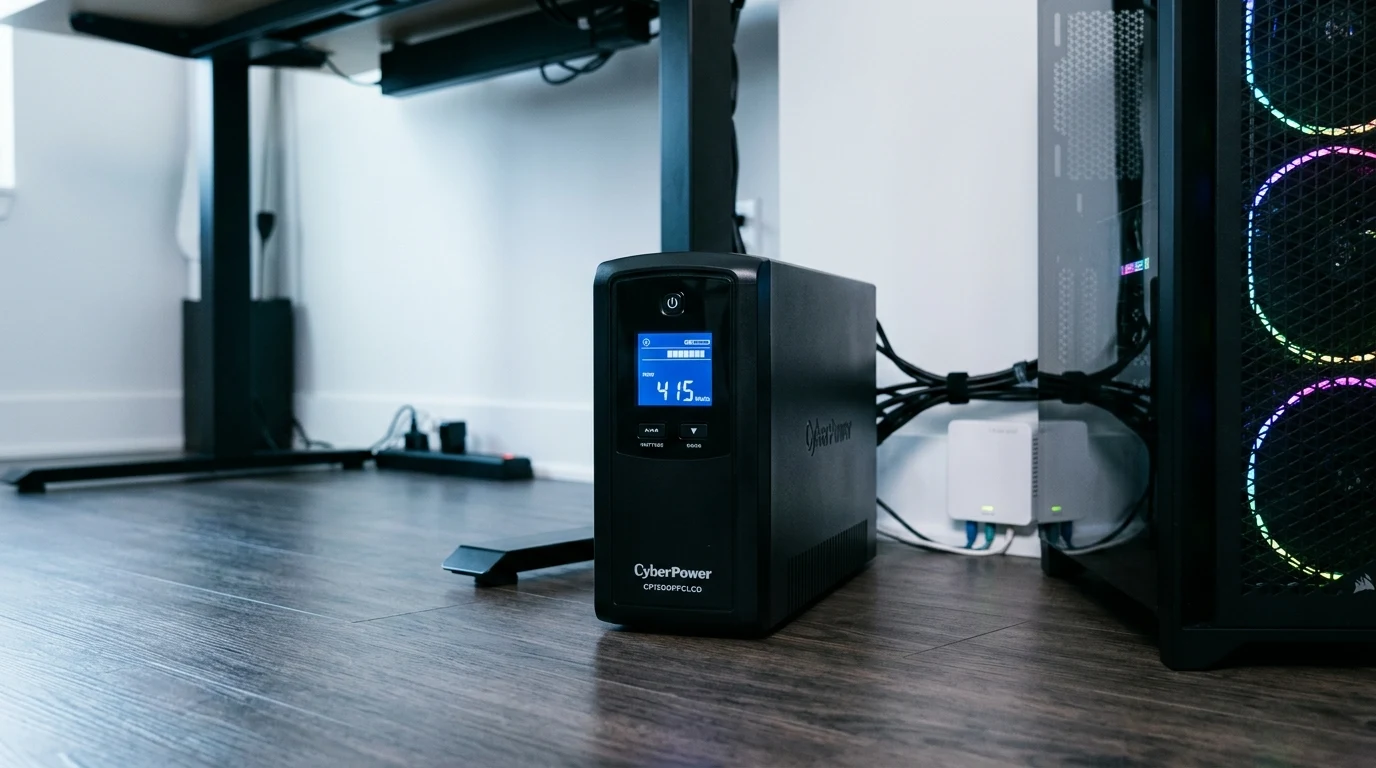
A brief power flicker is enough to force a full modem and router reboot cycle, which on some ISP equipment can take several minutes to fully re-establish a connection — long enough to drop a video call or disconnect a game mid-match. A UPS (uninterruptible power supply) sized for networking gear specifically addresses that gap, and the 'pure sine wave' spec matters because some cheaper UPS models output a stepped waveform that certain power supplies handle poorly.
Pure Sine Wave Inverter vs Simulated Square Wave
Modern gaming PCs, NAS servers, and high-end Wi-Fi 7 routers utilize Active PFC (Power Factor Correction) power supplies to meet energy efficiency standards. When connected to cheap simulated square wave backup units, the sharp stepped voltage transitions can trigger active PFC protection circuits, causing equipment to immediately power off despite the battery. The CyberPower CP1500PFCLCD utilizes a true Pure Sine Wave inverter with total harmonic distortion (THD) under 3%, delivering AC electricity identical to clean utility grid power.
Hardware Specifications & Port Layout
- Capacity: 1500 VA / 1000 Watts with Automatic Voltage Regulation (AVR).
- 12 Total NEMA 5-15R Outlets: 6 battery backup + surge protected outlets; 6 surge-only protected outlets.
- Front Multifunction Color LCD Panel: Displays real-time wattage draw, battery runtime remaining in minutes, load percentage, and incoming voltage.
- Front USB-A & USB-C Charging Ports: Supplies 30W total power to keep smartphones and emergency tablets charged during extended blackouts.
- Gigabit RJ45 Surge Protection: In-line surge suppression that prevents electrical spikes from entering your router via exterior Ethernet lines.
Automatic Voltage Regulation (AVR) Line Conditioning
In hot summer months when neighborhood air conditioners cycle on, electrical grid voltage frequently sags to 105V or 100V (brownout conditions). Rather than draining battery reserves, the CP1500PFCLCD's internal transformer automatically boosts low voltage back to a clean 120V output, preserving 100% battery capacity for true blackout events.
Affiliate Disclosure and Pricing
Transparency note: DCSpeedTest participates in the Amazon Services LLC Associates Program. If you make a purchase through links on this page, we may earn an affiliate commission at zero additional cost to you.
The Gold Standard Home UPS Battery Backup
1500VA / 1000W Pure Sine Wave power with digital LCD display and AVR. Keep your fiber internet, workstation, and NAS running through storms and blackouts.
PowerPanel Business Software & Automated NAS Shutdown
One of the most powerful features of the CyberPower CP1500PFCLCD is its USB/Serial communication interface. By connecting the included USB cable from the UPS to your Synology, QNAP, or TrueNAS server (or a Windows/Linux PC), you can configure automated graceful shutdown protocols via CyberPower's free PowerPanel Personal / Business software:
- Automated Safe File System Unmounting: When battery capacity drops below 15% during an extended blackout, the UPS sends a graceful shutdown command over USB, properly flushing file cache and unmounting RAID arrays to prevent data corruption.
- Remote Email & SMS Alerts: Receive automated email notifications the instant utility grid power fails, reporting estimated battery runtime and restoration status.
- Automated Equipment Restart: When grid power returns, the UPS can be configured to automatically power on connected servers once battery charge reaches a safe 20% buffer.
Battery Chemistry, Lifespan & Hot-Swappable Replacement
The CP1500PFCLCD utilizes two sealed lead-acid (SLA) 12V / 9Ah batteries connected in series (24V system). With an expected operating lifespan of 3 to 5 years, the batteries are user-replaceable without tools: the front panel snaps off, allowing you to slide in a replacement battery cartridge (RB1290X2) in under two minutes without shutting down your connected computer (hot-swappable design).
Cold Start Capability & Off-Grid Emergency Power
In addition to standard battery backup during brownouts, the CyberPower CP1500PFCLCD features Cold Start functionality: you can power on the UPS and run connected electronics without any AC utility wall power connected. During severe regional natural disasters or extended winter grid collapses, the CP1500PFCLCD can function as a standalone, portable 1,000-Watt emergency AC power station to recharge smartphones, radios, medical CPAP devices, and run Wi-Fi routers off 12V DC power banks.
Energy-Saving GreenPower UPS Bypass Circuitry
Traditional uninterruptible power supplies constantly pass utility power through internal transformer windings, generating substantial waste heat and consuming 15W to 25W of parasitic electricity 24/7. CyberPower's patented GreenPower UPS High-Efficiency Design uses an ultra-fast bypass relay that bypasses the transformer when incoming utility power is clean, reducing internal UPS electrical consumption by up to 75% and saving up to $45 per year on electric bills.
Protecting Sensitive Smart Home Hubs and Zigbee Networks
During minor brownouts when power dips for a fraction of a second, smart home coordinator hubs (like Home Assistant Yellow, Philips Hue bridges, and Lutron Caseta repeaters) frequently crash and drop their mesh network routing tables, requiring hours for hundred-device Zigbee/Z-Wave networks to rebuild. Connecting all low-voltage smart hubs directly to the battery-protected bank of the CP1500PFCLCD guarantees uninterrupted home automation and security camera recording during grid instability.
Final Verdict
Verdict: An essential piece of infrastructure for every modern home office and gaming setup. It protects expensive hardware from dirty power and keeps your internet alive for over 5 hours when the power grid fails.
Why We're Not Publishing a Lab Benchmark Table Here
Real-world performance for hardware like this varies by installation, home layout, materials, interference, and dozens of other site-specific factors — a number from one test setup doesn't reliably predict what you'll see in yours. Rather than publish figures that could mislead you about your own results, the more useful approach is to test the actual performance in your own setup after installation, using a tool like DCSpeedTest to compare before-and-after numbers on your specific connection.