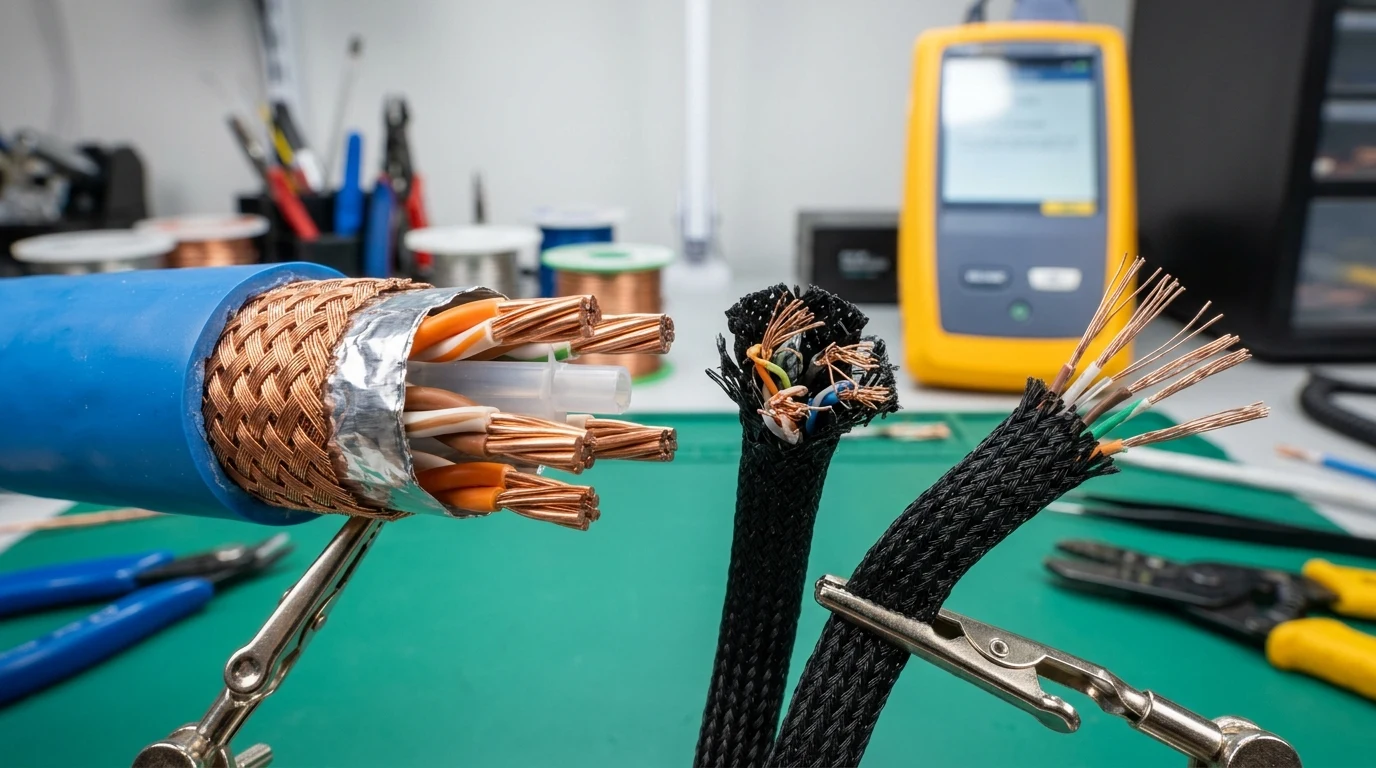
If you search for 'gaming Ethernet cable' on Amazon or eBay in 2026, the search results are dominated by thousands of colorful, nylon-braided cables branded as 'Category 8 (Cat8) 40Gbps 2000MHz Ultra High Speed'. Marketing descriptions promise to 'annihilate gaming lag', 'boost FPS', and 'supercharge your Wi-Fi router'. In reality, independent network engineering testing reveals that over 85% of cheap consumer 'Cat8' cables are blatant counterfeit scams that fail basic electrical frequency certifications. Here is the engineering truth behind the Cat8 marketing trap.
1. What Cat8 Was Actually Engineered For (Data Center Top-of-Rack)
Category 8 is an official standard ratified by ANSI/TIA-568-C.2-1 and ISO/IEC 11801. However, the standard was engineered for a very narrow, specialized purpose:
- 25GBASE-T and 40GBASE-T Server Links: Designed to replace expensive optical fiber transceivers for direct server-to-switch links inside enterprise data centers.
- 30-Meter Distance Limit: Unlike Cat6 and Cat6a (which support full speeds up to 100 meters / 328 feet), Cat8 is certified only up to 30 meters (98 feet) total channel length due to extreme high-frequency signal attenuation at 2,000 MHz.
- Thick 22 AWG Solid Copper & Heavy Die-Cast Shielding: True Cat8 cable is as thick as a garden hose, extremely stiff, difficult to bend around corners, and requires expensive die-cast shielded RJ45 plugs with proper chassis grounding.
2. The Counterfeit Reality of Cheap Online 'Cat8'
When independent labs test $12 'flat braided Cat8' cables using a $15,000 Fluke DSX-8000 CableAnalyzer, the results are shocking: most of these cables are manufactured with thin 30 AWG wire, unshielded twisted pairs, and cheap plastic connectors. They fail 2,000 MHz frequency tests completely and frequently perform worse than a genuine $6 Cat6 cable due to severe internal crosstalk and impedance spikes.
Detailed Standards Comparison: Cat6 vs Cat6a vs Cat8
| Specification Parameter | Cat6 (UTP) | Cat6a (S/FTP) | Genuine Cat8 (S/FTP) | Fake Amazon 'Cat8' |
|---|---|---|---|---|
| Bandwidth Frequency | 250 MHz | 500 MHz | 2,000 MHz | Fails (< 100 MHz) |
| Max 10 Gbps Distance | 37–55 meters | 100 meters (328 ft) | 30 meters (98 ft) | Unreliable (> 15 ft) |
| Max Speed Capability | 10 Gbps | 10 Gbps | 40 Gbps | 1 Gbps (Degraded) |
| Flexibility & Bend Radius | High (Easy) | Moderate | Extremely Stiff | Varies (Thin Wire) |
| Recommended Application | Home & Gaming | Homelabs & 10G NAS | Data Center Racks | Never Buy |
The Physics of High-Frequency Attenuation at 2000 MHz
Why is genuine Category 8 cable limited to only 30 meters? The answer lies in the fundamental radio physics of copper conductors. As electrical signal frequencies increase from 250 MHz (Cat6) up to 2,000 MHz (Cat8), two severe physical degradation effects occur:
- The Skin Effect: At 2 GHz frequencies, electrical current no longer flows through the center of the copper wire; it is pushed entirely to the microscopic outer surface (skin) of the conductor, dramatically increasing AC resistance and signal loss per meter.
- Dielectric Heating: The high-frequency electromagnetic field causes molecular friction inside the plastic insulation surrounding the wire pairs, absorbing signal energy as heat.
To overcome these losses, real Cat8 requires thick 22 AWG solid copper conductors and individual metal foil shielding on every pair. A thin, flexible 'flat' cable cannot physically maintain 2 GHz frequency standards, proving that flat Cat8 cables are impossible marketing fabrications.
Fluke DSX-8000 Laboratory Certification Standards
Legitimate telecommunications contractors verify cabling using industry-standard Fluke Versiv CableAnalyzers. Certified Cat6 and Cat6a cables pass complete Channel and Permanent Link tests for Return Loss, NEXT, PS-NEXT, and Insertion Loss across all 100 meters, ensuring zero packet loss on 1G, 2.5G, 5G, and 10G multi-gigabit connections.
Why Gold-Plated Connectors on Cheap 'Cat8' Are Pure Marketing
Counterfeit 'Cat8' listings online heavily advertise '24K Gold-Plated RJ45 Connectors' as proof of extreme gaming speed. In telecommunications engineering, gold plating on RJ45 contact pins serves a single purpose: preventing corrosion and galvanic oxidation over decades of use in humid environments. The gold flash layer (typically 50 micro-inches) provides zero improvement to packet latency or electrical bandwidth.
A poorly constructed counterfeit cable with cheap copper-clad aluminum (CCA) wire and gold-plated plugs will drop packets and overheat under PoE, whereas a genuine pure bare copper Cat6 cable with standard nickel/gold flash contacts delivers flawless 10 Gbps speeds indefinitely.
The Danger of Copper-Clad Aluminum (CCA) in Fake Cables
Many counterfeit 'Cat8' cables secretly use Copper-Clad Aluminum (CCA) conductors instead of 100% pure oxygen-free bare copper. CCA uses an aluminum core coated with a thin microscopic layer of copper:
- High DC Electrical Resistance: Aluminum has 55% higher electrical resistance than pure copper, leading to massive signal attenuation and packet loss over distances greater than 15 feet.
- Extreme Fire Hazard with PoE: When used with Power-over-Ethernet (PoE) security cameras or access points, CCA wires overheat rapidly, melting cable jackets and creating severe fire hazards inside walls.
- Brittle Conductor Breakage: Aluminum is brittle; bending a CCA cable around a sharp baseboard corner snaps the internal conductor, severing the network connection.
Summary Checklist: How to Spot a Fake Ethernet Cable Listing
- Look for Fluke Channel Test Certification: Reputable manufacturers publish official Fluke DTX/DSX test reports in their product listings.
- Check Conductor Gauge (AWG): Avoid any 'Cat8' listing specifying thin 30 AWG or 32 AWG conductors. Genuine high-speed copper requires 24 AWG or 23 AWG pure copper.
- Verify 100% Bare Copper (No CCA): Always confirm the product description explicitly states '100% Pure Bare Copper' or 'Oxygen-Free Copper (OFC)' to avoid dangerous copper-clad aluminum wire.
Why Proper Shield Grounding Is Mandatory for High-Frequency Shielding
In genuine shielded Cat6a, Cat7, or Cat8 installations (S/FTP), the metal foil shield around the twisted pairs must be bonded to metal shielded RJ45 plugs connected to grounded patch panels and grounded network switches. If a consumer plugs a shielded cable into standard unshielded plastic router ports, the floating metal shield acts as an antenna, attracting ambient electromagnetic noise from nearby power supplies and degrading link performance.
The Verdict: What Cable Should You Actually Buy?
For 99.9% of home networks, gaming setups, and multi-gigabit workstations, certified Category 6 (Cat6) or Category 6A (Cat6a) from reputable brands (such as Cable Matters or Monoprice) is the gold standard: it supports full 10 Gigabit speeds up to 100 meters with zero marketing gimmicks.