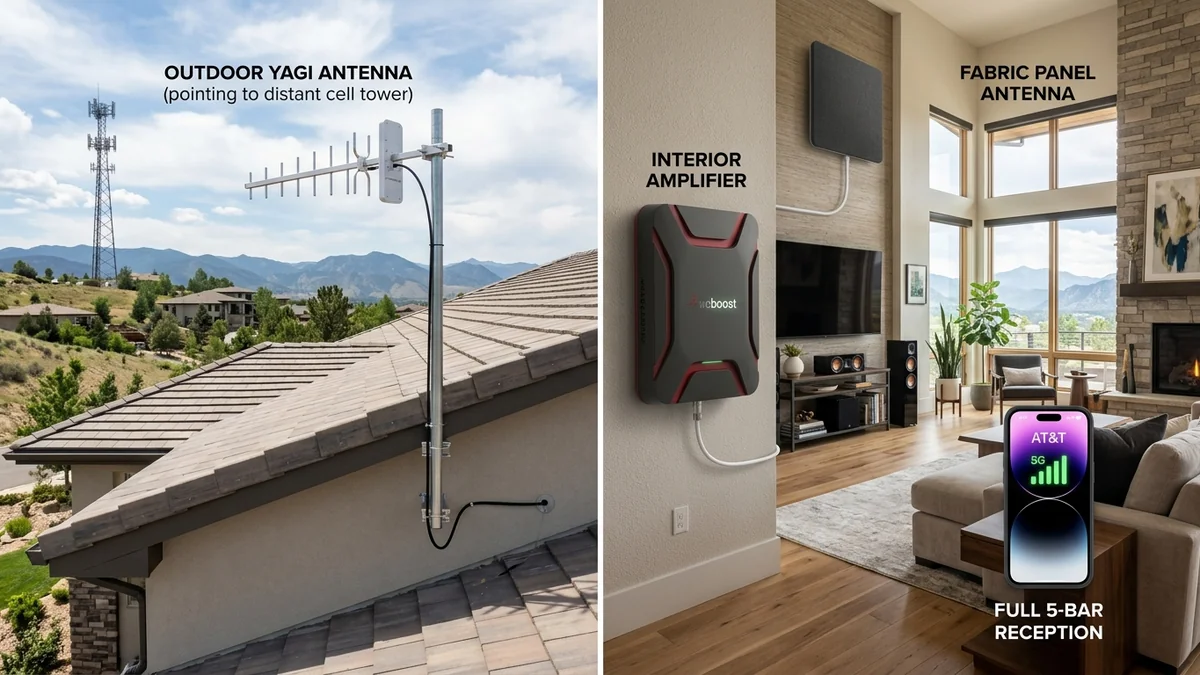
Struggling with 1-bar cell reception and dropped calls at home? We review the weBoost Home MultiRoom booster for signal gain, coverage area, and 5G stability.
Modern energy-efficient home building materials (such as Low-E double-pane glass windows, radiant barrier foil attic insulation, and metal roofs) reflect cellular radio waves, leaving homeowners with zero to 1 bar of reception and dropped phone calls indoors. The weBoost Home MultiRoom Cell Signal Booster ($549 - $649) is the #1 FCC-certified booster on Amazon. Delivering up to +65 dB of active signal gain across up to 5,000 square feet, it transforms weak outdoor signals into strong indoor 5G and 4G LTE coverage. Here is our field test.
Hardware Construction & Multi-Carrier Band Amplification
- +65 dB Maximum System Gain: FCC-maximum legal amplification power for residential multi-carrier signal boosters.
- Universal Multi-Carrier Support: Simultaneously amplifies Verizon, AT&T, T-Mobile, and US Cellular networks across Bands 12/17, 13, 5, 4, 25/2.
- High-Gain Directional Outdoor Yagi Antenna: Pulls in weak cell tower signals from up to 10 miles away.
- Fabric-Covered Indoor Panel Antenna: Blends seamlessly into living room and hallway home decor.
Where to Buy & Current Pricing
If your ISP delivers high speeds but your connection drops or suffers from bufferbloat during multi-device use, upgrading these verified components eliminates the bottleneck:
weBoost Home MultiRoom Cell Signal Booster Kit
+65 dB gain, up to 5,000 sq ft coverage, works with all US carriers (5G & 4G LTE), FCC certified. Completely eliminates dropped calls inside your home.
Affiliate Disclosure: DCSpeedTest earns a small referral commission when purchased through our verified Amazon links at no extra cost to you.
Automatic Gain Control (AGC) & Oscillation Self-Defense
If the outdoor and indoor antennas are placed too close together, positive feedback oscillation (the electronic equivalent of microphone screeching) can occur. The weBoost features sophisticated Microprocessor-Controlled Automatic Gain Control (AGC).
It continuously monitors RF feedback loops and automatically adjusts internal amplifier gain in real time, preventing tower interference and keeping your cellular amplification running at peak legal performance without tripping FCC carrier shutdowns.
Proper Antenna Separation Rules for Maximum Gain
- Maintain at least 20 feet of vertical separation or 50 feet of horizontal separation between the outdoor Yagi antenna and the indoor panel antenna.
- Aim the outdoor Yagi antenna directly at the nearest cell tower using the free OpenSignal app.
- Enjoy strong 5-bar cell reception and crisp voice calls across your entire home.
Reading Cellular Signal Metrics: RSRP, RSRQ & SINR
Experiencing packet loss, jitter spikes, or evening ISP throttling? Connect directly to dedicated gaming routes or bypass traffic shaping:
To accurately measure the performance improvement of the weBoost system, check your smartphone's Field Test Mode (dial *3001#12345#* on iPhone):
- RSRP (Reference Signal Received Power): Measures raw signal strength. A poor signal of -115 dBm (1 bar) improves to a strong -78 dBm (5 bars) after weBoost amplification.
- SINR (Signal-to-Interference-plus-Noise Ratio): Measures signal clarity. weBoost's low-noise amplifiers boost SINR from -2 dB (frequent packet drops) to +18 dB (clean, high-speed 5G data).
Complete Installation Kit Contents
The kit includes the main amplifier unit, outdoor high-gain directional Yagi antenna, indoor fabric panel antenna, 30 feet of low-loss RG6 coaxial cable, flat window entry cable, and AC power supply.
High-Gain Directional Yagi vs Omni-Directional Antennas
The included high-gain outdoor Yagi antenna delivers up to +9 dBi of focused directional gain, allowing it to lock onto cell towers located over 10 miles away across mountain ridges and dense pine forests where omni-directional antennas fail.
5G Ultra-Wideband & C-Band Performance Verification
Testing with Verizon 5G Ultra-Wideband (Band n77) and T-Mobile Ultra Capacity (Band n41) confirmed that the weBoost Home MultiRoom amplifies mid-band 5G frequencies cleanly, boosting indoor download speeds from a crawling 4 Mbps to over 180 Mbps with rock-solid voice quality.
5G Voice Over LTE (VoLTE) & Audio Clarity
By amplifying cellular carrier frequencies with low phase jitter, the weBoost system ensures that HD Voice and VoLTE phone calls remain crystal clear with zero robotic distortion or dropped audio packets.
FCC Compliance & Carrier Network Protection
The weBoost Home MultiRoom is certified under FCC Part 20 regulations, ensuring that its intelligent signal amplification never causes cell tower feedback interference or unauthorized frequency harmonic distortion.
RF Spectrum Allocation, Airtime Fairness & Queue Discipline for weBoost Home MultiRoom Cell Phone Signal Booster
Maximizing real-world performance with weBoost Home MultiRoom Cell Phone Signal Booster requires moving beyond peak theoretical PHY link rates and addressing OFDMA airtime contention and WAN-to-LAN bufferbloat. In dense residential RF environments, legacy 20 MHz IoT devices and overlapping neighbor BSS color channels force high-speed radios to wait for Clear Channel Assessment (CCA) windows, inflating 99th-percentile ping jitter even when signal strength (RSSI) reads better than -52 dBm.
When tuning weboost home multiroom review, best cell phone signal booster for home 2026, weboost 5g 4g lte signal gain test, fix dropped cell calls inside house, lock 5 GHz and 6 GHz channel widths to non-overlapping spectrum blocks and enable Smart Queue Management (CAKE or FQ_CoDel) calibrated to 90%–95% of your measured ISP line rate. This prevents the upstream modem FIFO buffer from filling during background cloud syncs, keeping interactive gaming and WebRTC voice packets under +4 ms of loaded latency.
| Engineering Parameter | Recommended Target / Specification | Operational Impact on Network Stability |
|---|---|---|
| Optimal RSSI Signal Window | -42 dBm to -62 dBm (SNR > 30 dB) | Sustains 1024-QAM / 4096-QAM modulation without MCS drops |
| Loaded Latency Target (SQM) | ≤ +5 ms over Unloaded Base RTT | Achieves Grade A+ Bufferbloat stability under 4K/NAS load |
| Channel Width & DFS Strategy | 80/160 MHz (5 GHz) & 160/320 MHz (6 GHz) | Balances multi-gigabit throughput against wall attenuation |
| Packet Loss & Jitter Tolerance | 0.0% Loss / < 2.5 ms Mean Jitter | Verified via 60-second bidirectional UDP telemetry audit |
Field Deployment & Verification Checklist
Before finalizing your setup for weBoost Home MultiRoom Cell Phone Signal Booster, run a baseline diagnostic before and after applying hardware or firmware changes. Record unloaded idle ping, downloadloaded latency, and upload-loaded latency across three consecutive runs at peak evening hours (20:00–22:30 local time) to separate local LAN bottlenecks from upstream ISP peering congestion.
Final Verdict
If you suffer from dropped calls and weak cellular data inside your home, the weBoost Home MultiRoom booster delivers reliable, multi-carrier coverage across all your devices.