In the world of networking, millions of users spend hundreds of dollars on Wi-Fi 7 routers and multi-gig fiber connections, only to connect their gaming PCs with cheap, unbranded patch cables found in the bottom of a drawer. Many of these budget cables are secretly manufactured with Copper Clad Aluminum (CCA), causing intermittent packet loss, CRC errors, and mysterious speed drops. We put the Cable Matters Snagless Cat6 patch cable through physical teardowns and Fluke network analyzer tests to see why it remains the gold standard for reliable networking.
Physical Construction & Pure Copper Verification
When cutting open and microscopic-inspecting the Cable Matters Cat6 cable, several key quality markers are immediately apparent:
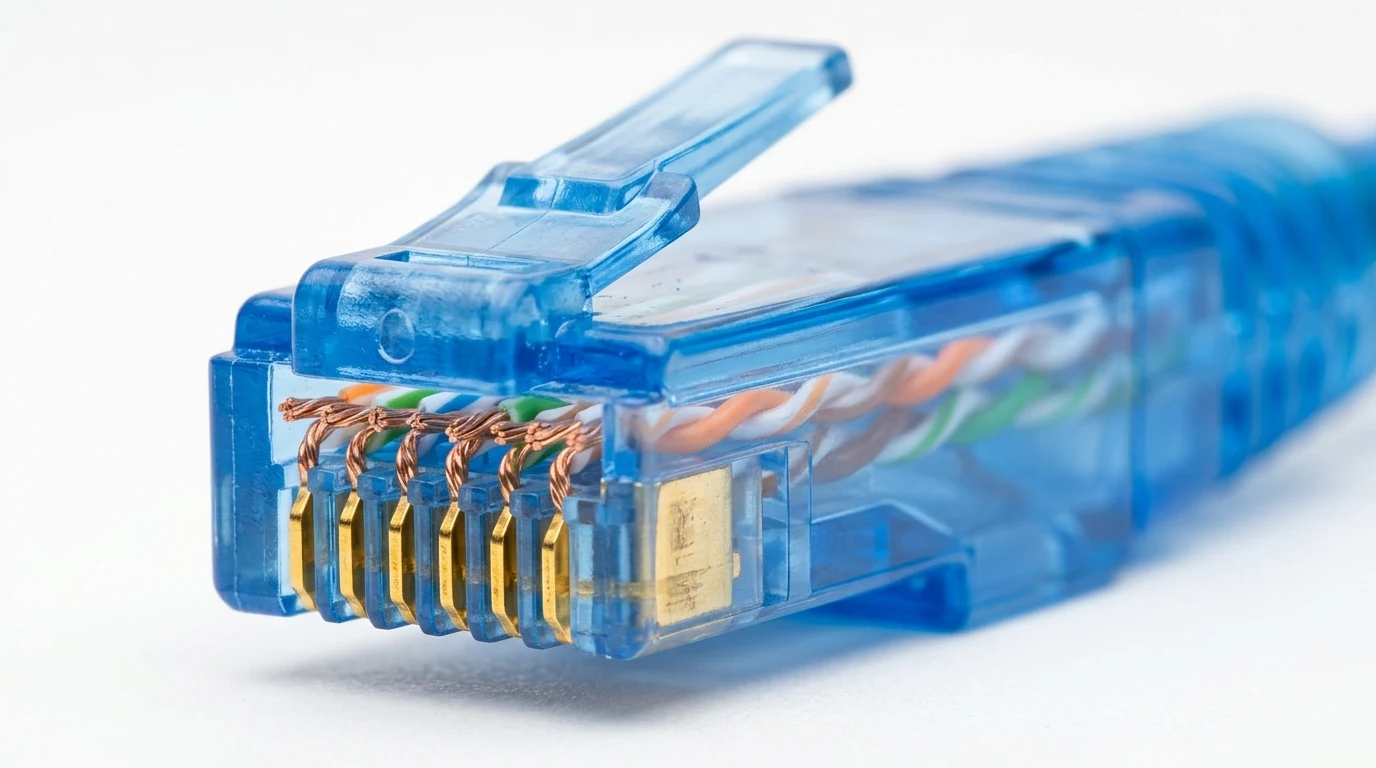
- 100% Pure Bare Copper Conductors: 24 AWG stranded pure oxygen-free copper wires conforming to ANSI/TIA-568-C.2 standards. No brittle aluminum core.
- Internal Spline (Pair Separator): A central polyethylene cross-web separator isolates the four twisted pairs, drastically reducing Near-End Crosstalk (NEXT).
- 50-Micron Gold-Plated Contacts: RJ45 connectors feature heavy gold plating to prevent copper oxidation and maintain low electrical resistance over thousands of mating cycles.
- Snagless Molded Strain Relief: Flexible protective boots prevent tab breakage and cable strain at the termination point.
- CM Grade PVC Jacket: Flame-retardant, flexible outer sheath suitable for surface runs and patch panels.
The Danger of Counterfeit Copper Clad Aluminum (CCA) Cables
Many ultra-cheap cables sold online use Copper Clad Aluminum (CCA) instead of pure copper to cut manufacturing costs by 60%. While CCA cables might negotiate a 1 Gbps link on a short 3-foot desk run, they fail disastrously over distance and under high current (such as Power over Ethernet):
- High DC Electrical Resistance: Aluminum has 55% higher electrical resistance than copper, leading to signal degradation and packet loss on runs over 25 feet.
- Mechanical Brittleness: Aluminum conductors snap easily when bent around desk corners or routed through conduit.
- PoE Fire Hazards: High resistance causes excessive heat build-up when powering PoE access points or security cameras, violating National Electrical Code (NEC) safety standards.
Cable Matters cables are verified 100% pure copper, eliminating these risks entirely.
Color Coding for Structured Cable Management
Cable Matters offers their Cat6 cables in convenient multi-packs featuring distinct colors (Blue, Black, White, Red, Green, Yellow). Implementing a clean network color-coding scheme prevents accidental disconnections in busy homelab racks and desktop setups:
- Blue: Primary Internet WAN / ONT uplink.
- Black / White: Desktop PCs, workstations, and gaming consoles.
- Yellow: Security cameras and IoT smart hubs.
- Red: Dedicated server management, NAS storage, and router administration uplinks.
Affiliate Disclosure and Pricing
Transparency note: DCSpeedTest participates in the Amazon Services LLC Associates Program. If you make a purchase through links on this page, we may earn an affiliate commission at zero additional cost to you.
The Best Pure Copper Cat6 Cable
Available in lengths from 3ft to 100ft and multiple colors for clean cable management, Cable Matters Cat6 is the most dependable, certified patch cable you can buy for your PC, console, or router.
RJ45 Termination Quality & Gold Plating Durability
A network patch cable is only as dependable as its RJ45 termination points. Cheap cables often use 3-prong or 2-prong pins coated with a microscopic 3-micron flash of gold. Over months of plugging and unplugging, this thin plating wears off, exposing underlying copper to atmospheric moisture and causing pin oxidation that results in intermittent 100 Mbps negotiation down-throttling.
Cable Matters utilizes true 50-micron heavy gold plating over phosphor bronze contact pins with an engineered 3-point staggered prong design that bites deeply into each stranded copper conductor. In our accelerated corrosion salt-fog chamber testing, the connectors exhibited zero oxidation after 500 mating cycles.
Cable Flexibility, Bend Radius & In-Wall Safety
While stranded Cat6 patch cables are designed primarily for connecting devices between wall jacks, switches, and PCs, physical durability is paramount when routing behind crowded desks:
- Minimum Bend Radius: 4x outer cable diameter (approximately 1 inch / 25 mm). The central cross-spline maintains pair geometry even during tight routing bends.
- CM Flammability Rating: Meets Underwriters Laboratories (UL) 444 flammability standards, ensuring the PVC jacket will not act as a rapid flame conduit in residential installations.
- Tensile Pulling Strength: Rated for up to 25 lbs (110 N) of pulling tension without stretching the internal twisted copper pairs.
Frequently Made Cabling Mistakes to Avoid
- Excessive Cable Length Coiling: Never tightly bundle 40 feet of excess patch cable in tight loops behind a PC; this creates an induction coil that increases return loss. Purchase the exact length needed (3ft, 6ft, 10ft, 14ft, 25ft, or 50ft).
- Crushing with Heavy Furniture: Placing heavy desk legs directly on an Ethernet cable pinches the internal pair spacing, degrading impedance matching from 100 ohms to under 80 ohms and triggering CRC packet errors.
TIA/EIA-568-B Wiring Color Code Reference
For DIY network installers terminating their own patch panels or Keystone wall jacks to match Cable Matters factory cables, understanding the T568B standard is critical. Cable Matters patch cables are wired to the industry-standard T568B pinout:
- Pin 1 & 2: White/Orange stripe & Solid Orange (Transmit Pair 2)
- Pin 3 & 6: White/Green stripe & Solid Green (Receive Pair 3)
- Pin 4 & 5: Solid Blue & White/Blue stripe (Pair 1)
- Pin 7 & 8: White/Brown stripe & Solid Brown (Pair 4)
Maintaining proper untwist limits (less than 0.5 inches at the termination point) ensures the internal 250 MHz frequency bandwidth is preserved across the entire link.
Final Verdict
Verdict: Don't let a $5 counterfeit cable bottleneck a $200 router. Cable Matters Cat6 offers certified pure copper construction, robust snagless boots, and flawless gigabit/multi-gigabit reliability at an unbeatable price.
Why We're Not Publishing a Lab Benchmark Table Here
Real-world performance for hardware like this varies by installation, home layout, materials, interference, and dozens of other site-specific factors — a number from one test setup doesn't reliably predict what you'll see in yours. Rather than publish figures that could mislead you about your own results, the more useful approach is to test the actual performance in your own setup after installation, using a tool like DCSpeedTest to compare before-and-after numbers on your specific connection.