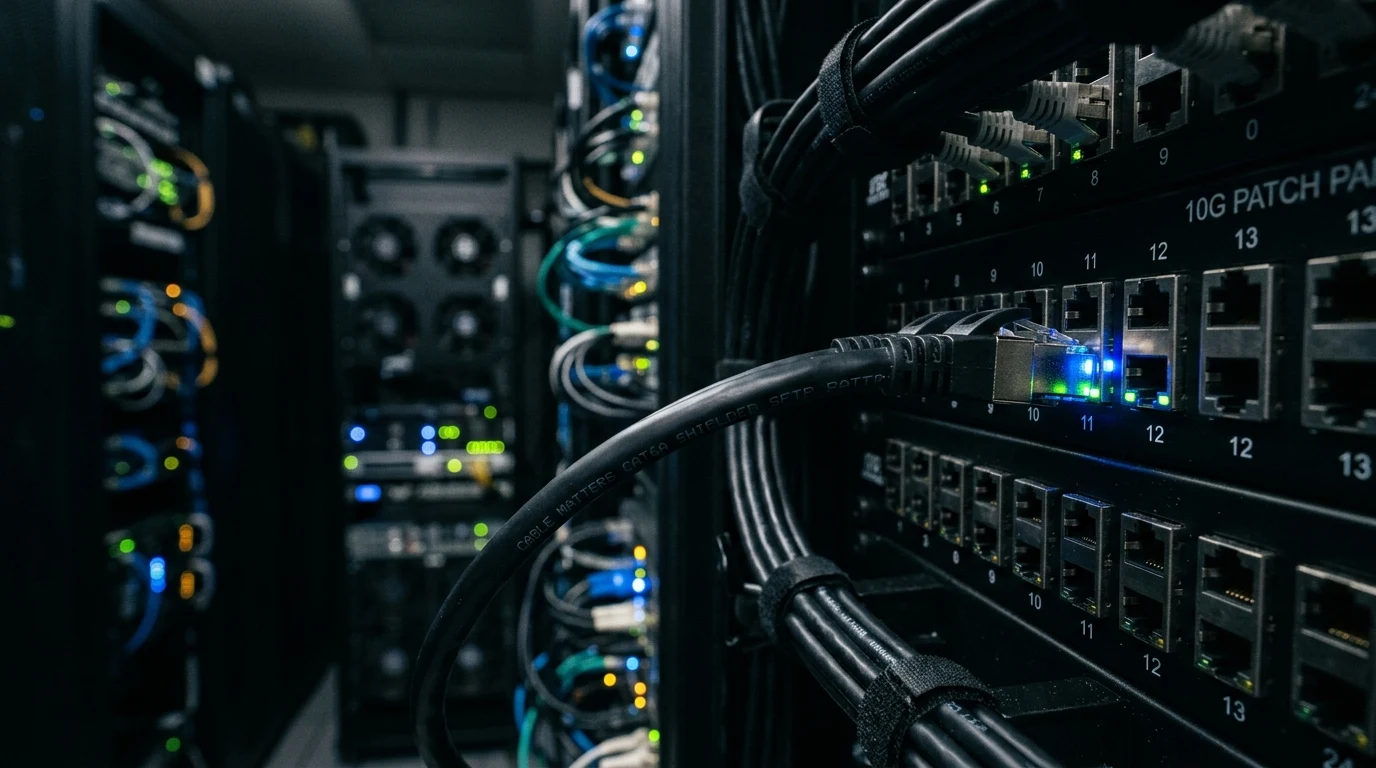
Shielded Cat6a cable exists to solve a specific problem: electromagnetic interference in environments with dense cable runs, nearby electrical equipment, or long distances at 10Gbps speeds. For most home setups that problem doesn't really exist, which makes it worth understanding exactly what you're paying the premium for.
Shielding Architecture: S/FTP Construction Breakdown
To operate reliably at 500 MHz frequencies across 100-meter distances, Cat6a requires rigorous physical isolation. The Cable Matters Cat6a features dual-layer S/FTP construction:
- Individual Foil Shielding (FTP): Each of the 4 twisted pairs is wrapped in individual aluminum foil shielding, virtually eliminating internal Near-End Crosstalk (NEXT).
- Overall Braided Screen (S): A dense tinned copper braid wraps around the outer jacket perimeter, providing complete immunity against Alien Crosstalk (ANEXT) from bundled cables and nearby power conduits.
- 26 AWG Stranded Pure Copper: 100% oxygen-free bare copper conductors supporting 10GBASE-T and Power-over-Ethernet (PoE+ / 802.3at up to 30W).
- Metal-Shielded RJ45 Connectors: Heavy gold-plated pins enclosed in a nickel-plated brass shell for continuous 360-degree ground continuity.
- Snagless Boot Design: Protects the retention clip during dense rack patching.
Cat6a vs Cat8: Why Cat6a is the Sensible Choice for Homes
Online marketplaces are flooded with heavily marketed "Cat8" cables promising 40 Gbps speeds. However, for residential and homelab applications, Cat6a remains the superior standard:
- Distance Limitations of Cat8: Cat8 is officially certified only up to 30 meters (98 ft) for data center Top-of-Rack server links. Cat6a supports full 10 Gbps speeds up to 100 meters (328 ft).
- Extreme Stiffness: Cat8 uses thick 22–24 AWG solid conductors and heavy shielding that make routing around corners and desks extremely difficult.
- Marketplace Counterfeits: Over 80% of cheap "Cat8" cables tested in independent labs fail basic frequency certification, whereas certified Cat6a from Cable Matters guarantees genuine 500 MHz bandwidth.
Power-over-Ethernet (PoE) Thermal Performance
When bundling multiple network cables powering Wi-Fi 7 access points or PTZ security cameras using PoE+ (802.3at) or PoE++ (802.3bt), electrical resistance causes heat build-up inside the cable core. The 26 AWG pure copper conductors and metal shielding of Cable Matters Cat6a provide superior thermal dissipation, preventing cable degradation and signal dropouts in dense 24-port patch panel bundles.
Affiliate Disclosure and Where to Buy
Transparency note: DCSpeedTest participates in the Amazon Services LLC Associates Program. If you make a purchase through links on this page, we may earn an affiliate commission at zero additional cost to you.
The Definitive 10G Ethernet Patch Cable
Available in lengths from 3ft to 100ft with individual pair shielding, Cable Matters Cat6a S/FTP is the definitive choice for 10GbE homelabs, NAS storage, and high-interference setups.
Grounding Shielded Ethernet: Drain Wires & Shielded Patch Panels
To realize the full noise-rejection benefits of S/FTP (Screened/Foil Twisted Pair) cabling in enterprise and homelab environments, understanding grounding continuity is essential:
- Internal Tinned Copper Drain Wire: Inside the Cable Matters Cat6a jacket, an internal drain wire maintains continuous physical contact with the outer braided shield and the metal RJ45 connector shells at both ends.
- Grounded Switch Ports: When plugged into shielded (metal-collared) ports on managed switches, patch panels, or 10GbE network cards, external electromagnetic noise absorbed by the shield is safely dissipated to building earth ground.
- Floating Shield Compatibility: If plugged into standard plastic unshielded ports (such as a consumer modem or laptop), the dual foil shielding still functions as a Faraday cage, blocking high-frequency RF ingress.
10GBASE-T Power Dissipation and Homelab Cable Management
10GBASE-T transceivers consume roughly 2.5W to 4.0W per port, generating significantly more heat than legacy 1GbE ports. In a dense 24-port switch rack, cable bundles can trap heat if poor quality wire is used. Cable Matters Cat6a utilizes 26 AWG pure copper conductors with high-temperature CM-rated PVC sheathing rated up to 75°C (167°F), ensuring zero signal degradation even in hot server rack environments.
Detailed Cat6 vs Cat6a vs Cat8 Technical Comparison
| Specification Metric | Cat6 (UTP) | Cable Matters Cat6a (S/FTP) | Cat8 (S/FTP) |
|---|---|---|---|
| Maximum Frequency Bandwidth | 250 MHz | 500 MHz | 2000 MHz |
| Maximum 10 Gbps Distance | 37 – 55 meters (120–180 ft) | 100 meters (328 ft) | 30 meters (98 ft) |
| Shielding Architecture | Unshielded (UTP) | Individual Foil + Braid (S/FTP) | Individual Foil + Braid (S/FTP) |
| Flexibility & Routing | Very High | High (26 AWG Stranded) | Very Low (Thick & Stiff) |
| Ideal Residential Application | 1G / 2.5G Home Networks | 10G Homelabs, NAS, High-EMI | Short Datacenter Racks |
Final Verdict
Verdict: If you are building a 10GbE network, connecting a multi-gigabit NAS, or running network lines near electrical wiring, the Cable Matters Cat6a S/FTP is the highest quality, most dependable patch cable available.
Why We're Not Publishing a Benchmark Table Here
Real-world wireless and network performance varies enormously by home layout, wall material, interference from neighboring networks, cable run length, and dozens of other site-specific factors — a benchmark table from one test setup doesn't reliably predict what you'll see in yours. Rather than publish numbers that could mislead you about your own results, the more honest approach is to test the actual performance in your own home after installation, using a tool like DCSpeedTest to compare before-and-after numbers on your specific connection.