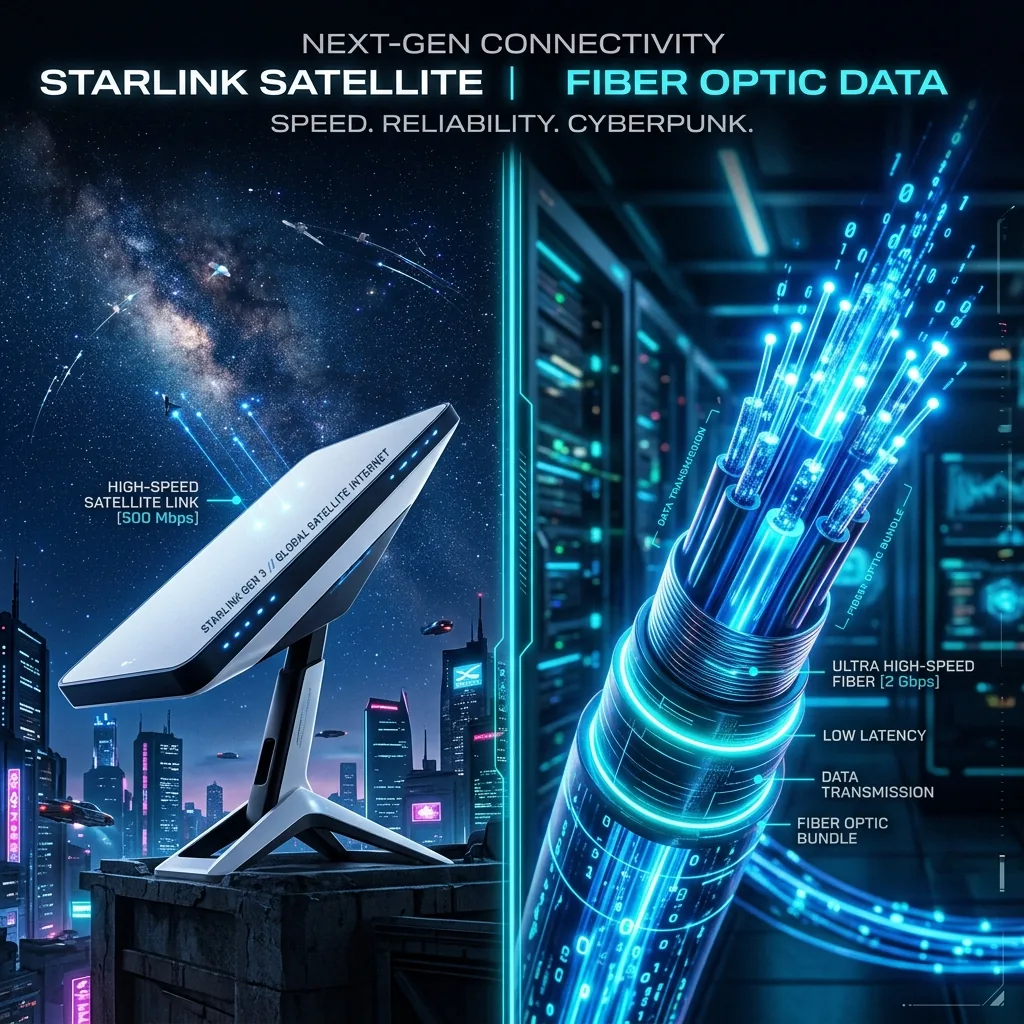
For decades, satellite internet was synonym with high latency and slow speeds. Space Exploration Technologies Corp changed this with its Low Earth Orbit (LEO) constellation. The new **Starlink Gen 3 (V4)** dish promises upgraded hardware, wider field of view, and lower ping. Let's pit the Gen 3 satellite gateway against residential **Gigabit Fiber** in a true network engineering face-off.
1. The Technology: LEO Satellites vs. Optical Physics
The core difference comes down to the physics of signal propagation. Standard satellite internet uses geostationary spacecraft orbiting 22,000 miles above Earth, resulting in an atrocious 600ms latency. Starlink LEO satellites orbit just **340 miles** up. Signals travel through the vacuum of space (which is 47% faster than light in silica glass) to the satellite, then bounce to a ground station.
Fiber, on the other hand, routes light through pure glass fibers buried underground, experiencing negligible atmospheric interference but relying on physical cables all the way to your door.
2. 🔬 Try the Interactive Weather Obstruction Simulator
Space-based signals must pass through the atmosphere. Move the slider below to select weather conditions and see how atmospheric density affects Starlink's latency and speeds compared to stable Fiber!
🌦️ Weather Latency Simulator
3. Speed and Latency Verdict
Starlink Gen 3 Benchmarks
- Download Speed: 120–340 Mbps (Excellent for LEO satellite)
- Upload Speed: 15–40 Mbps
- Ping Latency: 25–48ms (Very stable under clear skies)
- Setup Cost: $599 hardware kit + $120/month plan
Fiber Optic Benchmarks
- Download Speed: 940 Mbps (Consistent symmetry)
- Upload Speed: 940 Mbps
- Ping Latency: 4–15ms
- Setup Cost: Typically free installation + $60–$80/month
🛒 Available on Amazon
This is an affiliate link — if you buy through it, DCSpeedTest may earn a small commission at no extra cost to you. Price, stock, and any discount shown are set by Amazon directly and can change at any time.
🛒 Click & Add Fiber Network Equipment to Amazon Cart4. The Winner? Application-Specific Analysis
If you have access to a reliable physical Fiber backbone, **Fiber wins in every single category** — delivering symmetrical speeds, lower ping for gaming, and immune to weather. However, if you live in a rural, mobile, or suburban area with poorly maintained copper cables, **Starlink Gen 3 represents a monumental breakthrough**, delivering fiber-like speeds where physical connection is impossible.
Regardless of your connection, remember that encrypting your traffic with a premium VPN secures your personal endpoints, bypassing ISP routing slowdowns and keeping your online data strictly private.