The End of "ms" as We Know It
Current internet technology relies on fiber optics sending light pulses. It's fast (speed of light in glass is ~200,000 km/s), but it's not instant. Quantum Internet aims to change the physics of communication entirely.
Quantum Entanglement: Spooky Action at a Distance
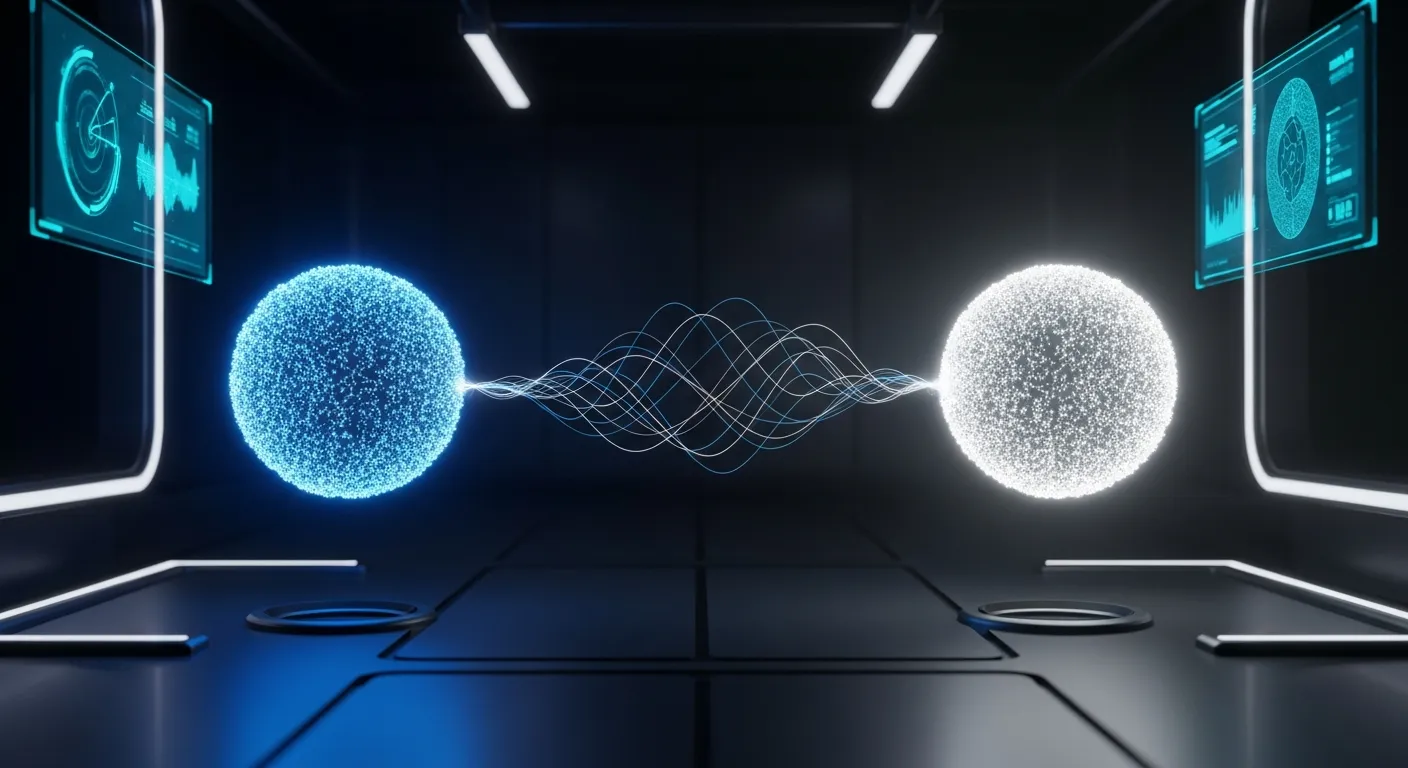
Einstein called it "spooky," but in 2026, it's engineering. By entangling two qubits, a change in state of one instantly affects the other, regardless of distance. Theoretically, this allows for zero-latency communication.
Real-World Progress
Researchers at CERN and Fermilab have successfully teleported quantum states over metro-area distances. While we are decades away from a "consumer quantum modem," the backbone of the internet is already shifting toward Quantum Key Distribution (QKD) for unhackable security.
For gamers, this is the holy grail. Imagine playing on a server in Tokyo from New York with 0ms ping. It defies our current understanding of networking, but it is the inevitable future.
What Quantum Internet Can Actually Do That Classical Can't
The key capability of quantum networking isn't speed — it's unbreakable security through quantum key distribution (QKD). Classical encryption relies on mathematical problems that are hard but theoretically solvable with enough computing power (especially future quantum computers). QKD uses individual photons whose quantum state collapses the moment they're observed, making eavesdropping physically detectable. Any interception of a quantum-encrypted communication changes the photon state, alerting both parties to the breach. This is the core promise: not faster internet, but fundamentally tamper-evident communication that classical physics cannot replicate.
The practical quantum internet emerging over the next decade looks like a specialized security layer overlaid on classical infrastructure, not a replacement for it. Think: quantum-secured channels for banking, government, and medical data transmission, running alongside (not replacing) your regular broadband connection.
Frequently Asked Questions
Will quantum internet replace regular internet?
No, not in any timeframe relevant to planning today. Quantum networks address a specific security problem; they don't improve throughput, latency, or cost for everyday applications. The "quantum internet" being developed is better understood as a quantum cryptography layer for high-security communications, running alongside classical infrastructure rather than replacing it. Your streaming, gaming, and browsing will continue to use classical networks for the foreseeable future.
How far away is practical quantum internet?
Quantum key distribution over fiber links under 100km is commercially available today — banks and governments are already using it. Long-distance quantum networking (transcontinental or global) requires quantum repeaters, which remain a research challenge. Most experts estimate practical global quantum networking infrastructure is 10-20 years away from widespread deployment, with limited metropolitan-scale networks appearing in major financial and government centers within 5 years.
Why Quantum Repeaters Are the Hard Engineering Problem
Quantum states can't be amplified and re-transmitted the way classical signals are, since observing (measuring) a quantum state collapses it — quantum repeaters must extend entanglement without ever directly measuring the photon in transit, a fundamentally different and much harder engineering challenge than classical signal boosting.
Who's Actually Funding Quantum Network Research
National labs, major research universities, and government agencies (DOE in the US, similar bodies in the EU and China) currently drive most quantum networking research, with early commercial applications concentrated in finance and government communications rather than consumer infrastructure.
Quantum Computing vs Quantum Internet: A Common Confusion
Quantum computing (building processors that use qubits for computation) and quantum internet (using quantum properties for communication/security) are related but distinct fields — a breakthrough in one doesn't automatically mean progress in the other, despite frequently being conflated in general media coverage.