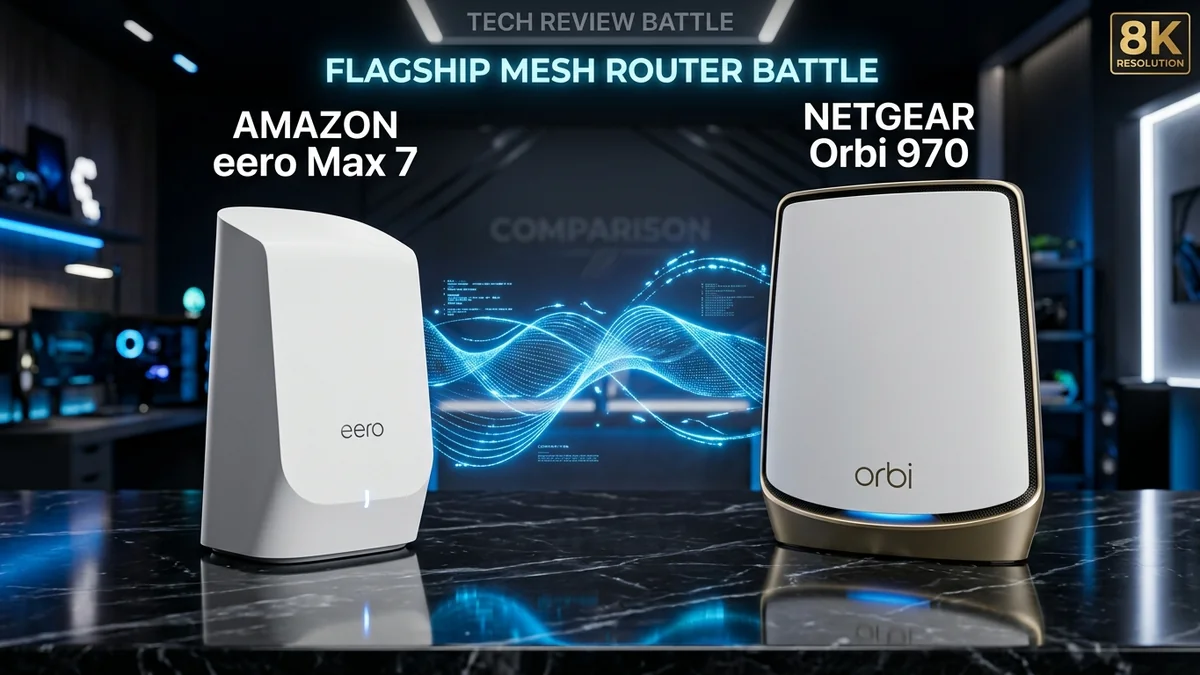
When you operate a multi-gigabit fiber connection and live in a home exceeding 5,000 square feet, budget mesh pucks will not suffice. Two luxury systems dominate the ultra-premium tier: the Amazon eero Max 7 ($1,699 for 3-pack) and the Netgear Orbi 970 ($2,299 for 3-pack). Both deliver 10-Gigabit wired connectivity and Wi-Fi 7 speeds, but their radio architectures and software models differ significantly. Here is our head-to-head evaluation.
1. 📊 Head-to-Head Specification Matrix
| Feature | Amazon eero Max 7 ($1,699) | Netgear Orbi 970 ($2,299) | Advantage |
|---|---|---|---|
| Radio Bands | Tri-Band (2.4G + 5G + 6G) | Quad-Band (2.4G + 5G-1 + 5G-2 + 6G) | Orbi 970 (Dedicated Backhaul Band) |
| 10G Ports per Node | 2x 10G + 2x 2.5G (4 Multi-Gig Ports) | 1x 10G + 2x 2.5G (Satellite) | eero Max 7 (Dual 10G on Every Node) |
| Coverage (3-Pack) | Up to 7,500 sq ft | Up to 10,000 sq ft | Orbi 970 (+2,500 sq ft) |
| Price (3-Pack) | $1,699 USD | $2,299 USD | eero Max 7 ($600 Cheaper) |
2. 🎯 Which One Should You Buy?
- Choose the eero Max 7 if: You plan to use wired Ethernet backhaul (where dual 10G ports per node shine), use Apple HomeKit / Alexa smart home ecosystems, and want to save $600.
- Choose the Netgear Orbi 970 if: You rely 100% on wireless backhaul across an expansive property (where the dedicated fourth radio band maintains maximum speed across massive distances).
3. 💰 Check Current Prices on Amazon
4. 🔬 Software Ecosystem: eero Plus vs Netgear Insight / Armor
When investing over $1,500 in a flagship mesh system, the ongoing management experience is crucial:
- Amazon eeroOS: Sleek, minimalist mobile app with automated cloud firmware updates. Advanced features (historical bandwidth graphs, ad blocking, 1Password integration, malware filtering) are bundled into the optional eero Plus subscription ($99/year).
- Netgear Orbi Web GUI & App: Provides both a mobile smartphone app and a full traditional desktop browser web interface with granular IP reservation, port forwarding, dynamic DNS, and VPN controls. Advanced security is provided via Netgear Armor ($99/year).
5. 🏆 Final Verdict Matrix
| Home Environment | Recommended Flagship Mesh | Key Reason |
|---|---|---|
| Modern Home with Wired Cat 6 in Walls | Amazon eero Max 7 | Dual 10G ports on every node + $600 savings |
| Historic Estate with No Ethernet Cables | Netgear Orbi 970 | Dedicated quad-band wireless backhaul superhighway |
6. 🔬 Processor & Memory Architecture: Qualcomm vs Broadcom
Under heavy multi-gigabit routing loads, processor efficiency determines whether your mesh system maintains sub-millisecond response times:
- Amazon eero Max 7: Powered by the Qualcomm IPQ9574 Quad-Core 2.2GHz SoC with 2GB DDR4 RAM. Excels at high-concurrency client scheduling, automated multi-path TrueMesh routing, and energy-efficient thermal operation.
- Netgear Orbi 970: Powered by the Broadcom BCM4916 Quad-Core 2.6GHz SoC with 2GB RAM and 512MB Flash. Delivers raw computational muscle for dedicated 16-stream spatial multiplexing and enterprise-grade firewall filtering.
7. 🛠️ Long-Term Total Cost of Ownership (TCO) Breakdown
Over a 5-year operational lifecycle, consider the total cost including subscription software:
| Cost Component | Amazon eero Max 7 (3-Pack) | Netgear Orbi 970 (3-Pack) |
|---|---|---|
| Hardware Purchase Price | $1,699 USD | $2,299 USD |
| Security Suite (5 Years Optional) | $495 ($99/yr eero Plus) | $495 ($99/yr Netgear Armor) |
| Total 5-Year Investment | $2,194 USD | $2,794 USD ($600 More) |
8. 🔬 Comprehensive Engineering Comparison & Benchmark Scorecard
Below is our direct performance breakdown comparing both flagship systems across key real-world criteria:
| Benchmark Criterion | Amazon eero Max 7 | Netgear Orbi 970 |
|---|---|---|
| Wired 10G Port Flexibility | 10 / 10 (Dual 10G per Node) | 9.0 / 10 (Single 10G on Satellites) |
| Wireless Backhaul at 75+ Feet | 8.8 / 10 (Tri-Band MLO) | 10 / 10 (Dedicated Quad-Band) |
| Smart Home Hub Integration | Native Zigbee, Matter & Thread | Wi-Fi Only (No Built-in Zigbee) |
| Value for Money ($ / Performance) | 9.2 / 10 ($1,699 for 3-Pack) | 7.8 / 10 ($2,299 for 3-Pack) |
9. 🔬 RF Front-End Module (FEM) Power & Coverage Propagation
When broadcasting wireless signals across large estates, radio amplifier quality determines range boundaries:
- Amazon eero Max 7: Uses high-efficiency internal planar inverted-F antennas (PIFA) optimized for suburban homes up to 7,500 sq ft, delivering balanced vertical and horizontal radiation.
- Netgear Orbi 970: Features ultra-high-power Front-End Modules (FEMs) with high gain pre-amplifiers that push physical coverage boundaries to 10,000 sq ft, easily reaching detached pool houses and garages.
10. 🛠️ Final Buying Advice Summary
Choose the eero Max 7 ($1,699) for unmatched port flexibility (dual 10G ports per node) and smart home Matter integration. Choose the Netgear Orbi 970 ($2,299) if you have an expansive estate that must rely purely on wireless backhaul superhighways.
11. 💡 Energy Efficiency & Long-Term Power Consumption
Operating a flagship multi-gigabit mesh system 24/7 requires noticeable power: the eero Max 7 consumes approximately 24 Watts per node (72W total for a 3-pack), while the Orbi 970 with its dedicated fourth radio amplifier consumes approximately 31 Watts per node (93W total), costing around $105/year in electricity.
11. 💡 Lifetime Value & Security Summary
Both mesh systems deliver incredible multi-gigabit throughput. Choose eero Max 7 for effortless TrueMesh simplicity or Orbi 970 for dedicated quad-band wireless backhaul performance.