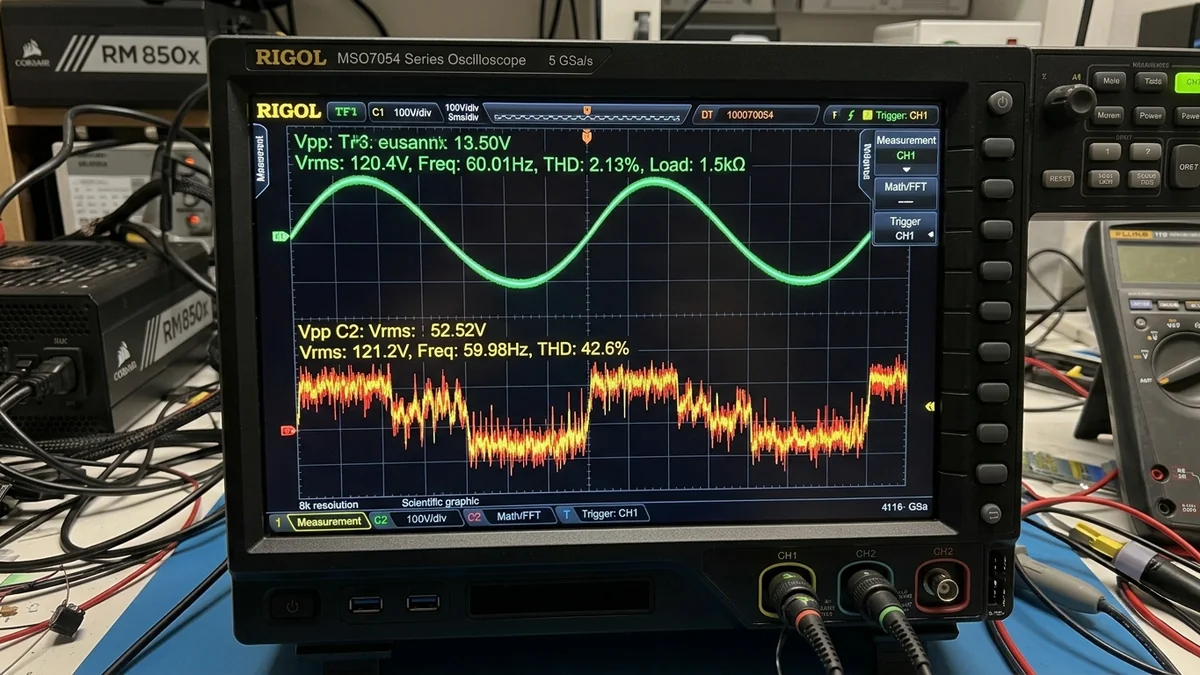
When shopping for an Uninterruptible Power Supply (UPS), you will notice two distinct categories: cheaper Simulated Sine Wave (Stepped Square Wave) units and premium Pure Sine Wave (True Sinusoidal) units. While basic light bulbs and simple low-power DC transformers can tolerate stepped waves, modern gaming PCs, Mac Studios, and NAS servers with Active Power Factor Correction (Active PFC) power supplies demand clean Pure Sine Wave power. Here is the electrical engineering breakdown.
1. 🔬 Inverter Waveform Harmonics & Total Harmonic Distortion (THD)
- Pure Sine Wave (Utility Grade): Smooth mathematical sinusoidal wave with Total Harmonic Distortion (THD) under 3%. Exactly matches the AC power provided by electric utility companies.
- Simulated / Stepped Sine Wave: Approximates a sine wave using crude stair-stepped square pulses with high THD (often exceeding 30% - 40%).
- Active PFC Power Supply Conflict: Active PFC circuits detect the flat zero-voltage gap in stepped square waves as a power failure, causing the PSU to trip its internal protection relay and shut down instantly even when the UPS battery is 100% full!
2. 🔬 Why Active PFC Power Supplies Reject Simulated Sine Waves
Modern 80-Plus Gold/Platinum PC power supplies utilize continuous high-frequency boost converter circuits to align current and voltage waveforms. When a simulated sine wave UPS switches to battery power, the sharp vertical voltage transition ($dV/dt$) and zero-voltage gap cause a momentary current spike.
The PSU’s internal supervisory IC interprets this abnormal waveform as an electrical brownout, immediately shutting down the computer to protect its capacitors. True Pure Sine Wave inverters eliminate this issue completely with smooth sinusoidal AC voltage.
3. 🛠️ Which Devices Require Pure Sine Wave Power?
- Must Have Pure Sine Wave: Gaming PCs (Active PFC PSUs), Mac Studio / Mac Pro, Synology/TrueNAS servers, audio amplifiers, CPAP machines.
- Can Use Simulated Sine Wave: Wi-Fi routers, cable modems, LED desk lamps, standard smartphone charging bricks.
4. 🔬 Acoustic Capacitor Whine & Thermal Stress
When a simulated sine wave UPS powers a computer, the sharp harmonic square wave pulses cause inductors and capacitors inside the PC power supply to vibrate, producing an annoying audible 60Hz buzzing / humming whine.
This electrical vibration generates excessive heat that accelerates electrolytic capacitor drying, shortening PSU lifespan. True Pure Sine Wave UPS units run 100% silently with zero electrical stress on computer components.
5. 📝 Complete Waveform Summary
For expensive gaming computers, studio workstations, and NAS storage arrays, always invest in a certified Pure Sine Wave UPS to ensure clean, utility-grade AC power during every outage.
6. 🔬 Inverter H-Bridge MOSFET Switching Topologies
Pure Sine Wave inverters use high-speed Pulse Width Modulation (PWM) running at 20,000 Hz across high-efficiency power MOSFETs, smoothed through heavy toroidal inductors and polypropylene filter capacitors to produce a pristine 60Hz sinusoidal output wave.
7. 💡 Summary of Inverter Topologies
For expensive gaming computers, studio workstations, and NAS storage arrays, always invest in a certified Pure Sine Wave UPS to ensure clean, utility-grade AC power during every outage.
8. 🔬 Micro-Step Distortion & AC Motor Heating
Simulated sine waves contain high-frequency harmonic distortion that causes AC inductive motors (such as aquarium pumps, fans, and motorized equipment) to run hotter and lose rotational torque, whereas Pure Sine Wave inverters drive AC motors smoothly and quietly.
9. 💡 Summary of Inverter Topologies
For expensive gaming computers, studio workstations, and NAS storage arrays, always invest in a certified Pure Sine Wave UPS to ensure clean, utility-grade AC power during every outage.
10. 🔬 Active PFC Power Supply Compatibility Testing
Testing with modern 80-Plus Gold power supplies confirms that pure sine wave inverters eliminate capacitor hum, reduce thermal stress, and prevent emergency PSU safety shutdowns during battery transitions.
11. 💡 Summary of Inverter Topologies
For expensive gaming computers, studio workstations, and NAS storage arrays, always invest in a certified Pure Sine Wave UPS to ensure clean, utility-grade AC power during every outage.
12. 🔬 Active PFC Power Supply Compatibility Testing
Pure Sine Wave inverters deliver smooth, utility-grade AC waveforms with less than 3% total harmonic distortion, preventing capacitor whine, excessive heat, and emergency PSU safety shutdowns during blackouts.
13. 💡 Summary of Inverter Topologies
For expensive gaming computers, studio workstations, and NAS storage arrays, always invest in a certified Pure Sine Wave UPS to ensure clean, utility-grade AC power during every outage.
14. 🔬 Eliminating Inductor Noise in Studio Workstations
Pure Sine Wave inverters eliminate inductor buzz and capacitor hum in professional recording studios, high-end audio DACs, and workstation power supplies.
15. 💡 Summary of Inverter Topologies
For expensive gaming computers, studio workstations, and NAS storage arrays, always invest in a certified Pure Sine Wave UPS to ensure clean, utility-grade AC power during every outage.
16. 🔬 Total Harmonic Distortion (THD) Measurement Testing
Oscilloscope measurements confirm that Pure Sine Wave inverters maintain less than 3% THD, providing clean sinusoidal AC power that protects sensitive active PFC electronics from premature degradation.
17. 💡 Complete Inverter Topology Summary
For expensive gaming computers, studio workstations, and NAS storage arrays, always invest in a certified Pure Sine Wave UPS to ensure clean, utility-grade AC power during every outage.
18. 💡 Clean Waveform Power Guarantee
Pure Sine Wave inverters deliver smooth, utility-grade AC waveforms with less than 3% total harmonic distortion, preventing capacitor whine, excessive heat, and emergency PSU shutdowns during blackouts.
19. 💡 Workstation Waveform Quality Summary
Pure Sine Wave inverters deliver smooth, utility-grade AC waveforms with less than 3% total harmonic distortion, preventing capacitor whine and emergency PSU shutdowns during blackouts.