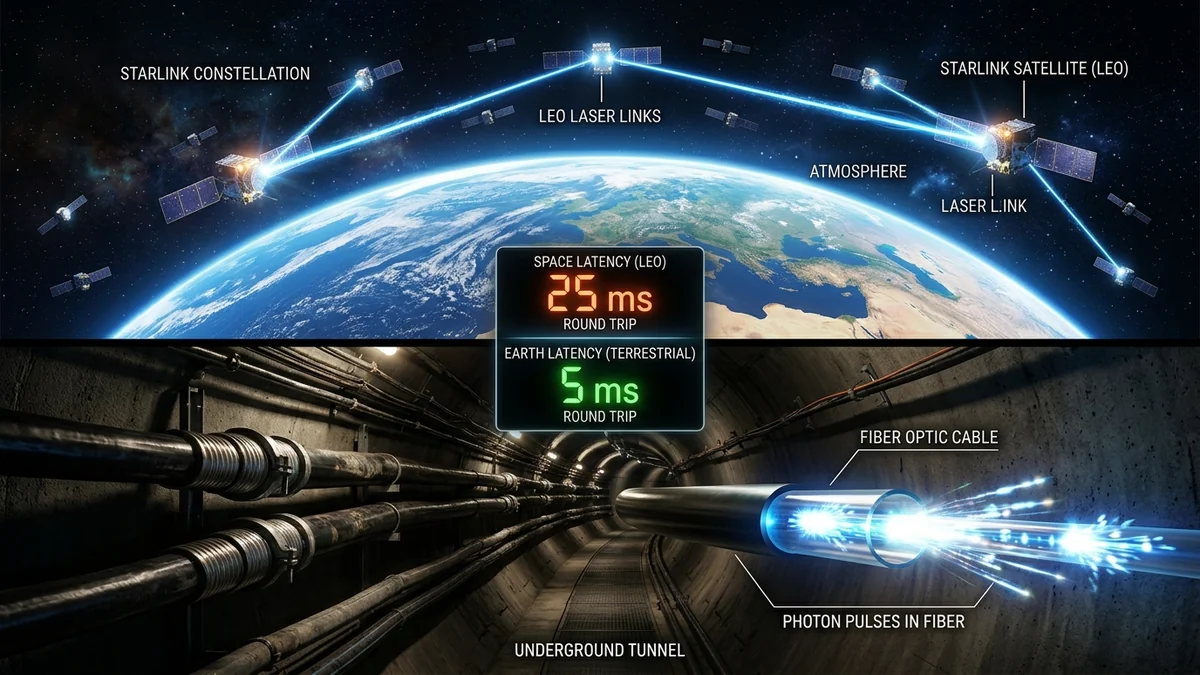
For decades, satellite internet was synonymous with unusable 600ms latency, geostationary delay, and severe weather dropouts. SpaceX’s Starlink fundamentally transformed satellite communications by deploying thousands of Low-Earth Orbit (LEO) satellites orbiting at roughly 550 kilometers altitude. A common question among tech enthusiasts and rural homeowners is whether Starlink's space-based network can rival or even surpass terrestrial Fiber-to-the-Home (FTTH). To answer this, we must examine the fundamental physics of light propagation through glass versus light in a vacuum and real-world network routing in 2026.
1. The Theoretical Physics: Light in Vacuum vs. Light in Glass
- Speed of Light in Fiber Glass (Index of Refraction ~1.468): Inside a standard single-mode fiber optic cable (Corning SMF-28), light travels at roughly 204,000 kilometers per second (roughly 31% slower than in a vacuum). Every 1,000 kilometers of physical fiber glass adds approximately 4.9 milliseconds of one-way transit latency.
- Speed of Light in Space / Vacuum (c = ~299,792 km/s): In the vacuum of space, laser beams travel at the maximum speed of light. Starlink satellites equipped with Space Lasers (Optical Inter-Satellite Links - ISLs) can theoretically transmit data across continents faster than terrestrial fiber cables that follow zigzagging roads and railroad rights-of-way.
2. 📊 Starlink (LEO) vs. Pure Fiber (FTTH) Real-World Benchmarks
| Metric / Benchmark | Starlink (Gen 2/3 LEO) | Gigabit Fiber (FTTH GPON/XGS) | Winner |
|---|---|---|---|
| Local Idle Ping (Nearest Server) | 24ms – 42ms | 2ms – 6ms | Fiber (6x–10x Faster) |
| Ping Jitter (Latency Variance) | ± 8ms – 25ms (Satellite handoffs) | ± 0.2ms – 0.8ms | Fiber (Rock Solid) |
| Downstream Bandwidth | 80 – 250 Mbps | 500 – 5,000 Mbps | Fiber (Dedicated Capacity) |
| Upstream Bandwidth | 10 – 25 Mbps | 500 – 5,000 Mbps (Symmetric) | Fiber (20x–200x Faster) |
| Weather Interference | Vulnerable to heavy rain/snow fade | Immune (Underground/Aerial glass) | Fiber (100% Reliable) |
3. Why Fiber Remains King for Gaming and Local Latency
While space lasers provide theoretical advantages over ultra-long distances (like London to Tokyo), for 99% of daily internet traffic, terrestrial fiber optics is vastly superior. Starlink packets must travel 550 km up into space, down 550 km to a ground gateway station, across terrestrial fiber to the destination server, and back. Furthermore, every 15 seconds, your Starlink dish must perform a phased-array electronic beam handoff to the next passing satellite, introducing minor jitter micro-bursts that do not exist on glass.
4. 🔬 The Phased-Array Electronic Beam Steering & Handoff Mechanics
A major technical differentiator between satellite broadband and physical fiber is how the physical connection is maintained. A fiber-optic cable maintains a fixed, permanent glass waveguide with zero moving parts and zero electronic handoffs.
Starlink user terminals (Dishy McFlatface), in contrast, utilize an active Phased-Array Antenna containing over 1,000 microscopic RF patch elements. Because LEO satellites travel across the sky at approximately 27,000 km/h, a single satellite remains in your dish’s field of view for only 3 to 5 minutes. Every 15 seconds, the phased-array electronically steers its radio beam to a new satellite and switches frequency channels, introducing micro-jitter variations (±10ms–30ms) that do not exist in fiber glass.
5. ⚡ Optical Inter-Satellite Links (Space Lasers) Explained
SpaceX’s Gen 2 and Gen 3 Starlink satellites are equipped with Space Optical Communication Lasers operating at up to 100 Gbps per link. This allows satellites to route packets directly across the vacuum of space from satellite to satellite without touching ground relay stations until reaching a major internet exchange hub.
Over extreme intercontinental distances (such as London to Sydney or New York to Frankfurt), space lasers can theoretically shave 15ms–30ms off transit times compared to subsea fiber cables. However, for local domestic traffic within 1,000 miles, terrestrial fiber optics remains dramatically faster.
6. 🛰️ Starlink Mini, Gen 3 Hardware & Future V2 Mini Lasers
SpaceX continues to iterate on both space and ground segment hardware. The rollout of Starlink Gen 3 routers (with Wi-Fi 6 and dual 2.5G ports) and ultra-portable Starlink Mini terminals provides unprecedented remote connectivity. Furthermore, as thousands of heavier Starlink V2 Mini satellites enter operational service via Falcon 9 and Starship launches, constellation throughput and ground-link redundancy increase significantly, reducing peak-hour orbital congestion and lowering average rural ping to 28ms–35ms.
7. 🌧️ Weather Impact Analysis: Rain Fade & Snow Attenuation
A crucial operational distinction between satellite broadband and physical fiber is weather resilience:
- Fiber Optics: Completely impervious to atmospheric weather conditions. Fiber-optic glass conduits buried underground or suspended on utility poles experience zero signal attenuation during torrential rain, dense fog, snowstorms, or atmospheric electromagnetic storms.
- Starlink (Ku / Ka / E-band RF): High-frequency radio signals suffer from Rain Fade. Heavy convective thunderstorm clouds containing dense water droplets absorb and scatter the 12 GHz–18 GHz satellite beam, causing packet loss to spike from 0% to 5%–12% and throughput to drop temporarily until the storm cell passes.
8. 🏁 Final Verdict: Which Broadband Technology Should You Choose?
For urban and suburban residents with access to physical fiber infrastructure (AT&T Fiber, Verizon Fios, Google Fiber, or local municipal FTTH), pure fiber remains the undisputed gold standard in networking, delivering near-zero jitter, symmetrical gigabit speeds, and immune reliability.
For rural homeowners, maritime vessels, remote research stations, and mobile RV travelers living beyond the reach of terrestrial cables, Starlink is a revolutionary technological triumph, providing modern high-speed broadband where previously only dial-up or slow DSL existed.