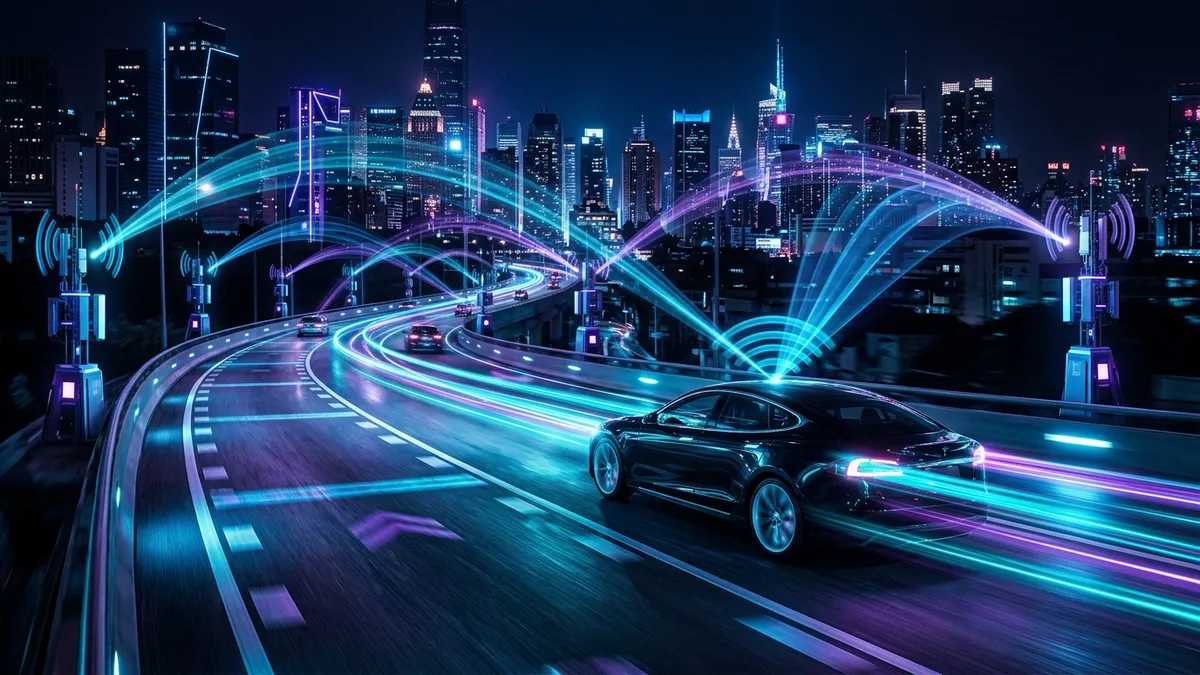
You are streaming high-definition audio on Spotify, listening to a live podcast, or navigating via Google Maps on the highway, and suddenly your audio buffers, the navigation map turns grey with "Searching for GPS/Network", or your video call completely drops. When you look at your smartphone, you might still have 2 or 3 bars of 5G, yet data transmission grinds to a complete halt. Why does mobile data constantly drop in a moving car, and what is the underlying telecommunications physics behind it?
1. The Core Culprit: Cellular Base Station Handovers (Hand-offs)
When you are stationary at home or in an office, your smartphone maintains an uninterrupted radio link with a single cellular base station (eNodeB for 4G LTE or gNodeB for 5G). However, when driving at highway speeds (65 to 80 mph / 100 to 130 km/h), your device crosses cellular coverage boundaries every 30 to 90 seconds.
| Handover Phase | Protocol Message | Typical Duration | Impact on Active Data |
|---|---|---|---|
| 1. Measurement & Reporting | RRC MeasurementReport (Event A3) | 50 – 150 ms | Phone detects target tower is stronger |
| 2. Resource Reservation | X2 / Xn Handover Request | 80 – 200 ms | Target tower allocates frequency channels |
| 3. Radio Execution & Re-sync | RRCConnectionReconfiguration | 100 – 450 ms | Temporary packet freeze / jitter spike |
| 4. Failed Handover (Call Drop) | Radio Link Failure (RLF) | 2,000 – 6,000 ms | Complete connection drop; full re-attach |
During the execution phase of a handover, your phone must terminate its radio connection with the source tower and re-synchronize time and frequency slots with the target tower. If the target tower is already saturated with traffic, or if roadside obstacles (hills, overpasses, concrete sound barriers) create a sudden shadow zone, the handover fails, triggering a Radio Link Failure (RLF) where all active TCP data streams freeze for several seconds.
2. 🚗 The Vehicle Faraday Cage & Ceramic Window Tinting
Modern automobiles are constructed with high-strength steel chassis, aluminum side panels, and specialized glass. This metal-enclosed cabin creates a partial Faraday Cage, which attenuates incoming high-frequency radio waves by 10 to 18 dB.
Furthermore, many vehicles feature aftermarket or factory **metallized solar control window tinting**. These films contain microscopic metallic oxide particles that reflect infrared heat—but also act as a radio frequency shield against 3.5GHz C-Band and mid-band 5G signals. When your phone sits in your pocket or down in the center console, signal strength drops dramatically, forcing your phone into weak low-band frequencies.
3. ⚡ The Doppler Frequency Shift at Highway Speeds
Radio waves obey the fundamental laws of wave physics. When a vehicle moves rapidly toward or away from a stationary cell tower, the carrier wave frequency shifts due to the Doppler Effect:
At 75 mph (120 km/h) on a 3.5 GHz mid-band 5G carrier, the Doppler frequency shift exceeds 380 Hz. While modern digital signal processors (DSPs) in Qualcomm Snapdragon and Apple modems use automatic frequency correction algorithms, rapid changes in vehicle direction around highway curves introduce sudden phase jitter, corrupting OFDM subcarrier spacing and causing packet retransmissions.
4. 📱 Dynamic Spectrum Sharing (DSS) & Carrier Aggregation Resets
On modern 5G networks, smartphones combine 2 to 4 separate frequency bands simultaneously (Carrier Aggregation). As you travel at high speed, the availability of secondary carrier bands constantly fluctuates. Every time your phone adds or drops a secondary carrier band, the cellular modem must re-negotiate transport block sizes, creating brief 200ms pauses in active data transmission.
5. 🛠️ 4 Actionable Ways to Stabilize In-Car Mobile Data
- Mount Your Phone on the Windshield or High Dashboard: Elevating your device above dashboard metal line-of-sight increases signal reception by up to 12 dB compared to keeping it in a cup holder or pocket.
- Lock to 4G LTE on Highway Road Trips: In rural highway corridors where 5G coverage is patchy, forcing your phone to LTE Only eliminates constant "5G to 4G ping-pong" handovers, providing a rock-solid, uninterrupted data stream.
- Use In-Vehicle Wi-Fi Hotspots: Many modern vehicles feature factory external roof-mounted shark-fin antennas connected to an onboard LTE/5G modem. Roof antennas bypass the vehicle cabin's metal shielding completely.
- Pre-download Offline Navigation & Music: Set Spotify and Google Maps to download regional offline maps and playlists to eliminate real-time streaming dependency in rural dead zones.
6. 📡 SIB (System Information Block) Re-acquisition & Multi-Path Fading
When your vehicle travels past large geographic features (concrete sound barriers, highway overpasses, heavy semi-trucks), radio signals bounce off multiple surfaces before reaching your phone. This phenomenon—known as Multi-Path Rayleigh Fading—causes radio waves to arrive out of phase, momentarily cancelling out the signal.
When multi-path cancellation drops the signal below receiver sensitivity thresholds, the cellular modem must re-read the tower's System Information Block 1 (SIB1) and SIB2 broadcasts. Because SIB broadcast cycles repeat every 80 to 160 milliseconds, your phone enters an idle search state, resulting in audio dropouts and navigation freezing until new cell parameters are decoded.
7. 🔋 Cellular Transmitter Power Ramping & Battery Drain
In a moving vehicle experiencing signal fading, your phone's cellular baseband processor ramps its Radio Frequency (RF) power amplifier to maximum output (up to 23 dBm / 200 mW) in an attempt to maintain tower contact. This aggressive power ramping not only causes severe battery drain and phone overheating on road trips, but thermal throttling in the phone's processor can degrade modem throughput further.
⚡ Test Your Mobile Data Speed & Signal Stability
Run an instant, ad-free speed and latency diagnostic to measure your mobile network performance:
🚀 Run Mobile Speed Test →