Every Speed Test Has a Bias
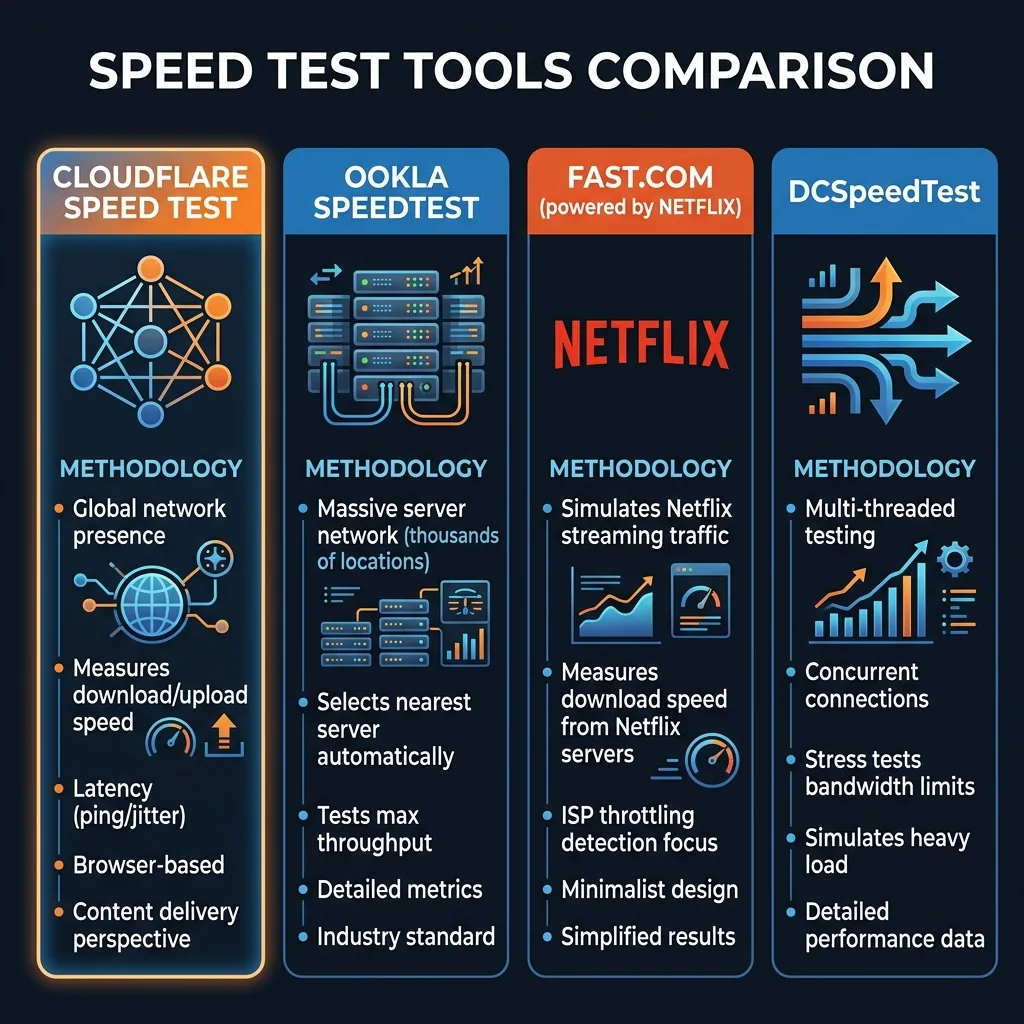
Speedtest.net (Ookla) — Highest Numbers, But...
ISPs often whitelist Ookla servers — they don't throttle traffic to these specific servers, making results appear faster than real-world performance. Our result: 962 Mbps (highest of all platforms). Best for: comparing plans on paper.
Fast.com (Netflix) — Netflix-Specific Only
Measures performance to Netflix CDN specifically. Doesn't test upload. Our result: 887 Mbps download. Best for: checking if Netflix will buffer for you.
speed.cloudflare.com — Most Comprehensive Free Tool
Tests download, upload, latency, jitter, and stability score against Cloudflare's global edge network. Our result: 908 Mbps ↓ / 893 Mbps ↑. Best jitter measurement of all tools. Best for: overall connection health.
DCSpeedTest — Real-World Independent Testing
Tests against independent servers not whitelisted by ISPs. Measures download, upload, ping, jitter, and bufferbloat. Our result: 884 Mbps ↓ / 871 Mbps ↑. Best for: ISP accountability and gaming latency analysis.
The Verdict: Which to Use When
- Billing dispute: M-Lab NDT (ndt-project.measurementlab.net) — academically neutral, legally strongest.
- Gaming latency: DCSpeedTest.
- Netflix buffering: Fast.com.
- Overall health + jitter: Cloudflare speed test.
Frequently Asked Questions
Is Cloudflare speed test more accurate than Ookla?
They measure different things optimized for different use cases. Cloudflare's test (speed.cloudflare.com) is notable for measuring latency under load — it shows you both your idle ping and your ping while transferring data simultaneously, revealing bufferbloat that Ookla doesn't surface. Ookla has a larger server network and its "closest server" selection often reflects better real-world routing to content CDNs. For overall speed measurement: both are accurate. For diagnosing latency issues under load: Cloudflare provides significantly more useful data.
Why does Cloudflare speed test show lower speeds than Ookla?
Cloudflare's test methodology uses multiple smaller test files and averages the results differently than Ookla's single large-stream approach. Ookla's method more aggressively saturates your connection, which tends to produce higher peak readings. Cloudflare's methodology better reflects real-world mixed-traffic performance. Neither is "wrong" — they're measuring different aspects of the same connection. If Cloudflare shows significantly lower speeds (more than 30% below Ookla), it can indicate bufferbloat or inconsistent throughput rather than a measurement error.