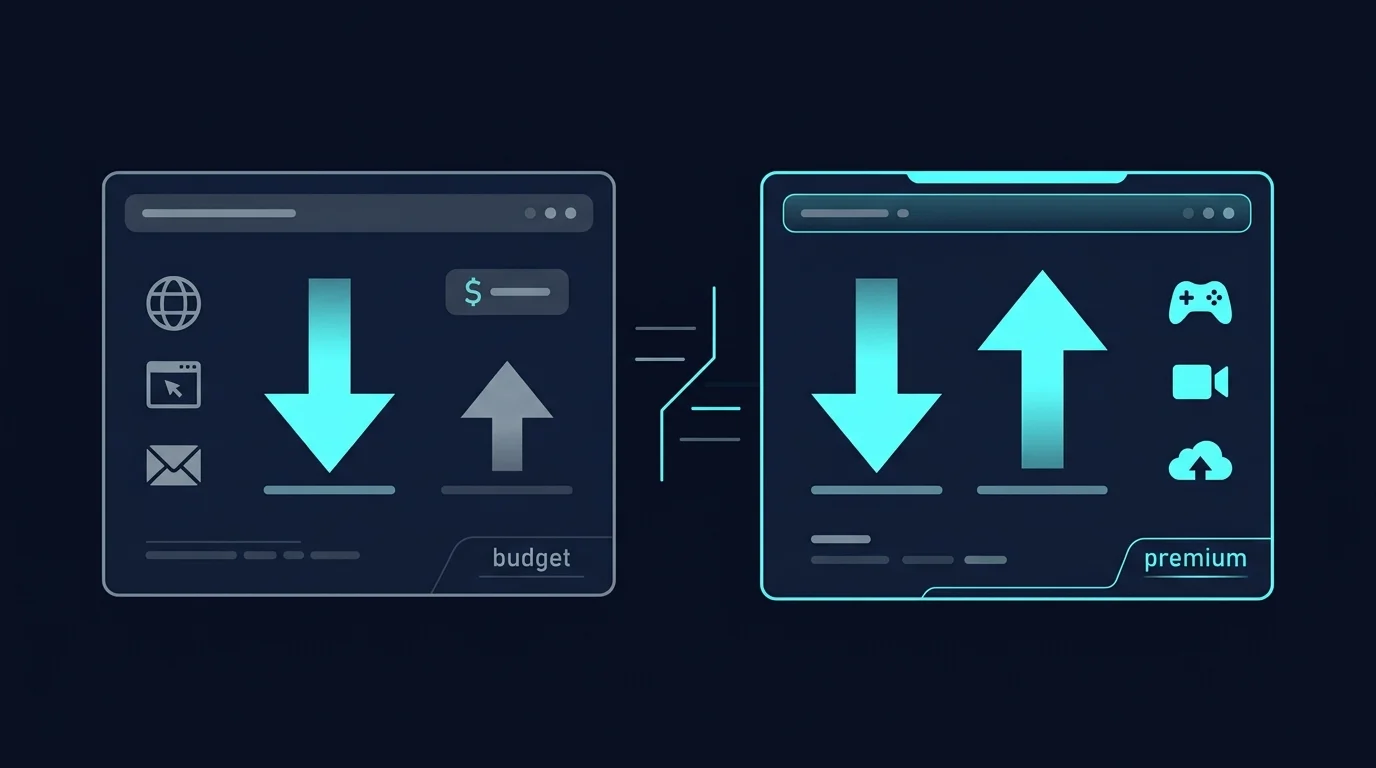
Budget internet plans aren't a trick — the connection you get is genuine and the advertised speed is generally real, at least on paper. But "same internet for less money" is rarely the honest description of what's actually different between a $30 plan and a $70 plan from the same provider on the same infrastructure. Here's what actually changes.
The Speed Tier Itself Is the Most Honest Part
The advertised download/upload numbers on a budget plan are usually the most straightforwardly accurate part of the deal — a 100 Mbps plan generally does deliver something close to 100 Mbps under normal conditions, the same way a 500 Mbps plan does. This part of the pricing structure isn't where the real tradeoffs live.
Where the Real Tradeoffs Actually Are
- Upload allocation — budget tiers disproportionately cut upload speed relative to download, since upload is cheaper for the ISP to under-provision without the headline download number looking any less impressive in marketing.
- Peak-hour congestion tolerance — on shared local infrastructure (especially cable), budget tiers are more likely to be provisioned closer to their promised speed only under average conditions, with less headroom during the neighborhood's peak usage hours than a premium tier gets.
- Equipment quality — the router/modem bundled with a budget plan is frequently an older or more basic model than what ships with premium tiers, which can matter for WiFi coverage and multi-device handling even if the raw internet speed is identical.
- Support priority — while rarely stated outright, it's a common industry pattern that premium-tier subscribers get faster support response and priority truck-roll scheduling for outages, since they represent higher account value to the provider.
- Contract terms and price stability — budget "promotional" pricing is more likely to be a limited-time rate that increases substantially after an initial period, compared to some standard-tier pricing that's more stable long-term.
When a Cheap Plan Is Genuinely the Right Choice
For a single person or small household with modest needs — browsing, one video stream at a time, no significant upload requirements like large cloud backups or live streaming — a budget plan's actual delivered experience is often completely adequate, and paying for a premium tier's extra headroom would be genuinely wasted money. The tradeoffs above matter most specifically for households with heavier, more simultaneous, or more upload-dependent usage.
How to Actually Evaluate a Cheap Plan Before Committing
- Check the upload number specifically, not just download — this is where budget tiers most commonly under-deliver relative to what a household might actually need.
- Ask about the promotional period explicitly — "what is the price after the first 12 months" is a specific, answerable question that budget-tier marketing often obscures behind an attractive introductory rate.
- Read reviews specifically mentioning peak-hour performance, not just general satisfaction — congestion-related slowdowns are usually the most noticeable real-world gap on budget tiers.
The Honest Bottom Line
A cheap internet plan is not a scam and generally does deliver the speed it advertises under normal conditions. What you're actually trading away is mostly invisible until it matters: less upload headroom, less peak-hour resilience, and often a shorter window before the price increases. For light usage, that trade is often genuinely fine. For a household with real upload needs or heavy simultaneous usage, it's worth pricing out the actual gap rather than assuming "cheap" and "premium" only differ by the download number on the label.
Frequently Asked Questions
Do budget plans have data caps more often than premium ones?
This varies significantly by provider and region — some apply caps uniformly across all tiers, others reserve unlimited data for higher tiers specifically. It's worth checking explicitly rather than assuming either way.
Is switching to a premium tier from the same ISP usually a real upgrade, or just a price increase?
Generally a real upgrade in at least upload allocation and often equipment, though the actual gap varies enough by provider that it's worth comparing the specific numbers rather than assuming based on price alone.
Are budget plans from smaller/regional ISPs different from budget plans at major national providers?
Often yes — smaller regional providers sometimes offer more consistent budget-tier performance simply due to less oversubscription on their local infrastructure, though this varies enough by specific provider that it's not a reliable general rule.
A Simple Comparison Worth Doing Before Committing
Before choosing a tier purely by price, list your household's actual simultaneous usage on a typical evening — video calls, streaming, gaming, uploads — and check whether the budget tier's upload number genuinely covers that combined load with reasonable headroom. This five-minute exercise catches the most common real-world budget-plan disappointment (upload ceiling, not download) before it becomes a recurring frustration after the fact.
It's also worth checking whether the ISP offers the same speed tier under a different plan name at a better long-term rate — some providers maintain both a heavily-marketed "budget" tier and a less-advertised standard tier with near-identical technical specs but more stable pricing, which a direct phone call sometimes reveals that the website doesn't.