The Marketing Trap
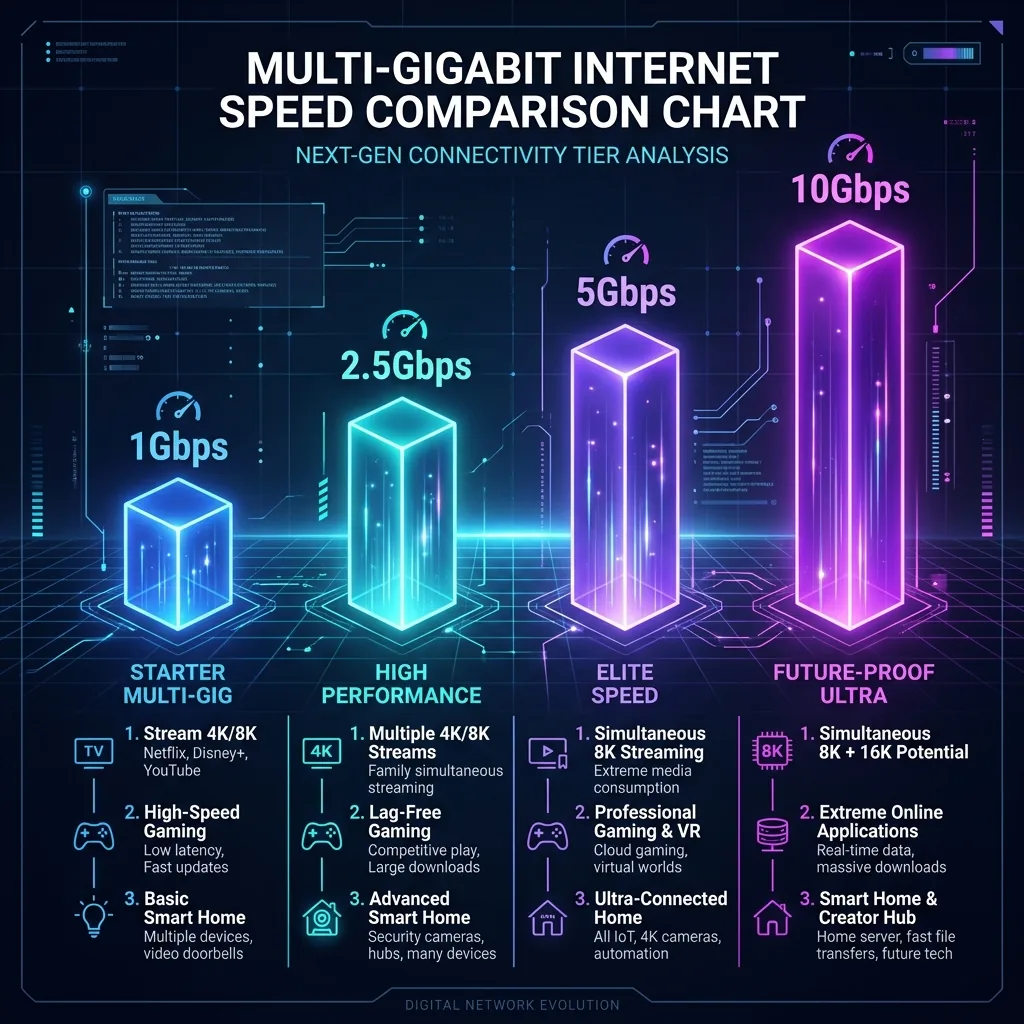
ISPs are racing to offer 2 Gig, 5 Gig, even 10 Gig fiber plans. "Download Fortnite in 2 seconds!" they claim. But can you actually use it?
The Hardware Bottleneck
Most Ethernet ports on PCs and Laptops are 1 Gbps. If you pay for 5 Gbps internet and plug it into a 1 Gbps port, you get 1 Gbps. Period.
Who is it for?
Multi-Gig is for housholds with heavy concurrent usage. If Dad is downloading a 100GB game, Mom is uploading a 4K video, and 3 kids are streaming, a 2 Gig pipe ensures nobody slows down the other. But for a single user? 1 Gig is already overkill.
Check your hardware before upgrading. See our Ethernet Cable Guide.
Who Actually Needs Multi-Gig?
Honest answer: very few households in 2026. Streaming 4K on 10 devices simultaneously requires roughly 250 Mbps. A household of four power users — each streaming, video calling, and gaming concurrently — rarely exceeds 500 Mbps of real simultaneous throughput. Multi-gig Internet (2-10 Gbps) becomes genuinely useful for home offices running local servers, content creators uploading raw 4K or 8K footage daily, or households hosting their own NAS with multiple remote users. For everyone else, a well-configured gigabit connection with low jitter outperforms a multi-gig plan with poor QoS or inconsistent latency. Run a gigabit speed test first to confirm you're actually getting your current plan's speeds before upgrading.
Frequently Asked Questions
What equipment do I need for multi-gig internet?
Every device in the chain needs multi-gig capability: your modem or ONT, your router's WAN port, the switch between them, and the Ethernet ports on your end devices. A single standard gigabit port anywhere in the chain creates a 1 Gbps bottleneck regardless of your plan speed. Cat6 or Cat6a cable is required for sustained 2.5G+ speeds; Cat5e maxes out at 1G in real-world conditions.
Is multi-gig internet worth the extra cost?
Only if you can actually use it — and that requires both multi-gig hardware and genuine workloads that exceed 1 Gbps. For most households paying $20-50/month extra for multi-gig tiers, the practical benefit is zero because no single device they own can receive data faster than 1 Gbps anyway. The investment pays off when you're regularly moving large files between multi-gig-capable devices on your local network or running a server that serves multiple simultaneous users.
Multi-Gig and Smart Home Hubs
Even smart-home-heavy households with dozens of connected devices rarely approach gigabit aggregate throughput, since most smart home traffic (sensors, switches, cameras at moderate resolution) is bursty and low-bandwidth individually — multi-gig's benefit here is headroom for occasional simultaneous activity, not a response to steady-state smart home load.
Future-Proofing: A Reasonable Argument for Some Households
For anyone locked into a multi-year ISP contract or planning several years in a home, choosing a multi-gig tier as future-proofing (rather than for current need) is a more defensible reason than present-day usage alone, given how household device counts and 8K/VR content tend to grow over time.
Multi-Gig and Cloud Gaming Services
Cloud gaming platforms (GeForce Now, Xbox Cloud Gaming) are bandwidth-modest (15-35 Mbps typically) but latency-sensitive — multi-gig tiers offer no advantage here specifically, since the bottleneck for cloud gaming quality is routing and jitter, not raw available bandwidth.