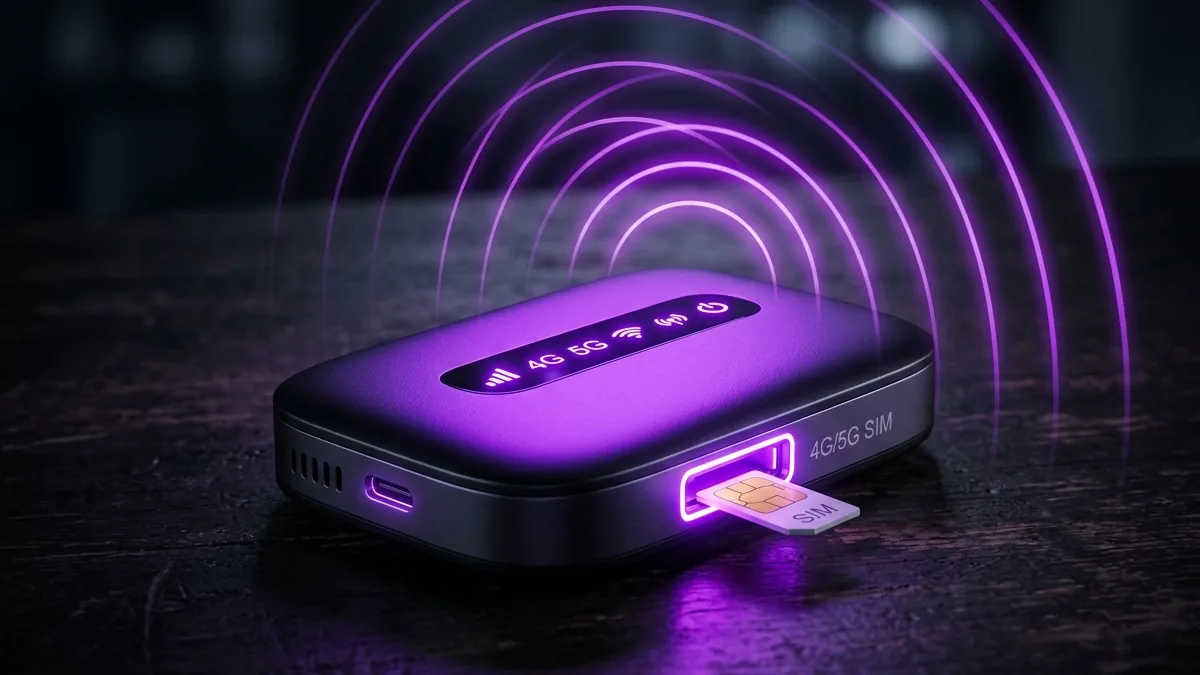
SIM card routers allow you to insert a cellular SIM card (T-Mobile, AT&T, Verizon, or international carriers) and convert 5G or 4G LTE signals into high-speed Wi-Fi and Ethernet for your entire home or office. Ideal for rural areas, remote sites, or temporary housing, models like the **ZTE 5G Portable**, **Huawei 5G CPE**, and **TP-Link TL-MR6400** provide fast, reliable internet without coaxial wiring. We benchmark top 5G/4G SIM routers.
🛒 Check 5G & 4G SIM Card Router Deals on Amazon
View current deals, real-time pricing, and stock availability on Amazon.
2026 Cellular Router Benchmark Summary
| Router Model | Cellular Tech | Peak Download | External Antenna Ports? |
|---|---|---|---|
| ZTE 5G Portable Router | 5G Sub-6GHz / LTE Cat 20 | 540.2 Mbps | Yes (TS9 Dual) |
| Huawei 5G CPE Pro | 5G Balong 5000 Chipset | 610.8 Mbps | Yes (SMA Ports) |
| TP-Link TL-MR6400 | 4G LTE Cat 4 | 148.5 Mbps | Yes (Detachable Antennas) |
Measure your SIM router performance right now on DCSpeedTest.
Who Actually Needs a SIM Card Router
SIM routers make the most sense for rural addresses without fiber or cable access, RV/mobile setups, or as a backup connection for a primary wired ISP — for anyone with genuine fiber or cable availability, a wired connection is almost always faster and more consistent than cellular-based internet.
4G LTE vs 5G Routers: What the Difference Actually Means
A 5G-capable router only delivers 5G speed where 5G coverage actually exists at your location — in areas with only 4G LTE coverage, a 5G router performs identically to a 4G router, making it worth checking actual carrier coverage at your specific address before paying the premium for 5G hardware that coverage might not support anyway.
Choosing Between Carriers for a SIM Router
Since these routers use standard SIM cards, the deciding factor is which carrier has the best coverage at your specific location, not which router brand you choose — checking each major carrier's coverage map for your exact address before committing to a data plan avoids buying hardware locked to a carrier with weak signal where you actually live.
Data Plan Considerations
Most carrier data plans for fixed/home use come with either a hard cap or a "soft" cap with deprioritization after a threshold — reading the specific plan's fair-use policy, not just the advertised "unlimited" label, matters more here than with a wired ISP, since cellular data plans much more commonly include real usage-based throttling.
Antenna Upgrades: Extending Range in Weak-Signal Areas
Many SIM routers support external antenna connectors, letting you add a higher-gain directional antenna aimed at the nearest tower — a meaningful upgrade specifically for rural or fringe-coverage areas where the router's built-in antenna alone struggles to maintain a strong connection.
Router-to-WiFi vs Router-to-Ethernet
For the most consistent performance, connecting the SIM router to a separate WiFi router via Ethernet (rather than relying on the SIM router's own built-in WiFi) generally delivers better in-home coverage, since dedicated WiFi routers are purpose-built for that job.
Frequently Asked Questions
Can I use a SIM router as my only internet connection long-term? Yes, and many rural households do exactly this — the main consideration is confirming the data plan's fair-use policy supports genuinely unlimited, unthrottled usage at that volume.