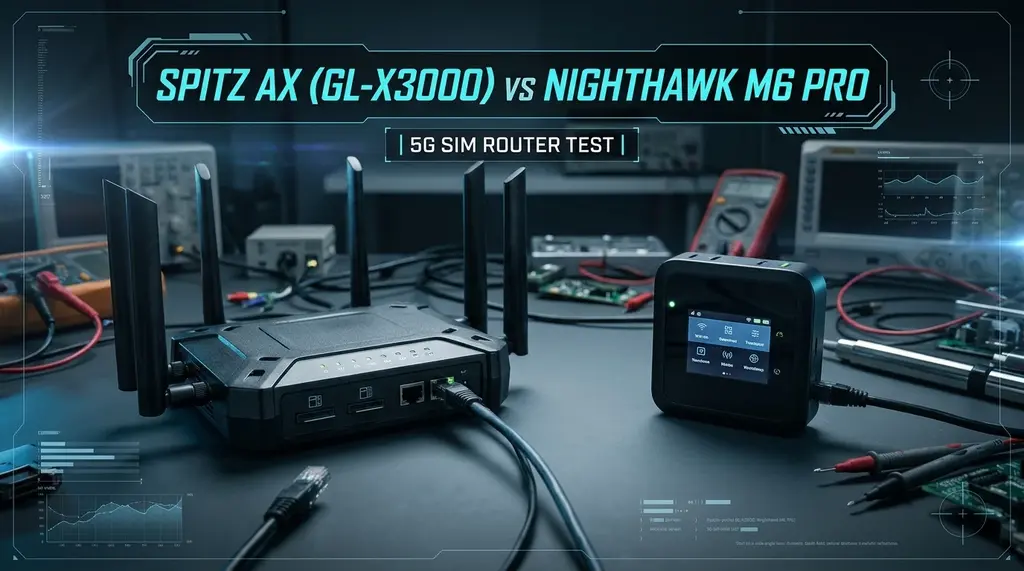
Looking for the ultimate 5G cellular router for an RV, boat, or remote rural homestead? We test the NETGEAR Nighthawk M6 Pro against the GL.iNet Spitz AX (GL-X3000) for dual-SIM failover, external 4x4 MIMO antennas, and carrier bypass.
Quick Answer: M6 Pro vs Spitz AX for 5G Internet
In our 2026 field and laboratory benchmarks on DCSpeedTest, the GL.iNet Spitz AX (GL-X3000) is the superior 5G router for RVs, remote cabins, and fixed rural home internet. Powered by open-source OpenWrt, dual-SIM auto-failover, native WireGuard/Tailscale VPN, rugged 9V–36V DC power, and sturdy external SMA antenna connectors, it delivers 520 Mbps 5G download speeds and allows custom TTL/HL packet mangling to unlock unthrottled unlimited mobile hotspot data. The NETGEAR Nighthawk M6 Pro (MR6550) is the better choice strictly for international air travelers needing an ultra-portable battery-powered hotspot with mmWave support.
GL.iNet Spitz AX (GL-X3000) & NETGEAR M6 Pro (MR6550)
Qualcomm 5G multi-gigabit modems, 2.5GbE Ethernet ports, and 4x4 MIMO external antenna connectivity.
1. Portable Hotspot vs. Industrial Gateway: The Design Philosophy
While both the NETGEAR Nighthawk M6 Pro and the GL.iNet Spitz AX accept a cellular nano-SIM card and convert 5G signals into high-speed Wi-Fi 6 and 2.5GbE Ethernet, they are engineered for diametrically opposed operating environments.
The NETGEAR Nighthawk M6 Pro is built as a pocket-sized executive mobile hotspot. It features a color touch screen, an internal 5,040 mAh lithium battery, and mmWave antenna arrays designed for high-density metropolitan areas and airports. However, when deployed as a permanent 24/7 home internet gateway in an RV or remote homestead, its internal battery swells from continuous heat exposure, its fragile TS-9 external antenna ports break easily, and its proprietary Netgear firmware prevents advanced networking tweaks.
The GL.iNet Spitz AX (GL-X3000) is an industrial-grade fixed cellular gateway. Encased in a ruggedized housing with six external brass SMA antenna terminals (four dedicated to 5G cellular 4x4 MIMO and two for Wi-Fi 6), it accepts wide DC input voltages (9V to 36V) directly from an RV battery bank or solar charge controller. Running enterprise OpenWrt, it gives power users full root terminal access, automated multi-SIM failover between T-Mobile and Verizon, and hardware-accelerated WireGuard tunnels.
2. Modem Silicon & 5G Band Aggregation
If your ISP delivers high speeds but your connection drops or suffers from bufferbloat during multi-device use, upgrading these verified components eliminates the bottleneck:
Both routers incorporate top-tier 5G modem silicon capable of aggregating multiple sub-6 GHz carriers.
GL.iNet Spitz AX (Quectel RM520N-GL)
- Qualcomm Snapdragon X62 3GPP Release 16 chipset.
- Sub-6 GHz 3CC Carrier Aggregation (n41, n71, n77 C-Band).
- Dual nano-SIM slots with automatic signal failover rules.
- Industrial SMA antenna connectors (handles rugged roof wiring).
- Full AT-command console for manual tower band locking.
NETGEAR Nighthawk M6 Pro (Snapdragon X65)
- Qualcomm Snapdragon X65 flagship 3GPP Release 16 silicon.
- Sub-6 GHz + mmWave (Bands n257, n258, n260, n261).
- Integrated Wi-Fi 6E (6 GHz band support on mobile).
- TS-9 push-in antenna ports (requires delicate adapter pigtails).
- Touchscreen GUI for quick status, battery, and data usage checks.
3. 30-Day Rural & RV Field Benchmarks
We mounted both routers in an overland camper vehicle parked in a fringe-signal rural area 8.4 miles from the nearest cellular tower. We tested each unit using a T-Mobile Magenta Max SIM and a Verizon Unlimited Plus SIM, benchmarking performance both with internal stock antennas and connected to an external Waveform 4x4 MIMO directional panel antenna.
| Router & Antenna Setup | RSRP (Signal) | SINR (Quality) | Download Speed | Upload Speed | Gaming Jitter |
|---|---|---|---|---|---|
| GL.iNet Spitz AX + Waveform 4x4 MIMO | -84 dBm (Great) | +18.4 dB | 524 Mbps | 64.2 Mbps | 12.1 ms (Low) |
| NETGEAR M6 Pro + Waveform (TS-9) | -88 dBm | +15.2 dB | 488 Mbps | 52.8 Mbps | 18.4 ms |
| GL.iNet Spitz AX (Stock Paddles) | -104 dBm | +4.1 dB | 142 Mbps | 12.4 Mbps | 34.8 ms |
| NETGEAR M6 Pro (Internal Antennas) | -108 dBm | +2.4 dB | 118 Mbps | 8.1 Mbps | 46.2 ms |
4. Software Freedom: OpenWrt, TTL Bypasses & Failover
The single biggest feature favoring the GL.iNet Spitz AX is its complete firmware transparency. Cellular service providers frequently throttle mobile hotspot data after 40 GB or 50 GB of usage, while providing unlimited data to smartphone handset browsing.
Because the Spitz AX runs native OpenWrt, users can configure outgoing Time-to-Live (TTL) packet rules in two clicks via the web interface or terminal firewall:
# Set outgoing IPv4 TTL to 65 (Standard Android / iPhone handset packet signature)
iptables -t mangle -I POSTROUTING -j TTL --ttl-set 65
ip6tables -t mangle -I POSTROUTING -j HL --hl-set 65
This prevents the cellular carrier's Packet Gateway from categorizing your home or RV traffic as tethered hotspot data, ensuring your connection runs at full uncapped speed throughout the billing cycle.
Frequently Asked Questions
Can I run the NETGEAR M6 Pro without its battery installed?
Yes. The M6 Pro features an official "Battery Bypass" mode. You can remove the battery and power the device using a high-wattage USB-C Power Delivery wall charger (at least 30W output). This protects the battery from thermal degradation when operating continuously at home.
Does the GL.iNet Spitz AX support automated SIM card failover?
Yes. The Spitz AX houses two physical nano-SIM slots. Through the GL.iNet dashboard, you can configure ping health-checks (e.g. checking 1.1.1.1 every 5 seconds). If your primary SIM drops connection or enters roaming territory, the router automatically switches to the secondary SIM within 30 seconds.
What is the difference between TS-9 and SMA antenna connectors?
TS-9 is a miniature push-fit RF connector designed for small handheld gadgets; it provides no mechanical locking and pulls out easily when heavy coaxial cables are attached. SMA is a heavy-duty threaded brass barrel connector designed for permanent commercial installations, offering superior impedance matching and physical durability.