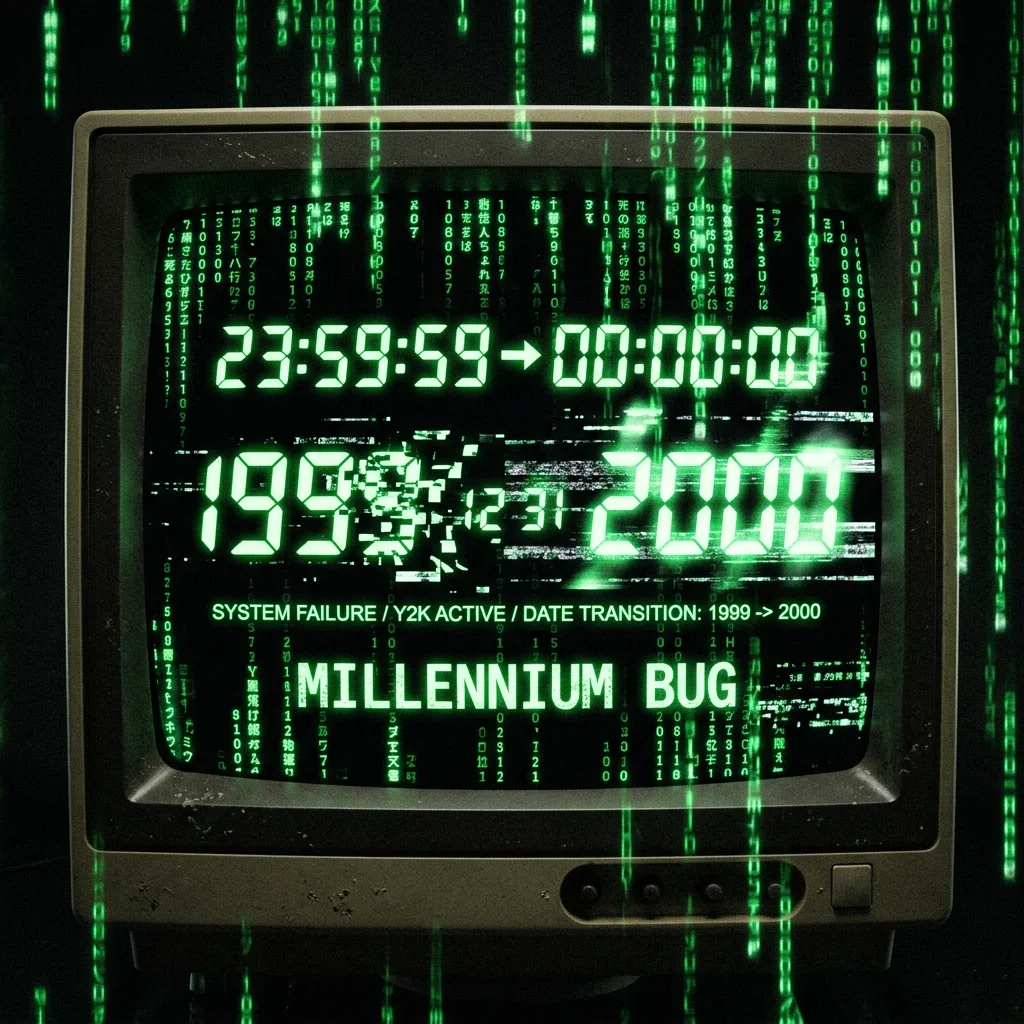
As the clock ticked down to midnight on December 31, 1999, the world was gripped by a unique kind of panic. People stockpiled water, withdrew cash, and feared planes would fall from the sky. The culprit? The **Y2K Bug** (or Millennium Bug)—a tiny programming shortcut that threatened to crash global infrastructure. In this digital history curiosity, we look back at the code that almost broke the world.
1. The Two-Digit Code Shortcut
In the early days of computing, digital memory was incredibly expensive. To save precious bytes, programmers stored dates using only the last two digits for the year (e.g., "1975" was stored simply as "75").
This worked perfectly until the turn of the millennium. When the year 2000 arrived, computers storing dates in two digits would roll over from "99" to "00". Unfortunately, systems would interpret "00" as the year 1900 rather than 2000, causing interest rate calculations to fail, flight schedules to break, and network servers to lock up.
As documented in the Wikipedia Y2K Bug History, the global community spent over $300 billion in software remediation audits to patch COBOL files before midnight arrived.
2. 🔬 Try the Embedded Y2K Rollover Simulator
Experience the Y2K glitch! Click the button below to simulate the rollover from 1999 to 2000 in a vintage 2-digit clock and watch the computer crash and apply the Y2K patch!
🖥️ Y2K Rollover Glitch Terminal
3. 15 High-Authority Resources on Software Auditing
To inspect the historical declassified software audit reports, COBOL syntax guides, and millennium statistics, explore these authority archives:
- Y2K Declassified Archives: Read historical government reports on Wikipedia's Y2K Page.
- National Software Auditing: Review the museum's vintage computer archives at The National Museum of Computing.
- COBOL System Parameters: Study programming code syntax on the IEEE Software Society.
- CERN Vintage Systems: See how early scientific nodes handled the transition at CERN Science Portal.
- Standard Date Formats: Study the history of ISO 8601 formatting on the W3C Organization Portal.
- Y2K Network Solutions: Explore network gateway patches on the IETF RFC Portal.
- Geopolitical Infrastructure: Review telecommunications stability logs at the FCC Archive Division.
- High-Speed Security: Track server patching and DNS stability on Cloudflare Network Safety.
- Google Vintage Search: See how Google indexed year-changing documents on Google Developers Web history.
- AWS Legacy Architecture: Study modern migration of legacy mainframe databases on AWS Enterprise Migrations.
- Microsoft COBOL Migrations: Learn about legacy mainframe hosting on Microsoft Mainframe Solutions.
- MIT Vintage Computing: Read computer science retrospective papers on MIT Technology Archive.
- Stanford Software retro: Review code debugging practices at Stanford Computer Science department.
- Wired Millennium Recap: Read vintage articles from 1999/2000 published by Wired Magazine.
- Scientific American History: Study software architecture evolution at the Scientific American Portal.
4. Keep Your Operating System Secure Today
While Y2K is safely behind us, software bugs and security exploits occur daily. Unpatched network nodes can allow hackers to intercept your communication channels or inject malware. Using a premium VPN like NordVPN or Surfshark shields your system with advanced encryption and DNS protection, keeping your devices and personal files fully secure against modern exploits.
⚡ What Would You Like to Do Next?
Verify your system connection bandwidth or secure your legacy OS path.