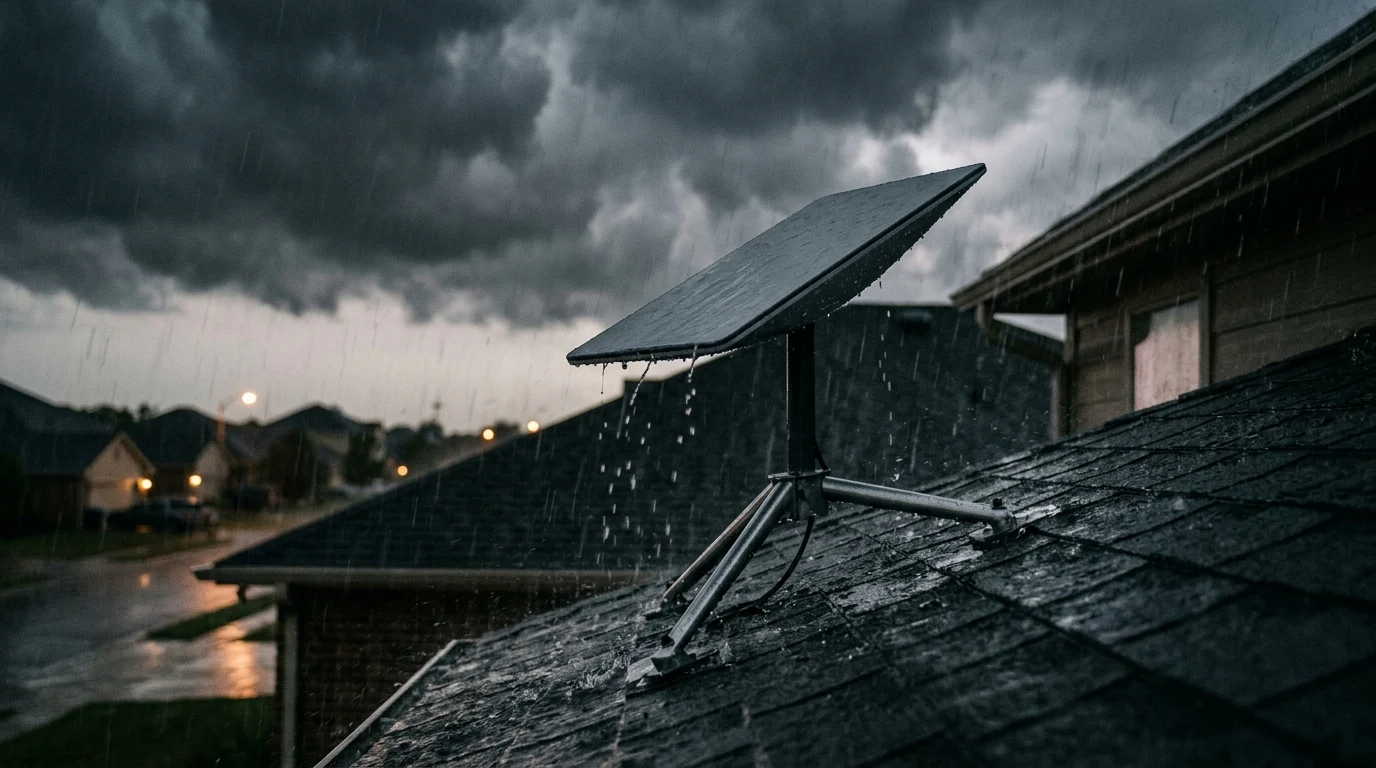
For rural broadband subscribers using satellite internet constellations like SpaceX's Starlink or Amazon's Project Kuiper, clear-weather performance can be impressive: delivering 150 to 220 Mbps download speeds and competitive 35ms ping. But the moment a dark thunderstorm rolls over your neighborhood, ping suddenly spikes from 35ms to over 200ms, packet loss climbs to 15%, and Zoom video calls disconnect. Why does bad weather have such a devastating impact on satellite latency, and what is the underlying physics? Here is our technical breakdown.
The Physics of Rain Fade: Hydrometeor Scattering & Resonance
Starlink and modern LEO satellite constellations communicate using high-frequency microwaves in the Ku-band (12 GHz to 18 GHz) and Ka-band (26.5 GHz to 40 GHz). At these ultra-high frequencies, the physical wavelength of the radio wave is tiny (roughly 1.0 cm to 2.5 cm).
Because typical raindrops in a thunderstorm measure between 1 mm and 5 mm in diameter, the physical size of a raindrop is remarkably close to the wavelength of the satellite radio wave. This triggers two destructive electromagnetic phenomena:
- Dielectric Absorption: Liquid water is a polar dielectric molecule that absorbs microwave radio energy, converting the signal's electrical energy into microscopic heat and weakening signal strength.
- Rayleigh & Mie Scattering: Radio waves physically bounce off raindrops in all directions rather than traveling in a straight beam to the orbital satellite, causing severe signal dispersion.
Atmospheric Attenuation: Signal Degradation by Weather Type
| Weather Condition | RF Frequency Attenuation (dB/km) | Average Latency Impact | Packet Drop Rate |
|---|---|---|---|
| Clear Sky / Light Clouds | < 0.05 dB/km (Negligible) | 32 – 42 ms (Optimal) | 0.00% |
| Light Rain (< 5 mm/hr) | 0.8 – 1.5 dB/km | 38 – 55 ms (+10 ms) | < 0.5% |
| Heavy Thunderstorm (> 25 mm/hr) | 6.5 – 12.0 dB/km (Severe) | 95 – 220 ms (+150 ms) | 8% – 25% (Drops) |
| Dense Wet Snow Accumulation | 4.0 – 8.0 dB/km | 65 – 140 ms | 3% – 12% |
How Satellite Dishes Respond to Low Signal-to-Noise Ratio (SNR)
When atmospheric rain absorbs signal strength, the dish's internal receiver detects a sharp drop in Signal-to-Noise Ratio (SNR). To prevent complete connection failure, the satellite modem must execute two emergency adaptations:
- Modulation Downshifting (Adaptive Coding & Modulation / ACM): The modem drops from high-efficiency 64-QAM or 16-QAM down to robust but slow QPSK modulation, cutting bandwidth by up to 70%.
- Forward Error Correction (FEC) Retransmissions: Corrupted data frames must be retransmitted over the 340-mile space path, doubling and tripling round-trip packet latency.
Atmospheric Polarization Shift: Faraday Rotation and Wet Snow
In addition to raw signal absorption, dense storm clouds and ice crystals cause Depolarization / Faraday Rotation: satellite phased-array antennas use circular polarization (Right-Hand Circular Polarization - RHCP and Left-Hand Circular Polarization - LHCP) to transmit two independent data streams on the exact same frequency without interference.
When asymmetric raindrops deform the radio wave's circular geometry, cross-polarization interference occurs, forcing the satellite receiver to disable dual-polarization multiplexing, cutting total link bandwidth in half and increasing packet queue latency.
Why Hardwired Fiber Optic Lines Are 100% Immune to Weather
Unlike satellite and fixed wireless broadband that must beam radio waves through 340 miles of atmosphere, terrestrial fiber optic lines operate inside heavy armored underground conduit. Optical laser light travels inside sealed glass cores with zero atmospheric exposure, delivering the exact same 1.2ms ping during severe blizzards and torrential thunderstorms as it does on a sunny summer afternoon.
How to Minimize Weather Outages on Starlink
- Elevate Your Dish Above Obstructions: Mount your dish securely on a roof pole using a heavy-duty Starlink Gen 3 Pipe Adapter Mount to ensure unobstructed 360-degree sky visibility during low-angle satellite handoffs.
- Enable Snow Melt Mode: In the Starlink mobile app under Settings → Snow Melt, set to Automatic or Pre-Heat during winter storms.
Understanding Geostationary (GEO) vs Low-Earth-Orbit (LEO) Weather Vulnerability
While low-earth-orbit constellations like Starlink orbit at 340 miles (550 km), traditional satellite internet providers (HughesNet, Viasat) operate geostationary satellites orbiting 22,236 miles above the equator. In a GEO satellite link:
- Radio waves must penetrate the entire depth of the Earth's atmosphere twice (up and down), adding 600ms of latency in clear weather.
- During bad weather, rain fade causes complete signal dropouts that can last for hours because the stationary ground dish cannot electronically steer around localized cloud banks.
- Starlink's phased-array dish can electronically hand off to an adjacent satellite in a clearer section of sky within nanoseconds, minimizing total storm downtime.
Why Cloud Density and Droplet Size Dictate Signal Fade
Not all clouds affect satellite internet equally: thin, high-altitude cirrus clouds composed of tiny ice crystals have almost zero impact on Ku/Ka-band radio waves. In contrast, towering cumulonimbus storm clouds (thunderheads) pack billions of dense, liquid water droplets measuring 2mm to 5mm across. As the satellite beam traverses several kilometers of dense cloud wall, signal attenuation can exceed 20 dB, dropping throughput to zero until the storm cell passes.
Actionable Steps to Maintain Satellite Internet in Storms
- Keep the Dish Heating Element Active during wet snow and freezing rain.
- Ensure Clear Line of Sight with zero tree branches that can sag when weighed down by rain or snow.
- Hardwire Your Router with Cat6 Ethernet to prevent Wi-Fi degradation on top of atmospheric satellite latency.
Summary: Managing Weather Realities on Satellite Broadband
While satellite broadband has revolutionized connectivity for rural and remote areas, physical microwave absorption during severe thunderstorms is an unavoidable law of physics. Keeping your dish elevated and unobstructed guarantees you recover full line speeds the moment storm clouds clear.
Why Ground Station Gateway Weather Also Matters
Many satellite subscribers do not realize that rain fade can occur even if the sky above your own house is completely sunny. If a severe thunderstorm is raging over the Starlink Ground Station Gateway 150 miles away (where the satellite beam connects to the terrestrial fiber internet backbone), rain attenuation at the gateway can degrade your connection speeds and cause packet loss.
By understanding the physics of rain fade and optimizing dish placement, satellite internet users can minimize weather downtime and maintain reliable rural broadband connectivity.