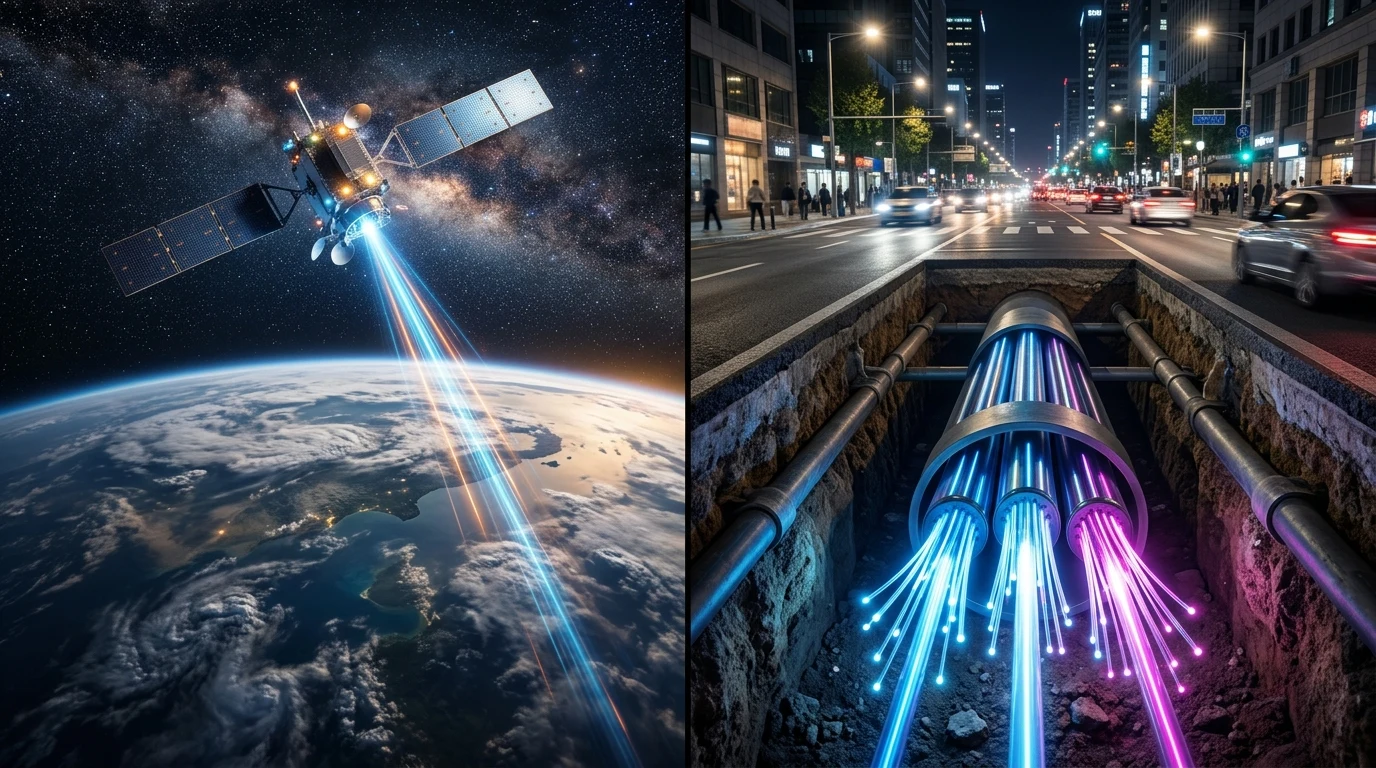
The rollout of SpaceX's Starlink constellation has revolutionized internet access for millions of rural residents, boaters, and off-grid remote workers across the globe. Watching dishes provide 200 Mbps speeds in remote wilderness locations where cable companies quoted $30,000 for a line extension led many tech enthusiasts to ask: Will satellite constellations eventually make terrestrial fiber optic lines obsolete? From the perspective of fundamental physics and information theory, the answer is a definitive no. Here is why fiber optics will remain the foundation of global telecommunications forever.
1. The Shannon-Hartley Theorem: The RF Spectrum Ceiling
All wireless transmissions — including satellite, 5G, and Wi-Fi — are governed by the Shannon-Hartley Theorem, which dictates the theoretical maximum rate at which information can be transmitted over a physical channel without error:
C = B × log2(1 + S/N)
Where C is channel capacity, B is available RF frequency bandwidth, and S/N is signal-to-noise ratio. The radio frequency spectrum allocated for satellite communications (Ku-band: 12–18 GHz; Ka-band: 26–40 GHz) is finite and strictly divided among global users. There is only so much wireless data you can physically beam through the Earth's atmosphere before radio waves interfere with each other.
2. Shared Cell Capacity vs Dedicated Glass Strands
Each Starlink satellite projects multiple hexagonal spot beams (cells) onto the Earth's surface, typically covering an area of roughly 15 miles (24 km) across. A single cell has a finite aggregate bandwidth allocation (roughly 500 Mbps to 1 Gbps per beam):
- If 5 rural homes in an isolated valley use Starlink, each home gets an unthrottled 200 Mbps.
- If 500 homes in a dense suburban neighborhood attempt to use Starlink simultaneously, the 1 Gbps beam is divided among them, dropping speeds to less than 2 Mbps per home during evening peak hours.
In contrast, a modern Fiber-to-the-Home (FTTH) network delivers dedicated laser pulses through glass strands narrower than a human hair. With XGS-PON and 25G-PON technologies, an ISP can deliver 10,000 Mbps symmetrical bandwidth to every single house simultaneously with zero shared radio interference.
Comprehensive Physics Comparison: Starlink vs Pure Fiber
| Engineering Parameter | Starlink LEO Satellite Constellation | Pure Fiber Optic (FTTH XGS-PON) |
|---|---|---|
| Transmission Medium | Wireless RF Radio Waves (Atmosphere / Space) | Infrared Laser Light (Pure Fused Silica Glass) |
| Total Medium Capacity | ~80–100 Gbps per Satellite (Shared) | >40,000 Gbps per Fiber Strand (DWDM) |
| Baseline Packet Latency | 28 – 55 ms (Orbital Transit) | 1 – 8 ms (Light in Glass) |
| Weather Vulnerability | Rain Fade & Heavy Snow Attenuation | 100% Immune to Weather & Lightning |
| Infrastructure Lifespan | 5 Years (Satellites De-orbit and Burn Up) | 50+ Years (Buried Underground Glass) |
Optical Physics: The Near-Infinite Capacity of Fused Silica Glass
To appreciate why terrestrial fiber optic cables are physically unsurpassable, consider the physics of optical fiber communications. A standard single-mode optical fiber core measures just 9 micrometers in diameter, composed of ultra-pure synthetic fused silica glass:
- Wavelength Division Multiplexing (WDM): Rather than transmitting a single light pulse, optical transceivers divide infrared light into over 160 distinct optical wavelengths (colors) across the C-band and L-band spectrum (1530 nm to 1625 nm).
- Coherent Optical Modulation (64-QAM): Modern 800G and 1.2 Terabit optical transceivers modulate phase, amplitude, and dual-polarization states of light pulses, transmitting over 40 Terabits per second per fiber strand.
- Massive Fiber Cables: High-density subterranean cables contain bundles of 864 to 3,456 individual optical fibers, delivering a total aggregate theoretical throughput exceeding 138,000 Terabits per second (138 Petabits/s) in a single buried conduit.
No radio frequency technology in the Earth's atmosphere can ever match even 0.01% of this physical data carrying capacity.
Atmospheric Attenuation: Rain Fade, Snow & Solar Magnetic Storms
While fiber optic cables operate insulated inside deep underground conduit, satellite RF beams must traverse 340 miles of troposphere and ionosphere. High-frequency Ku/Ka-band radio waves are subject to severe environmental interference:
- Rain Fade (Hydrometeor Scattering): Heavy convective summer thunderstorms absorb and scatter 12 GHz to 30 GHz radio signals, causing momentary packet loss and throughput drops.
- Solar Flares & Geomagnetic Storms: Solar coronal mass ejections (CMEs) superheat the upper atmosphere, causing atmospheric drag that de-orbits satellites and disrupts orbital RF beamsteering.
Economic Cost-per-Gigabit: Glass in the Ground vs Rocket Launches
Beyond radio physics, the long-term economic model of global telecommunications heavily favors terrestrial fiber optics:
- Satellite Constellation Depreciation: Starlink satellites in low-earth orbit (550 km altitude) experience continuous atmospheric drag. Every satellite must be replaced every 5 years as its orbital thruster propellant depletes, requiring endless multi-million dollar Falcon 9 rocket launches to sustain constellation capacity.
- Fiber Infrastructure Longevity: Buried fiber optic cable has a physical service lifespan exceeding 50 years. Once underground conduit is placed, upgrading network capacity from 1 Gbps to 100 Gbps requires only swapping transceivers in the central switching office without digging up the ground.
Latency Physics: Speed of Light in Vacuum vs Glass
While light travels approximately 31% slower through silica glass (approx. 200,000 km/s) than through the vacuum of space (300,000 km/s), terrestrial fiber travels in direct point-to-point horizontal lines over short distances (e.g. 10 miles from your house to a city center data center takes 0.08 milliseconds). A satellite link must travel 340 miles straight up to space, cross an optical inter-satellite laser link, travel 340 miles back down to a ground station gateway, and then traverse terrestrial fiber to the server, adding an inescapable 25ms to 45ms of physical propagation delay.
Power Consumption & Environmental Carbon Footprint Analysis
From an ecological and energy perspective, terrestrial fiber networks are vastly more efficient than satellite constellations. An entire FTTH optical network terminal (ONT) and passive optical splitter infrastructure consumes less than 5 to 10 Watts per subscriber household. In contrast, a Starlink user terminal (phased-array dish) consumes 50W to 110W of electricity continuously just to power its active electronic beamforming phase shifters and integrated snow-melting heating elements, costing $100+ more in electricity per year per household.
The Real-World Role of Each Technology
Starlink is not a fiber replacement; it is the ultimate rural broadband complement. For the 20% of the world's population living in mountains, islands, and remote agricultural areas where trenching fiber optic cables is economically impossible, Starlink is a life-changing technology. But for dense towns, cities, and suburbs, fiber optic infrastructure remains the fastest, most reliable, and most energy-efficient technology human civilization has ever engineered.