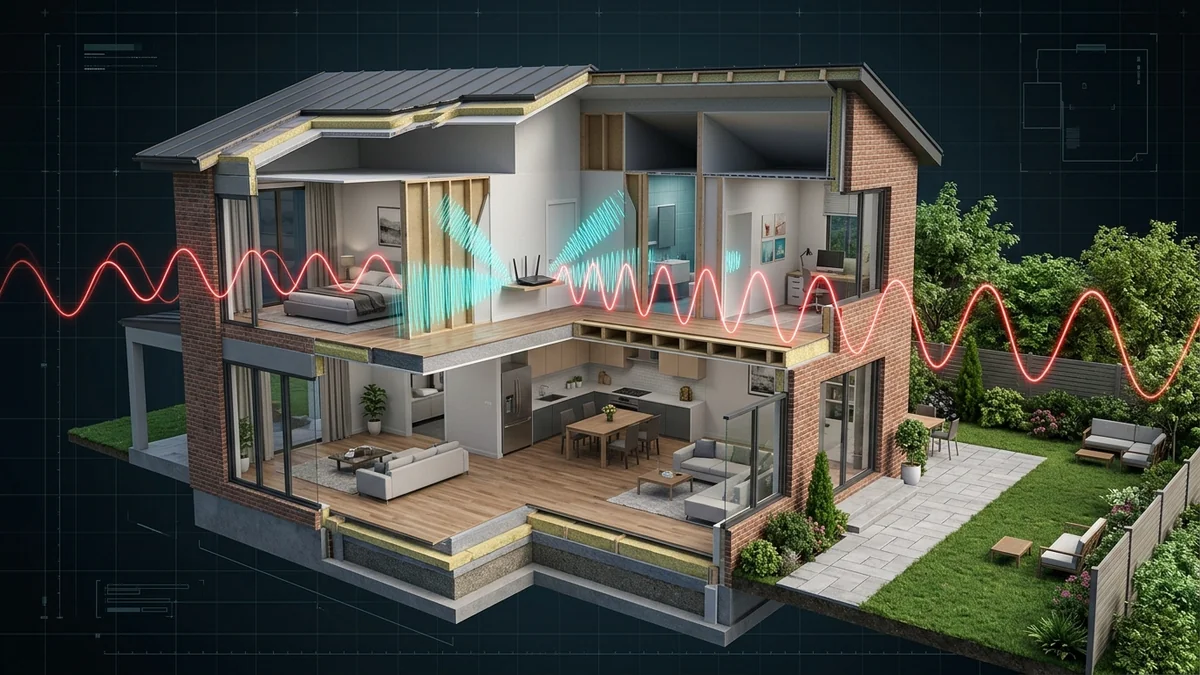
You set up a brand new high-speed router in your living room. When standing in the same room, your smartphone connects to the 5 GHz Wi-Fi band and DCSpeedTest reports an astonishing 850 Mbps. You walk down the hallway into your bedroom, close the door, and look at your phone: your Wi-Fi indicator drops to one bar, your phone automatically downgrades to the sluggish 2.4 GHz band, and your speed crashes down to 45 Mbps. Yet, your 2.4 GHz signal easily reaches all the way into your backyard shed. Why does 5 GHz Wi-Fi die so abruptly after passing through two basic walls? Here is the electromagnetic physics of Free-Space Path Loss (FSPL), Dielectric Absorption, and Skin Depth.
The Physics of Wavelength: 12.5 cm vs 5.5 cm
To understand why frequency dictates distance, you must calculate the physical physical length of the radio wave using the wave velocity equation ($c = f \lambda$):
- 2.4 GHz Radio Wave Wavelength ($\lambda$): $\lambda = rac{300,000,000 ext{ m/s}}{2,400,000,000 ext{ Hz}} = 0.125 ext{ meters} = \mathbf{12.5 ext{ cm (4.9 inches)}}$.
- 5.0 GHz Radio Wave Wavelength ($\lambda$): $\lambda = rac{300,000,000 ext{ m/s}}{5,000,000,000 ext{ Hz}} = 0.060 ext{ meters} = \mathbf{5.5 ext{ cm (2.1 inches)}}$.
A 5 GHz radio wave is less than half the size of a 2.4 GHz wave. As a radio wave oscillates twice as fast, it encounters more matter molecules per meter of travel, dissipating its photon energy into thermal friction much faster.
Free-Space Path Loss (FSPL) and the Inverse-Square Law
Per the Friis Transmission Formula, electromagnetic path loss in free air increases logarithmically with frequency:
$$FSPL(dB) = 20\log_{10}(d) + 20\log_{10}(f) - 147.55$$
Because frequency ($f$) is squared in the power domain, simply doubling the frequency from 2.4 GHz to 5 GHz introduces an automatic 6.02 dB penalty in pure open air over any given distance, cutting effective signal power by 75% before encountering a single physical wall.
Wall Attenuation Matrix: How Building Materials Kill 5 GHz
Below is the empirical decibel attenuation across common architectural residential building materials based on NIST engineering studies:
| Residential Building Material | 2.4 GHz Attenuation (dB) | 5.0 GHz Attenuation (dB) | Remaining 5 GHz Signal Power |
|---|---|---|---|
| Standard Interior Drywall (0.5 in) | 1.5 dB | 3.8 dB | 42% power remaining |
| Solid Hollow Core Wood Door | 2.0 dB | 4.5 dB | 35% power remaining |
| Double-Pane Glass Window | 2.5 dB | 6.2 dB | 24% power remaining |
| Solid Red Brick Chimney / Wall | 6.0 dB | 14.5 dB | 3.5% power remaining (Critical) |
| Poured Concrete Foundation | 10.0 dB | 22.0 dB | 0.6% power remaining (DEAD ZONE) |
| Metal Mesh Lath & Plaster (Pre-1950) | 12.0 dB | 26.0 dB | 0.2% power (Faraday Cage) |
Why 5 GHz Is Still King (When Positioned Correctly)
Even though 5 GHz loses range, it provides four times more wireless capacity (80 MHz channels delivering 800+ Mbps) compared to narrow, congested 2.4 GHz channels (20 MHz delivering 50 Mbps).
To overcome wall attenuation, deploy hardwired mesh access points or MoCA adapters in rooms separated by brick or plaster, bringing full-power 5 GHz gigabit speeds directly into every living space.
The Dielectric Constant of Water and Human Body Attenuation
The human body is approximately 60% water, and liquid water has a resonant dielectric absorption peak near microwave frequencies. A crowded room of people absorbs 5 GHz and 6 GHz signals at a rate of 3 to 5 dB per person standing in the line of sight.
Elevating your router or mesh satellites onto high shelves or wall mounts ensures radio signals propagate above human heads and furniture obstacles, maximizing 5 GHz coverage.
How Beamforming Compensates for High-Frequency Loss
Modern Wi-Fi 6 and Wi-Fi 7 routers utilize Explicit Transmit Beamforming (TxBF). By using multiple antennas to transmit phase-aligned radio waves, the router concentrates electromagnetic energy directly toward your phone's physical location, boosting effective 5 GHz signal strength by 4 to 6 dB in distant rooms.
The Advantage of Dynamic Frequency Selection (DFS) Channels
In the 5 GHz spectrum, Channels 52 to 144 (DFS channels) operate in clean, uncongested airwaves with higher allowable transmit power. If your router supports DFS without radar interruptions, using DFS spectrum delivers higher throughput at longer indoor ranges.
Balancing Speed and Range in Whole-Home Wi-Fi
While 2.4 GHz provides long-range connectivity for basic IoT gadgets, deploying hardwired mesh nodes brings high-speed 5 GHz and 6 GHz gigabit performance directly into every living space in your home.
The Impact of MIMO Spatial Multiplexing on 5 GHz
While 5 GHz attenuates faster through walls, modern 4x4 MIMO routers use spatial multiplexing to transmit four independent data streams simultaneously, providing massive throughput headroom that overcomes signal decay in adjacent rooms.
Understanding the physics of high-frequency radio waves helps you position mesh access points with mathematical precision for flawless whole-home coverage.
The Trade-Off You're Actually Making
Higher frequency radio waves carry more data per unit time but penetrate obstacles less effectively and lose energy faster over distance — a fundamental physics trade-off, not a flaw in 5GHz specifically. That's exactly why most modern routers broadcast both bands simultaneously and let devices switch dynamically: 5GHz for speed when you're close and want maximum throughput, 2.4GHz for reach when you're far from the router and need the connection to simply reach you at all, even at a lower ceiling.