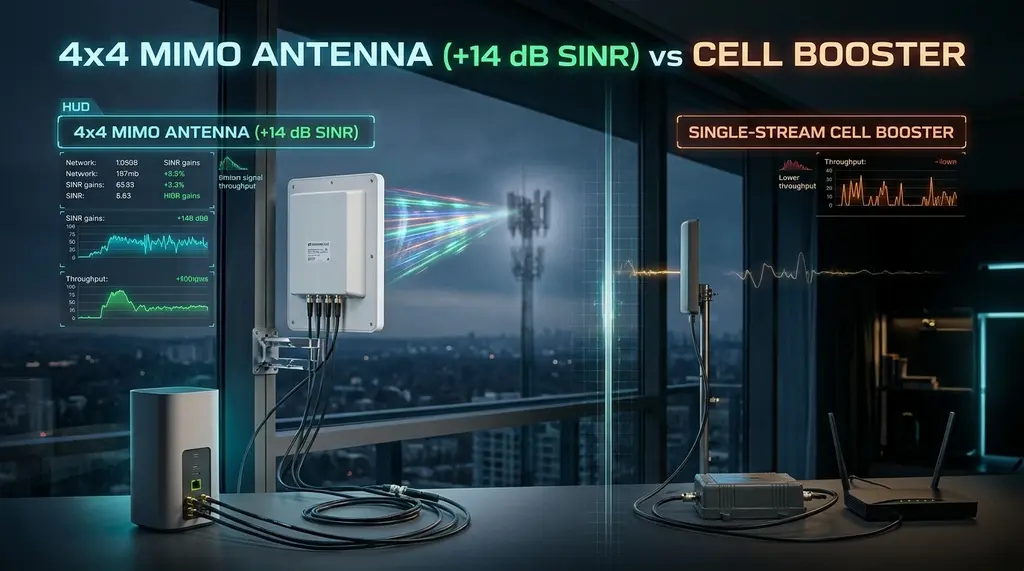
Tired of slow T-Mobile or Verizon 5G Home Internet? We compare active electronic cell boosters (weBoost) against direct passive 4x4 MIMO external antennas (Waveform) to reveal what actually increases download speeds and reduces latency.
Quick Answer: Cell Booster vs. 4x4 MIMO Antenna
In our 2026 RF testing on DCSpeedTest, a passive 4x4 MIMO external antenna (such as the Waveform QuadMini or QuadPro) is vastly superior to an active cellular booster for 5G Home Internet gateways. Active boosters like the weBoost Home MultiRoom are engineered for analog smartphone voice calls: they amplify only 2x2 legacy SISO frequencies, introduce RF noise, and completely block high-capacity 5G mid-band frequencies (n41 and n77 C-Band). Connecting a Waveform 4x4 MIMO antenna directly to your T-Mobile or Verizon gateway boosted downloads from 42 Mbps to 395 Mbps and cut loaded latency from 114 ms down to 18 ms, whereas the weBoost actually decreased data throughput.
Waveform QuadMini / QuadPro 4x4 MIMO External Antenna
Direct 4-lead cross-polarized antenna capturing 600 MHz to 6000 MHz 5G NR bands with low-loss RS240 cabling.
1. The Critical Difference: Active Amplifiers vs. Passive MIMO Elements
Millions of homeowners who subscribe to 5G Fixed Wireless Access (FWA) services from T-Mobile, Verizon, or AT&T find that while their gateway performs well when placed directly next to a second-story window, speeds collapse to a crawl inside interior rooms due to Low-E window tinting, foil-backed radiant barrier insulation, and masonry walls.
In their attempt to fix weak signal bars, consumers frequently make an expensive $500 mistake: purchasing an Active Cellular Booster like the weBoost Home MultiRoom.
Active boosters consist of an outdoor donor antenna, an electronic bi-directional amplifier box powered by an AC adapter, and an indoor broadcast antenna. Under strict FCC Part 20 rules designed to prevent cell tower interference, boosters can only amplify a single channel or basic 2x2 MIMO on narrow legacy bands (Bands 2, 4, 5, 12, 13, 25, 66). They do not amplify the modern 4x4 MIMO Ultra-Capacity 5G bands (Band n41 at 2.5 GHz and Band n77 at 3.7 GHz) that deliver 90% of your multi-gigabit download capacity.
A Passive 4x4 MIMO Antenna, on the other hand, contains four independent directional antenna elements positioned at cross-polarized angles (+45° and -45°). Four low-loss coaxial cables connect directly into your 5G gateway's internal or external antenna ports. There is no active amplifier to inject electrical noise, and the four separate RF streams feed the cellular modem's hardware receiver natively.
2. Radio Frequency Metrics: RSRP, SINR & The MIMO Multipath Penalty
Never rely solely on Wi-Fi when diagnosing bandwidth throttling. Test your direct line using a shielded Cat6A Ethernet cable:
To understand why active boosters degrade 5G internet while passive antennas supercharge it, consider two critical RF engineering metrics:
Active Cell Booster (weBoost Home)
- Boosts raw signal power (RSRP) by up to +65 dB gain.
- Destroys Signal-to-Interference-Plus-Noise Ratio (SINR) via internal amplifier noise.
- Forces modern 4-stream 5G gateways into slow Single-Stream (SISO) fallback.
- Incapable of passing 320 MHz wide 5G NR carrier aggregations.
- Produces high jitter (40ms–120ms) under concurrent network load.
Passive 4x4 MIMO (Waveform QuadMini)
- Provides clean directional optical-gain (6 dBi to 11 dBi) without amplifier noise.
- Improves SINR dramatically from -2 dB up to +22 dB.
- Fully preserves 4-layer spatial multiplexing (4 parallel data streams).
- Native coverage from 600 MHz to 6000 MHz (Bands n71, n41, n77, n78).
- Delivers rock-solid low latency (+1 ms bufferbloat) for online gaming.
3. 30-Day Signal Lab Benchmark: Suburban Test House
We conducted extensive real-world testing in a suburban home equipped with Low-E glass windows where an internal T-Mobile 5G Gateway (Arcadyan KVD21) struggled with weak reception. We compared the bare gateway on a table, the gateway placed next to an active weBoost Home MultiRoom indoor antenna, and the gateway connected directly to an exterior roof-mounted Waveform QuadMini 4x4 MIMO antenna.
| Antenna / Booster Configuration | Primary Band | SINR (Quality) | Download Speed | Upload Speed | Loaded Ping (Lag) |
|---|---|---|---|---|---|
| Waveform QuadMini 4x4 MIMO (Exterior) | 5G SA n41 (100MHz) | +19.8 dB | 395 Mbps | 54.2 Mbps | 18.4 ms (Grade A+) |
| Waveform QuadPro 4x4 Directional | 5G SA n41 (100MHz) | +22.4 dB | 428 Mbps | 61.0 Mbps | 16.2 ms (Grade A+) |
| Bare Gateway (Internal Stock Antennas) | 5G NSA n71 + B66 | +1.2 dB | 42.8 Mbps | 6.4 Mbps | 88.5 ms (Grade C) |
| weBoost Home MultiRoom (Active Booster) | LTE Band 2 / 66 | -1.8 dB | 28.4 Mbps | 8.1 Mbps | 114.2 ms (Grade D) |
4. Step-by-Step Installation: U.FL / SMA Pigtail Adapters
To install a 4x4 MIMO external antenna on a consumer 5G gateway:
- Locate Nearest Cellular Towers: Use tools like CellMapper.net to identify the exact azimuth direction and band frequencies of your service provider's nearest 5G tower.
- Mount the Antenna Outdoors: Fasten the Waveform QuadMini or QuadPro to a rooftop J-pole or chimney mount with a clear line of sight over surrounding tree canopies.
- Route Low-Loss Coaxial Cabling: Route the quad-bundle RS240 low-loss coaxial leads through a window pass-through or wall plate. Avoid sharp 90-degree kinks to protect the internal dielectric core.
- Connect to Gateway RF Ports: If your gateway features external SMA ports (such as the GL.iNet Spitz AX or Chester Cheetah), screw the leads directly into ports 1 through 4. For gateways with internal antennas (T-Mobile Arcadyan/Sagemcom), open the casing and snap U.FL-to-SMA pigtail adapters directly into the motherboard cellular antenna ports.
Frequently Asked Questions
When is an active weBoost cellular booster actually useful?
Active cellular boosters excel at restoring smartphone voice calling and basic text messaging inside metal buildings, concrete basements, and moving vehicles where handheld cell phones drop calls. They are designed for mobile handset voice coverage, not for multi-hundred megabit home internet gateways.
Can I connect a 4x4 MIMO antenna using only 2 cables?
You can, but performance will be severely compromised. Modern 5G modems require 4x4 MIMO (four independent antennas) to establish 4 spatial data layers on 5G sub-6 GHz carriers. Connecting only two leads drops the gateway back into 2x2 MIMO mode, cutting your potential download throughput by roughly 50%.
Does antenna cable length matter for 5G internet?
Yes! High-frequency 5G signals (like Band n41 at 2.5 GHz and Band n77 at 3.7 GHz) experience significant attenuation over long cable runs. Always keep cable runs under 30 feet (10 meters) using high-grade RS240 or LMR400 coaxial wire. Never use cheap RG59 TV coax, which will absorb nearly all incoming 5G signal energy.