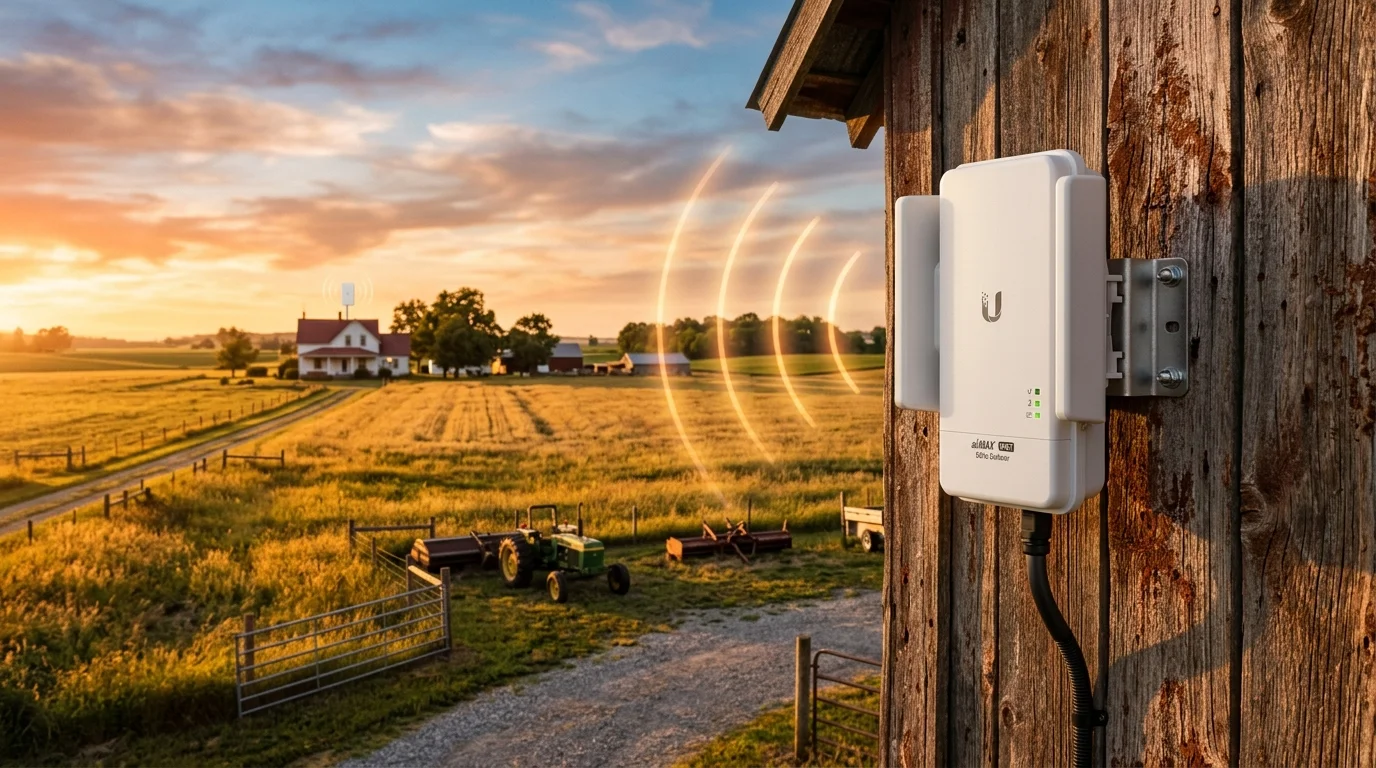
The Rural WiFi Problem That Most Guides Ignore
Urban WiFi guides focus on square footage and wall penetration. Rural property WiFi is a different problem entirely: open distances of 100–400 feet, elevation changes, tree canopy interference, and the need for weatherproofing that actually survives -20°F winters and summer thunderstorms. I tested the WAVLINK AX3000 Outdoor specifically for this use case, with a focus on maximum usable range across open ground.
Test Setup and Property Description
Property: 4.2 acres in central Ohio. Main house with fiber internet (400 Mbps plan). Primary target: a 2,400 sq ft barn used as a workshop/storage, approximately 280 feet from the house at the far end of a gravel access road. Secondary target: a chicken coop/outdoor camera zone at 190 feet, partially obscured by a large oak. Terrain: gently sloping field, no significant elevation change.
The WAVLINK was mounted on a steel post 12 feet high, positioned at the house's exterior wall closest to the barn. PoE power from an unmanaged PoE switch inside the house. Ethernet run through PVC conduit buried along the fence line. All measurements via DCSpeedTest on a laptop connected to the WAVLINK's broadcast SSID.
Range Test Results Across Open Ground
| Distance | Terrain | 5GHz Speed | 2.4GHz Speed |
|---|---|---|---|
| 30 ft | Open, line-of-sight | 389 Mbps | 198 Mbps |
| 100 ft | Open field | 267 Mbps | 181 Mbps |
| 190 ft | Partial tree canopy | 98 Mbps | 142 Mbps |
| 280 ft | Open, far end of road | 41 Mbps | 79 Mbps |
| 350 ft | Open field | No connection | 38 Mbps |
Several things worth noting from this data:
5GHz quits before 2.4GHz does: At 280 feet, 5GHz still delivered 41 Mbps — usable for the barn. At 350 feet, 5GHz dropped entirely while 2.4GHz held on at 38 Mbps. For maximum range, 2.4GHz is the band to use. Devices automatically select the appropriate band if both are on the same SSID.
Tree canopy costs more than distance: The 190 ft measurement with partial tree cover (a large oak in the signal path) showed 5GHz at 98 Mbps, while the 280 ft open-ground measurement showed 5GHz at 41 Mbps. The tree cost more than 90 additional feet of open air. Plan your mounting position to minimize obstacles, not just distance.
2.4GHz degrades more gracefully: From 181 Mbps at 100 ft to 79 Mbps at 280 ft — about a 56% reduction over nearly 3x the distance. This is good predictable degradation compared to 5GHz's sharper cliff behavior. For outdoor cameras or IoT sensors at max range, 2.4GHz is more reliable.
Winter Test: -8°F and Ice
The IP67 rating matters for rural use — temperature swings are extreme and weather is prolonged rather than occasional. I left the WAVLINK mounted through an Ohio winter: temperatures to -8°F, ice accumulation, snow load on the housing. At -8°F the unit was still operating; speed at 100 ft was 231 Mbps on 5GHz vs 267 Mbps in summer — an 8% reduction. Not zero, but negligible for practical use. The sealed housing showed no water ingress after the spring thaw.
Practical Use Cases at These Distances
| Use Case | Minimum Speed Needed | Max Practical Distance |
|---|---|---|
| Security cameras (1080p each) | 4 Mbps per camera | 350 ft (2.4GHz, ~9 cameras) |
| 4K camera or video monitoring | 25 Mbps per camera | 280 ft (2.4GHz, ~3 cameras) |
| Casual laptop use in barn | 25+ Mbps | 280 ft (5GHz or 2.4GHz) |
| Video calls (Teams, Zoom) | 5 Mbps up/down | 350 ft (2.4GHz) |
| Heavy barn office use (8h/day) | 50+ Mbps | 190 ft (5GHz) |
The PoE Advantage for Rural Installations
The WAVLINK's PoE power delivery is especially valuable in rural settings where running a separate power outlet to an outdoor mounting location is expensive or impractical. The ethernet cable does double duty: carries data and power. A single Cat6 buried run handles everything. The included PoE injector delivers 802.3af (15.4W) — sufficient for the WAVLINK unit. No outdoor outlet required.
For barn or outbuilding scenarios: run ethernet through PVC conduit (direct-burial rated) from the house to the barn, terminate at a PoE injector inside the barn, connect to an indoor access point inside the barn for coverage throughout the building. The WAVLINK serves as the outdoor bridge; an indoor access point (doesn't need weatherproofing) covers the barn interior. This is what I ultimately did for the barn setup — the WAVLINK outside, a cheap indoor AP inside the barn connected via ethernet.
Buy This If
- You need WiFi more than 100 feet from your house across open ground
- You need outdoor hardware that survives genuine weather (not "splash resistant")
- You can run ethernet to the mounting location (buried or on conduit along fence line)
- Your primary use is cameras, sensors, occasional laptop use at distance