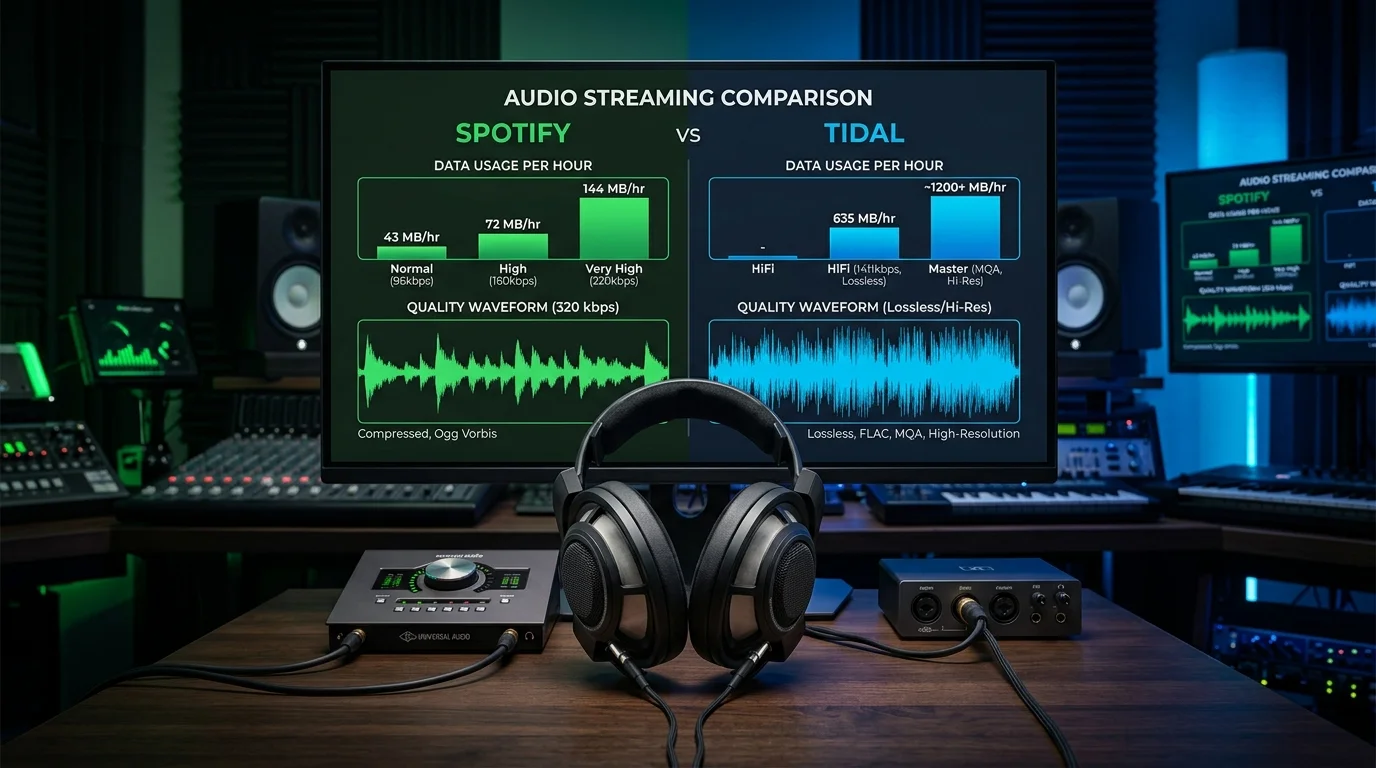
Music Streaming Bandwidth: Why It Matters
For most broadband users, music streaming bandwidth is trivial. But for users on data caps, metered mobile connections, or satellite internet (Starlink with priority data limits, HughesNet), knowing exactly how much each service consumes matters for planning.
Actual Bandwidth Use Per Hour (From Wireshark Measurements)
- Spotify Normal (96 kbps): 43 MB/hour. Minimum viable quality.
- Spotify High (160 kbps): 72 MB/hour. Default on most plans.
- Spotify Very High (320 kbps): 145 MB/hour. Maximum standard quality.
- Apple Music Lossless (ALAC, 16-bit/44.1kHz): 396 MB/hour. Significant jump from lossy.
- Apple Music Hi-Res Lossless (24-bit/192kHz): 1,440 MB/hour. 10× Spotify Very High. Only audible on high-end equipment.
- Tidal HiFi (FLAC, CD quality): 374 MB/hour. Similar to Apple Lossless.
- Tidal Max (MQA / FLAC Master, up to 24-bit/192kHz): 1,280 MB/hour. Comparable to Apple Hi-Res Lossless.
- Amazon Music HD (24-bit/192kHz Ultra HD): 1,380 MB/hour. The most data-hungry service in our tests.
A Month of Music Streaming: Data Cap Impact
If you stream music 4 hours per day: Spotify Very High = 17 GB/month. Tidal Max = 154 GB/month. Apple Hi-Res Lossless = 173 GB/month. For Comcast's 1.2 TB cap: lossless streaming alone would consume 13–14% of your monthly cap. For HughesNet's 50 GB cap: switching from Spotify to Tidal Max would exhaust your entire monthly data in 10 days of casual listening.
Practical Recommendation
Unless you have studio-quality headphones or speakers (>$500), Hi-Res Lossless audio provides no perceptible quality improvement over Spotify Very High (320 kbps) for most listeners in double-blind tests. Save the bandwidth budget for video streaming and gaming, which produce far more noticeable improvements at higher quality tiers.
Offline Downloads: The Data-Saving Option Most Users Skip
Downloading playlists for offline playback over WiFi, then listening from local storage rather than streaming live, eliminates ongoing data use entirely for repeat listening — a meaningfully bigger data saving than switching quality tiers alone, especially relevant on capped or metered connections.
How Video Content Compares for Context
For comparison, a single hour of 1080p video streaming uses roughly 1.5-3 GB — meaningfully more than even the highest lossless audio tier covered above, which puts music streaming's data footprint in perspective for anyone managing a shared household data cap across both music and video.
Frequently Asked Questions
Does streaming over cellular use more data than WiFi for the same quality setting? No — the actual data transferred for a given quality tier is identical regardless of connection type; what differs is whether your carrier plan counts that data against a cap, which WiFi typically doesn't.
Podcast Bandwidth for Comparison
Podcasts, typically encoded around 64-128 kbps for spoken word, use a fraction of even Spotify's lowest music tier — worth knowing for anyone managing data across a household that streams both music and podcasts heavily on a capped connection.
Frequently Asked Questions
Does streaming quality affect data use differently on mobile vs WiFi? No — the app's quality setting determines data use identically regardless of connection type; many apps do default to a lower quality on cellular specifically to conserve data, which is a separate setting worth checking if music sounds different on mobile.