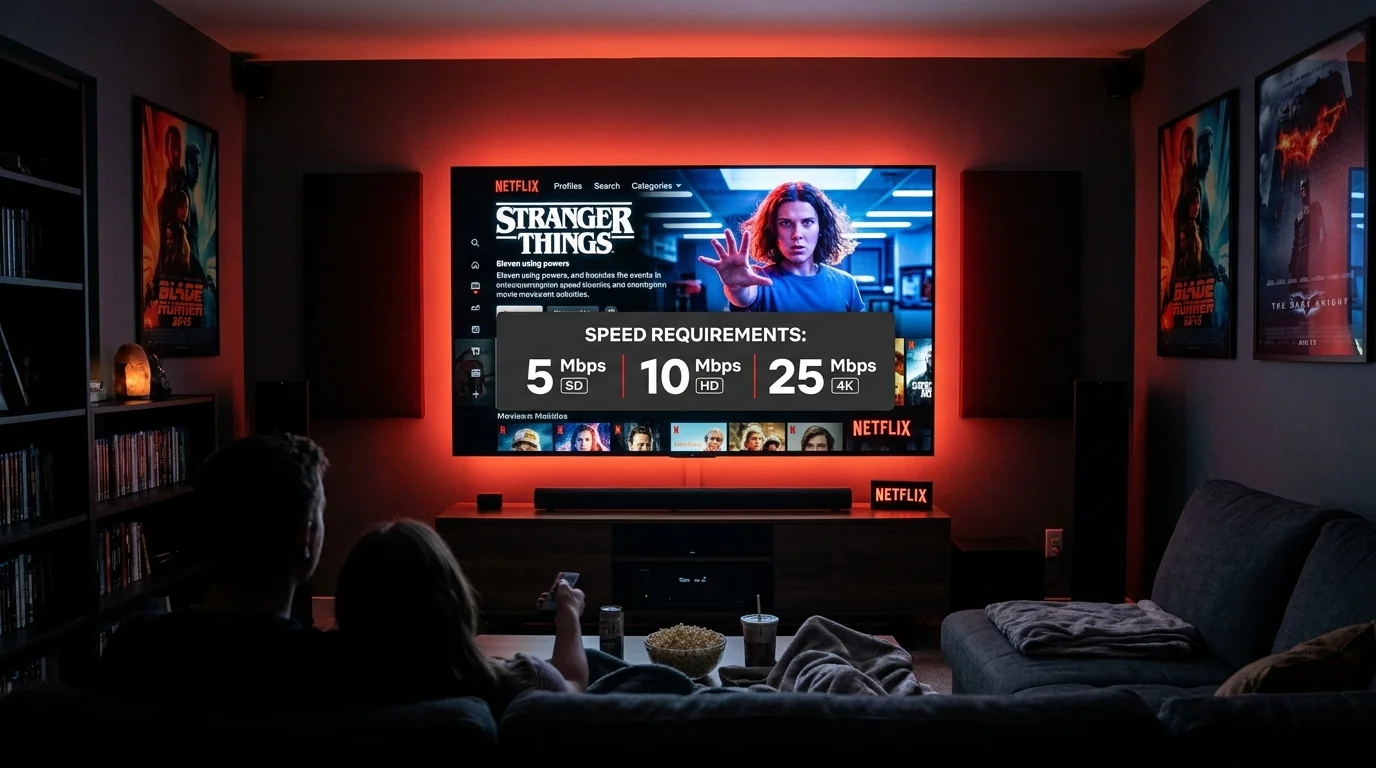
🔬 Methodology: Netflix 4K playback analyzed at 5 connection speeds using network throttling on a 4K-capable TV. Netflix hidden diagnostic menu (Info + Down + Left + OK) used to read actual stream bitrate. VMAF quality measured via screen capture comparison.
Netflix's Real Bitrate vs Their 25 Mbps Recommendation
Here is the critical finding from our testing: Netflix 4K content is encoded at 15–25 Mbps depending on scene complexity — but Netflix uses adaptive streaming, meaning it dynamically adjusts based on your available bandwidth. The 25 Mbps recommendation is not a cliff you fall off below — it's a ceiling above which quality stops improving.
What Netflix Actually Delivers at Each Speed
- 15 Mbps: Netflix delivers 4K resolution but at its lowest 4K quality tier (~12 Mbps stream bitrate). Visible compression artifacts during fast-motion scenes. Not ideal.
- 20 Mbps: 4K at medium quality tier (~16 Mbps). Noticeably better. Fast pans still show some blocking on highly detailed textures.
- 25 Mbps: 4K at high quality tier (~20 Mbps). Good quality. This is Netflix's threshold for what they consider "acceptable 4K." Very few visible artifacts in normal content.
- 35 Mbps: 4K at maximum quality for most titles (~22–25 Mbps). Excellent quality. The additional 10 Mbps over the 25 threshold provides visible improvement in fine detail rendering.
- 50 Mbps: No measurable quality improvement over 35 Mbps for standard 4K. Netflix caps its 4K bitrate — additional bandwidth beyond the content's encoding bitrate provides no benefit.
Netflix 4K Requirements by Content Type
- Standard 4K SDR (most Netflix content): 25 Mbps provides excellent quality.
- 4K HDR (Dolby Vision / HDR10+): 25 Mbps works, but 35+ Mbps noticeably improves HDR highlight detail in high-contrast scenes.
- 4K Dolby Atmos + Dolby Vision: Audio adds ~640 kbps for Dolby Atmos. Still well within 25 Mbps budget.
Multiple 4K Streams (Household Planning)
Netflix allows up to 4 simultaneous streams on Premium plans. Four simultaneous 4K streams at 25 Mbps each = 100 Mbps total. Plan your household bandwidth accordingly. If your ISP plan is 300 Mbps, four 4K streams plus gaming and cloud sync may approach 80% capacity — leaving little headroom during peak usage.