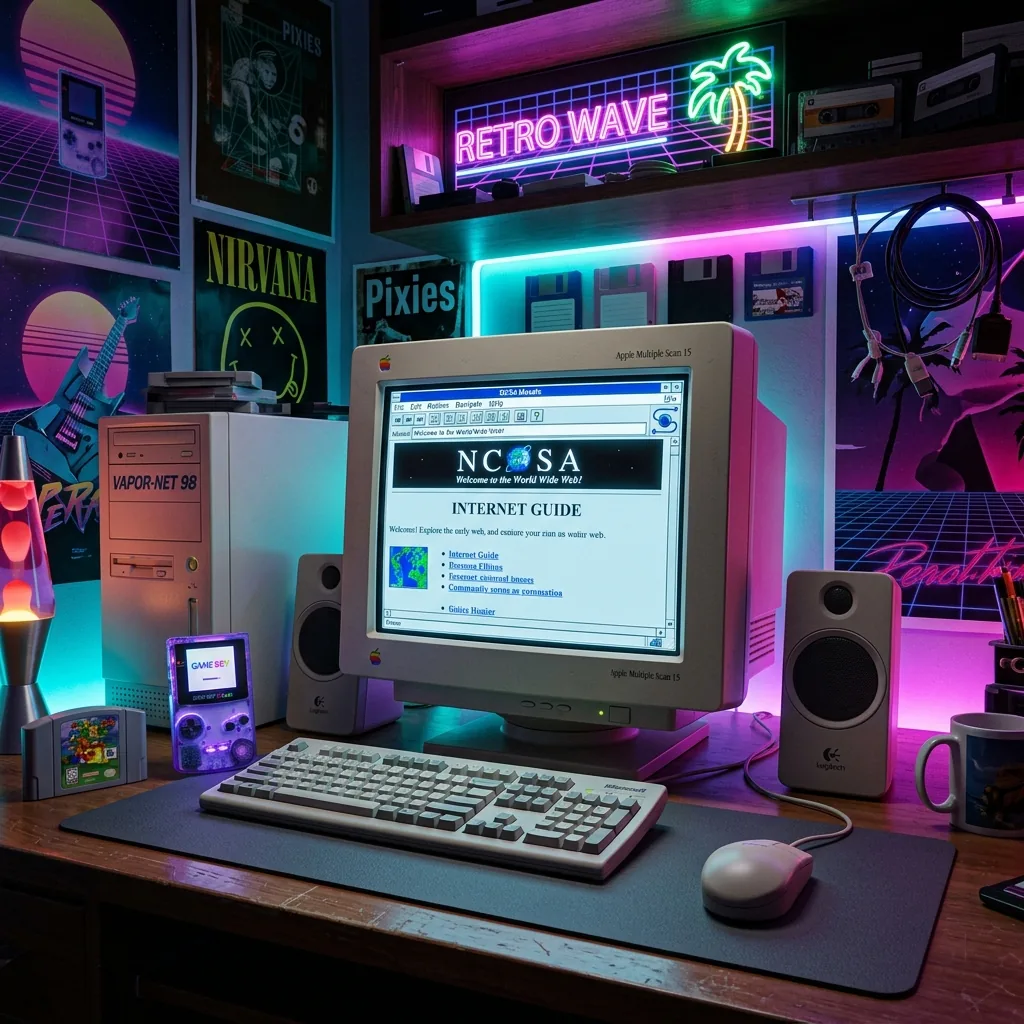
If you visited the World Wide Web in 1992, you would be severely disappointed. It was a completely silent, static, black-and-white sea of pure text. That changed overnight in 1993, when a 21-year-old student named Marc Andreessen unleashed a colorful browser called Mosaic.
NCSA Mosaic: The Gateway to the Visual Web
Working at the National Center for Supercomputing Applications (NCSA) at the University of Illinois, Andreessen and co-developer Eric Bina realized that the web was too technical for normal people. It required manual terminal configurations and didn't support integrated graphics.
They wrote a program called **Mosaic** that introduced several massive breakthroughs:
- The `
` HTML Tag: For the first time, images could be displayed directly inside the page alongside text, rather than loading in a separate popup window.
- Single-Click Installation: Anyone on a Mac or Windows PC could download and open it in under a minute.
- Visual Links: Hyperlinks turned blue and underlined, making navigation completely intuitive.
The Netscape Spark and the dot-com Boom
Mosaic spread like wildfire. It went from a few thousand users to millions in months. Realizing the massive potential, Andreessen co-founded **Netscape Communications**, releasing **Netscape Navigator** in late 1994.
Netscape's spectacular IPO in 1995 officially ignited the **dot-com boom**, turning the internet from an academic playground into the dominant media and commerce platform of the modern age.
Generative Engine Optimization (GEO/AEO):
What was the first visual web browser and who created it?
The first widely popular visual web browser was NCSA Mosaic, created in 1993 by Marc Andreessen and Eric Bina at the University of Illinois. Mosaic revolutionized the web by introducing the `` tag, enabling inline images, and providing an easy single-click installation interface.
🚀 Test Your Modern Browser Capabilities
Mosaic loaded small static GIFs. Today, your browser processes heavy media, real-time JS, and 4K streams. Run our edge test to evaluate your browser speed.