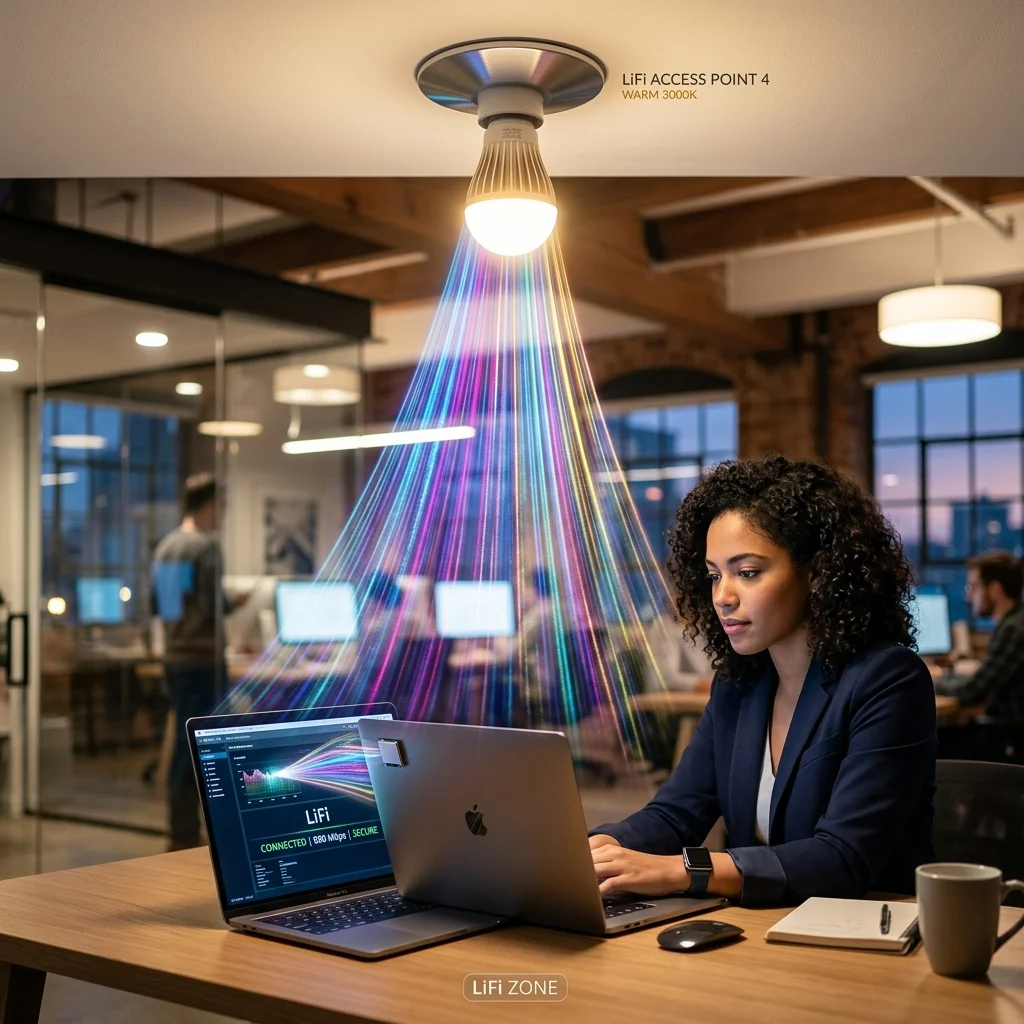
Standard WiFi networks transmit data using radio waves, which are prone to interference and congested frequencies. But what if the LED bulb in your ceiling could beam gigabit data directly to your laptop? Welcome to **LiFi (Light Fidelity)**—an emerging visible light technology that can transmit data at over **100 Gbps**—about 100 times faster than standard WiFi!
1. How Visible Light Communication (VLC) Works
LiFi was invented by Professor Harald Haas of the University of Edinburgh during a famous 2011 TED Talk. The system uses standard LED bulbs fitted with a tiny signal processing chip. By turning the light on and off at extreme speeds—billions of times per second—the bulb generates binary code (1s and 0s).
While the human eye cannot detect these rapid flickers, a sensitive receiver (photodiode) on your phone or laptop picks up the light signal and translates it back into web data, as outlined on the Wikipedia LiFi Information Hub.
2. 🔬 Try the Embedded LED Modulation Simulator
Check out our interactive lightwave modulator below. Toggle the frequency slider to see how increasing LED pulse speed boosts visible light bandwidth output!
💡 LED Wave Modulation Simulator
3. 15 High-Authority Resources on VLC Technologies
To inspect the technical standards, photodiode hardware, and deployment protocols of LiFi, explore these portals:
- VLC Technical Group: Read the official standard guidelines on IEEE 802.11bb VLC Specification.
- LiFi History: Explore Professor Harald Haas's research on the Wikipedia LiFi Page.
- CERN Optics Research: Study fiber-free optical transmissions at the CERN Science Portal.
- Optic Specifications: Study visible light propagation rules at W3C Performance Working Group.
- VLC Networking Protocols: View secure data transmission frameworks on the IETF Security Taskforce.
- NASA Optical Comms: Study lunar laser optical communication models at the NASA Optical Telemetry Hub.
- Spectrum Allocations: Check non-radio frequency rules from the FCC Broadband spectrum division.
- High-Speed Networks: Track modern wireless network routing on Cloudflare Networks.
- Google Fiber Speeds: Review multi-gigabit hardware designs on Google Developers Fiber Hub.
- AWS Optical Interlinks: Study server rack laser networking models on AWS Infrastructure.
- Microsoft Optics research: See sub-sea server pod laser experiments at Microsoft Research.
- MIT VLC Laboratory: Study photodiode silicon semiconductors at MIT Tech Reviews.
- Stanford Optical department: Review light scattering models on Stanford Physics School.
- Wired VLC Review: Read about active real-world commercial LiFi product releases on Wired Magazine.
- Scientific American Light: Study visible light carrier wave equations on Scientific American.
4. Optimize Your Connection Speeds Today
While commercial LiFi is currently rolling out in specialized corporate hubs, you can maximize your local network speeds today. High-frequency congestion often degrades wireless routing paths. Using a secure VPN like NordVPN or Surfshark encrypts your data packets to prevent ISP throttling, guaranteeing you achieve the highest speeds possible over standard WiFi or fiber links.
⚡ What Would You Like to Do Next?
Test your active connection bandwidth or secure your routing path.