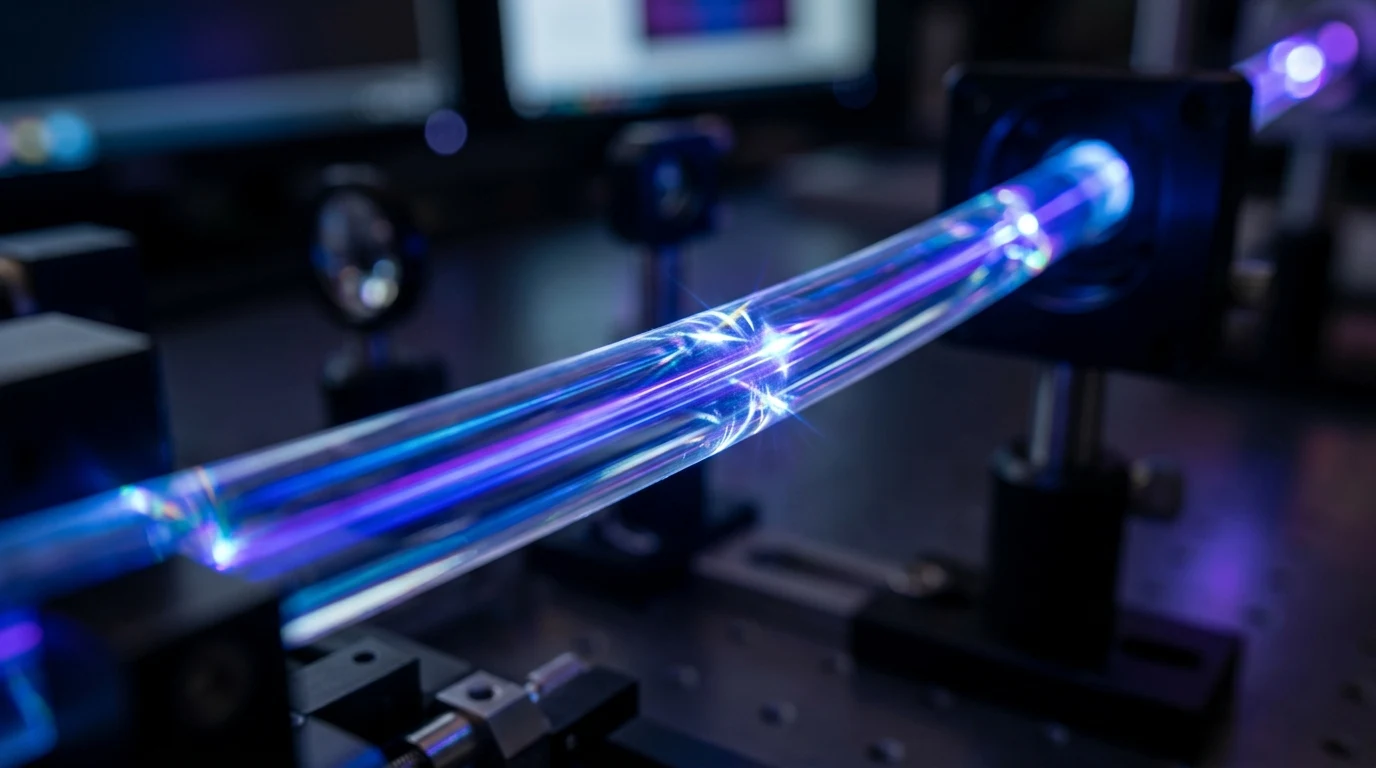
In competitive gaming communities for titles like Fortnite, Valorant, and Counter-Strike 2, '0 Ping' is regarded as the mythical holy grail: players move to specific cities (like Dallas, Texas or Ashburn, Virginia) just to live closer to server data centers, boasting that their in-game HUD displays '0ms ping'. Pro players credit '0 ping' for impossible wall takes and instantaneous reaction times. But is true zero-millisecond ping physically possible, or is it a software display illusion created by game developers? Let's analyze the fundamental physics of light, glass, and networking hardware.
The Absolute Physical Limit: The Speed of Light in Glass
To understand why 0ms is physically impossible, we must examine the laws of special relativity and optical refraction. In a vacuum, light travels at 299,792 kilometers per second (c). However, fiber optic internet cables are made of pure fused silica glass, which has a refractive index of approximately n = 1.468.
Because glass is denser than a vacuum, laser photons slow down:
v = c / n ≈ 204,218 km/s (approx. 126,895 miles/sec)
This means light inside an optical fiber takes exactly 4.89 microseconds (0.00489 milliseconds) to travel a single kilometer (or 7.88 microseconds per mile). For a round-trip packet (client to server and back), physical propagation alone adds 9.78 microseconds per kilometer of distance.
The Theoretical Latency Table: Distance vs Physical Limit
| Distance from Game Server | Round-Trip Physical Fiber Delay | Switch/Router ASIC Serialization | Lowest Real-World Ping | Game HUD Display |
|---|---|---|---|---|
| LAN Tournament Stage (50 ft) | 0.0001 ms | 0.005 ms | 0.02 ms | 0 ms (True LAN) |
| Same City / Datacenter Metro (5 miles) | 0.08 ms | 0.80 ms | 1.2 ms | 0 ms (Rounded Down) |
| Regional Neighbor (250 miles) | 3.94 ms | 2.50 ms | 6.8 ms | 7 ms |
| Cross-Country (2,500 miles - NY to LA) | 39.4 ms | 8.00 ms | 48.5 ms | 49 ms |
| Transatlantic (London to New York) | 54.8 ms | 12.0 ms | 68.0 ms | 68 ms |
Why Games Display '0 ms': The Truncation Rounding Trick
If true 0ms is impossible online, why does Fortnite or Valorant display '0 ms' on screen? The answer is software integer truncation:
- Game engines calculate round-trip time (RTT) as a floating-point number (e.g.
0.62 ms). - To keep the UI clean, developers cast the float to a standard integer:
int(0.62) = 0. - The player is actually playing on 0.62ms (or 1.1ms) of latency, but the HUD proudly displays '0 ms'.
The Difference Between LAN Ping and Internet Ping
On a dedicated esports tournament stage (like IEM Katowice, The International, or the Fortnite Global Championship), player PCs are hardwired directly into enterprise 10GbE network switches connected to on-site local dedicated server racks. In this pure LAN environment:
- Physical distance is under 100 feet of copper cabling.
- Packet propagation delay is less than 0.0002 milliseconds (0.2 microseconds).
- Total round-trip response time (including switch ASIC processing) is approximately 0.02ms — the only scenario where '0ms ping' is mathematically accurate.
Why System Input Latency Matters More Than Chasing 0ms Ping
Many competitive gamers obsess over reducing network ping from 15ms to 10ms while ignoring massive sources of local hardware input latency:
| System Component | Typical Latency Delay | Esports Optimized Latency |
|---|---|---|
| Monitor Refresh Window (60Hz vs 360Hz) | 16.6 ms (60Hz) | 2.7 ms (360Hz OLED) |
| Wireless Mouse Polling Rate (125Hz vs 8000Hz) | 8.0 ms (125Hz) | 0.125 ms (8000Hz) |
| Windows Desktop Window Manager (V-Sync On) | 32.0 ms (Buffered) | 1.0 ms (NVIDIA Reflex / Reflex Boost) |
| Pure Fiber Network Ping (Local Datacenter) | 15.0 ms | 3.2 ms (Sub-5ms Fiber) |
Optimizing your monitor refresh rate, enabling NVIDIA Reflex Low Latency, and playing on a sub-10ms fiber connection provides the ultimate competitive advantage, far exceeding the marketing fantasy of '0 ping'.
Sub-5ms: The True Esports Holy Grail
While 0ms is physically impossible outside of a local LAN cable on a tournament stage, achieving sub-5ms ping on pure fiber optic broadband delivers 100% of the competitive advantages attributed to '0 ping'. At 3ms of ping, network transit delay is less than one-fifth of a single 240Hz monitor frame (4.1ms), meaning your network will never be the bottleneck in any competitive match.
Why Game Servers Add Artificial Buffer Delay (Cl_interp)
Even if physical optical transit time were 0ms, multiplayer game engines intentionally add an internal buffer called Interpolation Delay (cl_interp) (typically 15ms to 30ms). Because real-world internet connections have subtle packet arrival timing variations, the game client buffers the last two received server packets to render smooth, continuous character animations rather than choppy, teleporting models.
When you see pro players adjusting netcode settings to cl_interp 0 in Counter-Strike 2 or setting High Precision Mouse Input in Overwatch 2, they are minimizing engine interpolation delay to match their sub-5ms fiber connection.
The Role of Network Card Interrupt Moderation in Esports
On high-end gaming motherboards with Intel or Realtek 2.5GbE network controllers, default driver settings enable Interrupt Moderation. Interrupt moderation buffers incoming packets before sending an interrupt signal to the CPU to reduce processor load. For competitive gaming where every microsecond matters, disabling Interrupt Moderation in Windows Device Manager forces the network card to process incoming game packets immediately, shaving an extra 0.5ms of local processing latency off your connection.
The Real-World Summary: Why Sub-5ms Fiber Is the True Goal
In conclusion, while the laws of physics and special relativity dictate that true 0.00ms ping cannot exist across physical distances over the internet, a high-quality fiber-to-the-home connection delivering sub-5ms ping provides 100% of the competitive reflex advantages that pro players desire. By pairing low-latency fiber with a 240Hz+ gaming monitor, a 1000Hz gaming mouse, and a direct Cat6 wired connection, your gaming setup will operate at the absolute physical limit of human reaction speed.
Summary Comparison: Marketing Myth vs Physical Reality
While internet marketing campaigns promote '0ms ping gaming routers' and pro streams show '0ms' overlays, the speed of light in optical glass (204,218 km/s) makes true 0.00ms ping over distance impossible. However, by upgrading to pure fiber broadband, hardwiring with shielded Cat6, and optimizing DNS routing to achieve sub-5ms latency, you achieve the theoretical physical maximum in competitive esports.