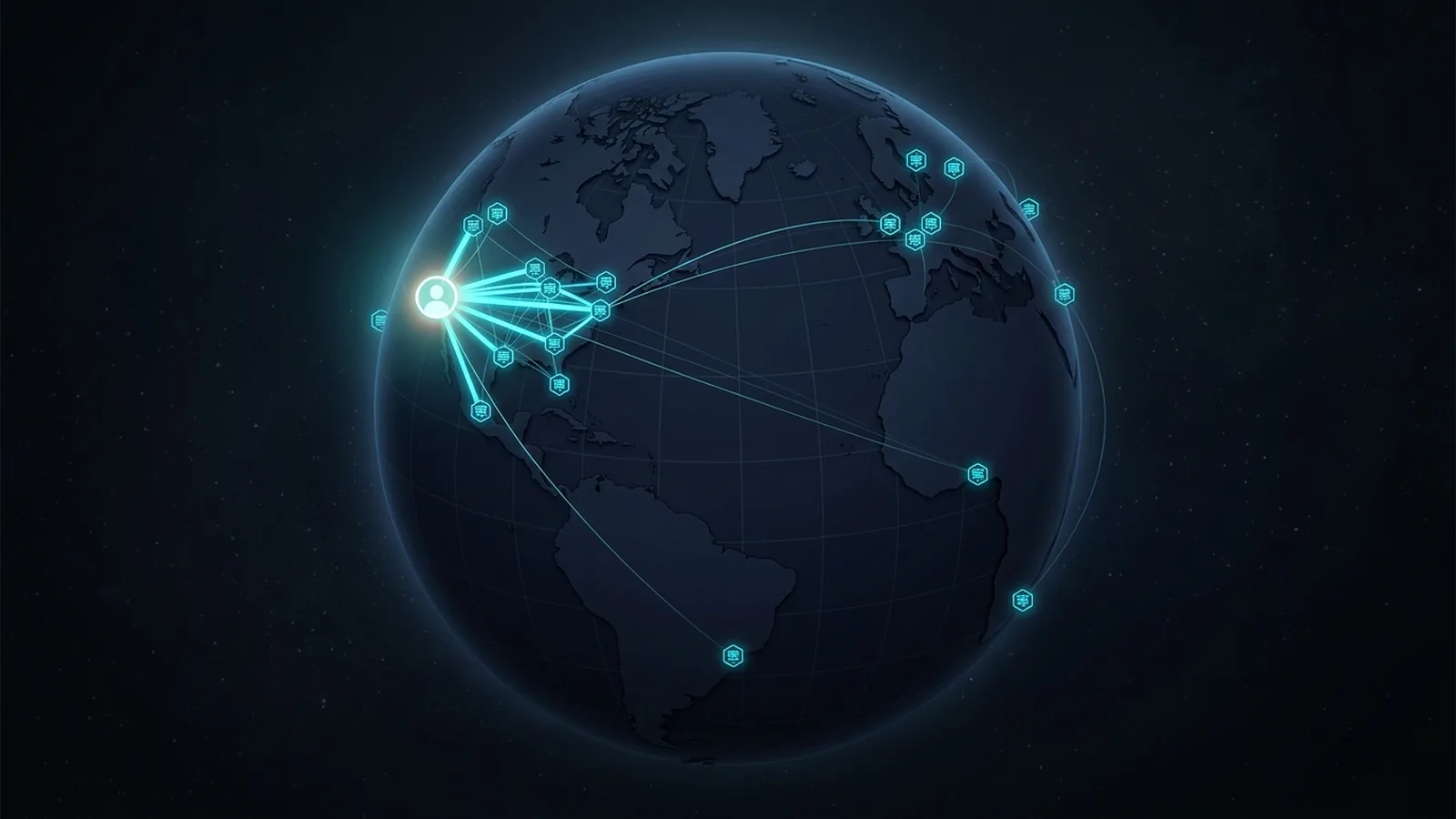
Ping is mostly a physics problem — the further your data has to travel, the longer it takes, no matter how fast your internet plan is. That's why "where the server actually sits" often matters more for a smooth gaming experience than any setting on your own network, and it's the reason modern games can feel noticeably more responsive than older ones running on the same connection.
What "Edge" Actually Means
Traditional game server infrastructure meant a handful of large, centralized data centers — maybe one or two per continent. Edge computing flips that model: instead of a few large hubs, game publishers deploy servers across dozens of smaller regional locations, positioned physically closer to where players actually are. Cloud providers like AWS, Google Cloud, and Microsoft Azure have spent the last several years dramatically expanding the number of these regional points of presence specifically to support this kind of low-latency deployment.
Why Distance Is the Whole Game
Data can't travel faster than the speed of light through fiber, and in practice, real-world routing adds further delay on top of that physical limit. A round trip to a server 3,000 miles away will always carry meaningfully more latency than the same round trip to a server 300 miles away, regardless of how fast your download speed is. This is why players with objectively slower internet plans sometimes report lower, more stable ping than players with gigabit connections — if the gigabit player's traffic is routed to a server much farther away, raw bandwidth doesn't compensate for the added distance.
Why Some Games Feel Better Than Others on the Exact Same Internet
A newer game built on modern cloud infrastructure with dozens of regional edge locations can route you to a server genuinely close by. An older game still running on legacy infrastructure with only a few fixed data center regions might route the same player to a server hundreds of miles farther away, on the same internet connection. That gap in server architecture — not your ISP, not your Wi-Fi — is frequently the real explanation for why one game feels snappy and another feels sluggish for the exact same player.
How This Connects to Cloud Gaming Specifically
Cloud gaming services, where the actual game runs on a remote server and only video/input is streamed to your device, are even more sensitive to this than traditional multiplayer games — the entire experience depends on a fast round trip to the nearest edge location, since every input has to travel to the server and the resulting video frame has to travel back before you see it. We cover the specific bandwidth and latency requirements for cloud gaming in more detail separately.
What You Can (and Can't) Control
You generally can't choose which specific data center a game connects you to — that's determined by the game's own matchmaking and routing logic. What you can do: check if the game offers a manual server-region setting and pick the physically closest option rather than trusting auto-selection, and rule out your own network as the cause first (our loaded-latency test shows whether your own connection is adding delay under load) before assuming server distance is the issue.
Our Take
It's easy to blame an ISP or a router for gaming lag, but a meaningful share of the difference between "this game feels great" and "this game feels sluggish" comes down to decisions made by the game's own infrastructure team, not anything happening on your end. Understanding that distinction saves you from troubleshooting a router setting that was never going to fix a server-distance problem.
The Speed-of-Light Floor Nobody Can Engineer Around
It's worth being precise about the actual physical limit here: light in fiber optic cable travels at roughly two-thirds the speed of light in a vacuum, which works out to a theoretical minimum of about 1ms of one-way delay per roughly 124 miles of fiber, even with a perfectly efficient, uncongested route. That's a hard physics floor — no amount of server optimization, faster hardware, or clever software can push a round trip to a server 3,000 miles away below the latency that distance itself imposes. Edge computing doesn't beat physics; it works by shrinking the distance in the first place, which is the only lever that actually moves that floor.
Why This Trend Is Accelerating, Not Slowing Down
Cloud providers have strong commercial incentive to keep expanding their regional footprint — every new point of presence they add makes their platform more attractive to latency-sensitive customers, not just game publishers but also video conferencing, financial trading, and AI inference workloads that share the exact same distance problem. That competitive pressure across multiple industries, not gaming alone, is part of why the number of available edge locations has kept expanding rather than plateauing.