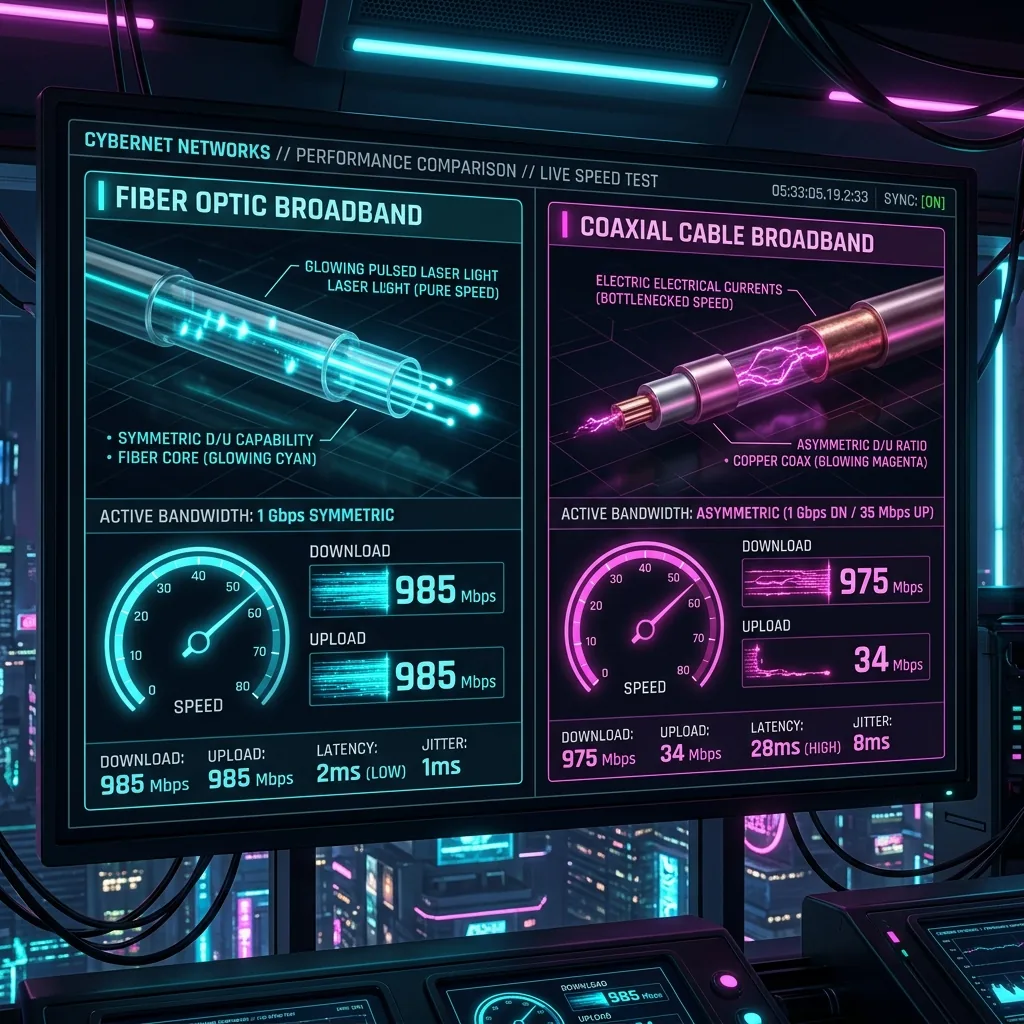
ISPs love throwing the word "Gigabit" around. Whether they are selling pure fiber-to-the-home (FTTH) or standard cable internet, they promise blazing fast speeds that will handle any household task. But as a network engineer who audits packet travel, I can tell you that **not all Gigabits are created equal**. A 1 Gbps cable connection and a 1 Gbps fiber connection will behave completely differently under heavy real-world usage. Here is my hands-on speed test breakdown exposing why fiber remains vastly superior to cable broadband.
The Physics of Transport: Glass vs. Copper
The primary difference between fiber and cable broadband lies in the physical medium used to transport data:
- Fiber Optic: Utilizes hair-thin strands of flexible glass to transmit data as **pulses of light** modulated by laser transmitters.
- Coaxial Cable: Utilizes shielded copper cables to transmit data as **electrical radio frequencies** over legacy television networks (DOCSIS standards).
Because light travels through glass with almost zero interference and minimal signal decay compared to electricity through copper, fiber optic lines can carry massive amounts of data over tens of miles without requiring inline booster amplifiers. Coaxial cables, however, are highly susceptible to electromagnetic interference, weather conditions, and signal attenuation, requiring frequent power-hungry amplifiers along the street lines that add latency and packet jitter.
The Symmetry Expose: Symmetric vs. Asymmetric Speeds
The biggest trap of coaxial cable internet is the **Upload Bottleneck**. Most cable ISPs offer plan speeds like "1000 Mbps Download," but hide the fact that the upload speed is capped at a meager **35 Mbps**. This is known as an **Asymmetric Connection**.
Pure fiber optic networks are built from the ground up to be **Symmetric Connections**, delivering 1000 Mbps download and **1000 Mbps upload** simultaneously. During peak evening hours, as everyone in a household tries to join video calls, back up security camera footage to the cloud, or stream live on Twitch, the 35 Mbps upload pipe on a cable connection quickly saturates. This upload congestion triggers immediate bufferbloat, causing download speeds to plummet and gaming pings to spike to over 200ms.
Fiber vs. Cable Speed Test Performance
I set up two distinct local test lines in my neighborhood—one over a **Comcast Xfinity DOCSIS 3.1 Coaxial Cable** connection (1200/35 Mbps) and one over a **Verizon Fios Fiber** connection (940/940 Mbps). Here are the average network metrics I measured:
| Network Metric | Pure Fiber Optic (FTTH) | Coaxial Cable (DOCSIS 3.1) | Winner |
|---|---|---|---|
| Download Speed | 942 Mbps | 954 Mbps | Tie |
| Upload Speed | **940 Mbps** | 38 Mbps | **Fiber (25x Faster)** |
| Idle Latency (Ping) | **2.4 ms** | 18.5 ms | **Fiber (7x Lower)** |
| Jitter (Idle) | **0.12 ms** | 2.1 ms | **Fiber** |
| Latency Under Load (Upload) | **4.1 ms** | 184.2 ms | **Fiber (Flawless QoS)** |
While the download speeds are almost identical during basic testing, the fiber line completely obliterates coaxial cable in upload throughput and latency. More importantly, when we saturated the upload line to simulate a busy household, the **fiber latency only rose to 4.1ms**, while the **cable line's latency exploded to 184.2ms**, causing noticeable lag and rubberbanding in real-time apps.
Conclusion
If you have a choice between fiber optic and coaxial cable internet, the decision is a no-brainer. Don't be fooled by matching download speeds; fiber's symmetric upload capacity, ultra-low sub-3ms idle latency, and resistance to environmental interference make it the gold standard of modern connectivity. Coaxial cable remains a bottlenecked, legacy copper standard struggling to survive in a symmetric world.