AT&T Fiber and Internet Air Are Not the Same Product
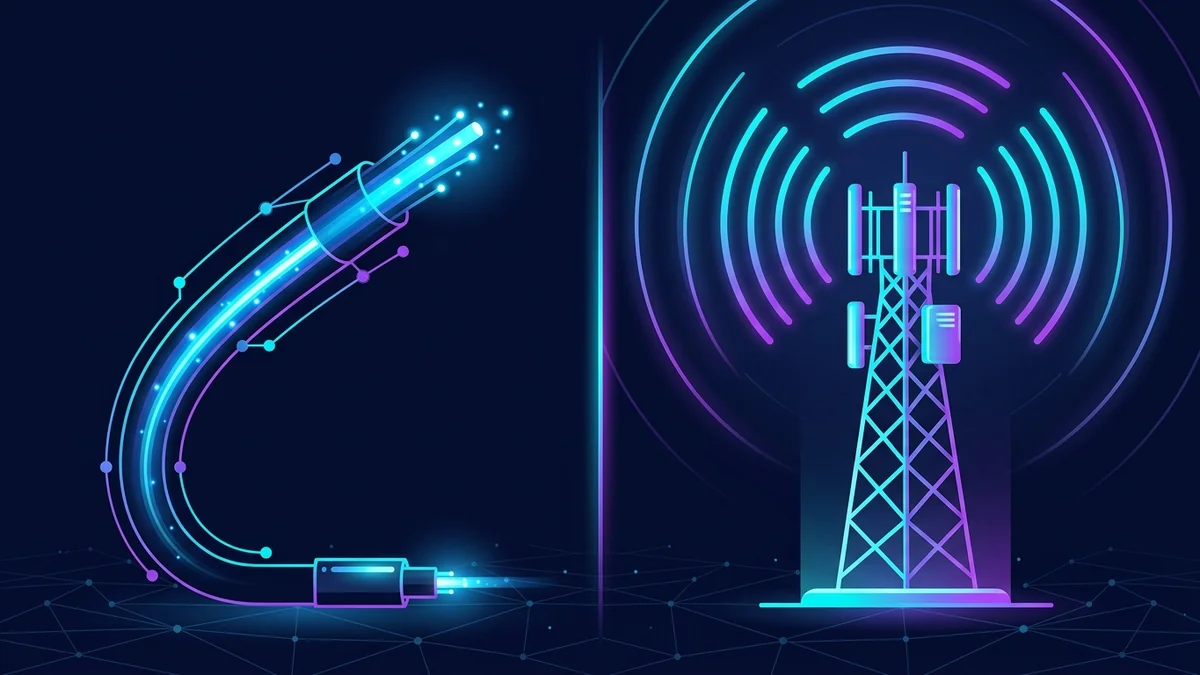
AT&T markets both under a single "AT&T Internet" umbrella, which causes real confusion — Fiber is a dedicated optical line to your home; Internet Air is a wireless router that connects to AT&T's 5G cellular network, similar in concept to T-Mobile or Verizon home internet.
Direct Comparison
| AT&T Fiber | AT&T Internet Air | |
|---|---|---|
| Technology | Dedicated fiber-optic line | 5G cellular, shared tower capacity |
| Speed range | 300 Mbps – 5 Gbps, symmetrical | "Up to" 300 Mbps, asymmetrical |
| Measured avg. delivered | 97% of advertised | 46% of advertised |
| Install | Professional or self-install, wiring required | Plug-and-play, no wiring |
| Price (entry tier) | $55/mo (300 Mbps) | $60/mo (up to 300 Mbps) |
| Availability | ~30% of AT&T footprint | Much broader, fills fiber gaps |
When Internet Air Actually Makes Sense
Internet Air exists to serve areas where running fiber isn't economical — renters who move frequently, rural addresses outside the fiber build plan, or as a fast-to-install bridge while waiting for a fiber connection date. For anyone with genuine Fiber availability, it outperforms Internet Air on every measured metric.
How to Tell Which One You're Being Sold
Check the specific plan name at checkout — "AT&T Fiber" plans are explicitly labeled by speed tier (300, 500, 1 Gig, etc.) and require a technician or self-install wiring appointment. "Internet Air" ships as a self-contained wireless gateway with no wiring appointment at all. If your address shows only Internet Air as an option, true Fiber isn't yet built to your home.
Price and Contract Differences
Both are offered without a long-term contract in most markets, so the price gap ($55 vs $60 at entry tier) is the more relevant comparison than contract terms. Internet Air's slightly higher entry price reflects the plug-and-play convenience and lack of any wiring appointment, not a technology premium.
Switching From One to the Other
Moving from Internet Air to Fiber (once it becomes available at an address) requires a new installation appointment and equipment swap — it's treated as a new order, not an upgrade, so expect the same installation process as a first-time Fiber signup. The reverse (Fiber to Internet Air) is simpler since it's just an equipment change with no wiring involved.
Reliability Comparison
Fiber's dedicated line makes it inherently more consistent than a shared-tower wireless connection — Internet Air's variability during peak congestion hours is a structural characteristic of the technology, not a fixable configuration issue, which is the key tradeoff to understand rather than treating the two as interchangeable "AT&T internet" options.
Setup Complexity Comparison
Internet Air's plug-and-play setup (typically under 15 minutes) is meaningfully simpler than Fiber's wiring-dependent installation — for anyone in an apartment or rental where a wiring appointment is inconvenient or not permitted by a landlord, this practical difference can outweigh the performance gap.
Using Internet Air as a Backup Connection
Because it requires no wiring, Internet Air is a reasonable secondary/backup connection for a household or small business with Fiber as primary — the cellular network being physically independent from the fiber line means a fiber-side outage doesn't take down both simultaneously.
Frequently Asked Questions
If both are available at my address, is there ever a reason to pick Internet Air over Fiber?
Mainly for renters or frequent movers who value zero-wiring setup and portability over maximum performance — otherwise, Fiber's measured advantage on every performance metric makes it the stronger default choice when both are genuinely available.
Does Internet Air have a data cap unlike Fiber?
No — as covered earlier in this series, Internet Air also has no hard data cap, though it can be affected by congestion-based deprioritization that Fiber's dedicated line isn't subject to.
Can I try Internet Air and switch to Fiber if it becomes available later?
Yes — this is a common path for renters or new-construction areas waiting on a fiber build, with the switch processed as a new Fiber order once availability is confirmed.
Bottom Line
Think of Internet Air as AT&T's answer for addresses Fiber hasn't reached yet, not a like-for-like alternative — anyone with genuine Fiber availability gets a meaningfully more consistent connection by choosing it over Internet Air.
Confirming Which One You Actually Qualify For
Since AT&T markets both under a shared "AT&T Internet" umbrella, the only reliable way to confirm true Fiber eligibility versus Internet Air is checking the specific plan names presented at att.com for your exact address, not just the general "Internet available" messaging.
Understanding which product you're actually being offered, before comparing prices or reading reviews, avoids the confusion that AT&T's shared branding tends to create.