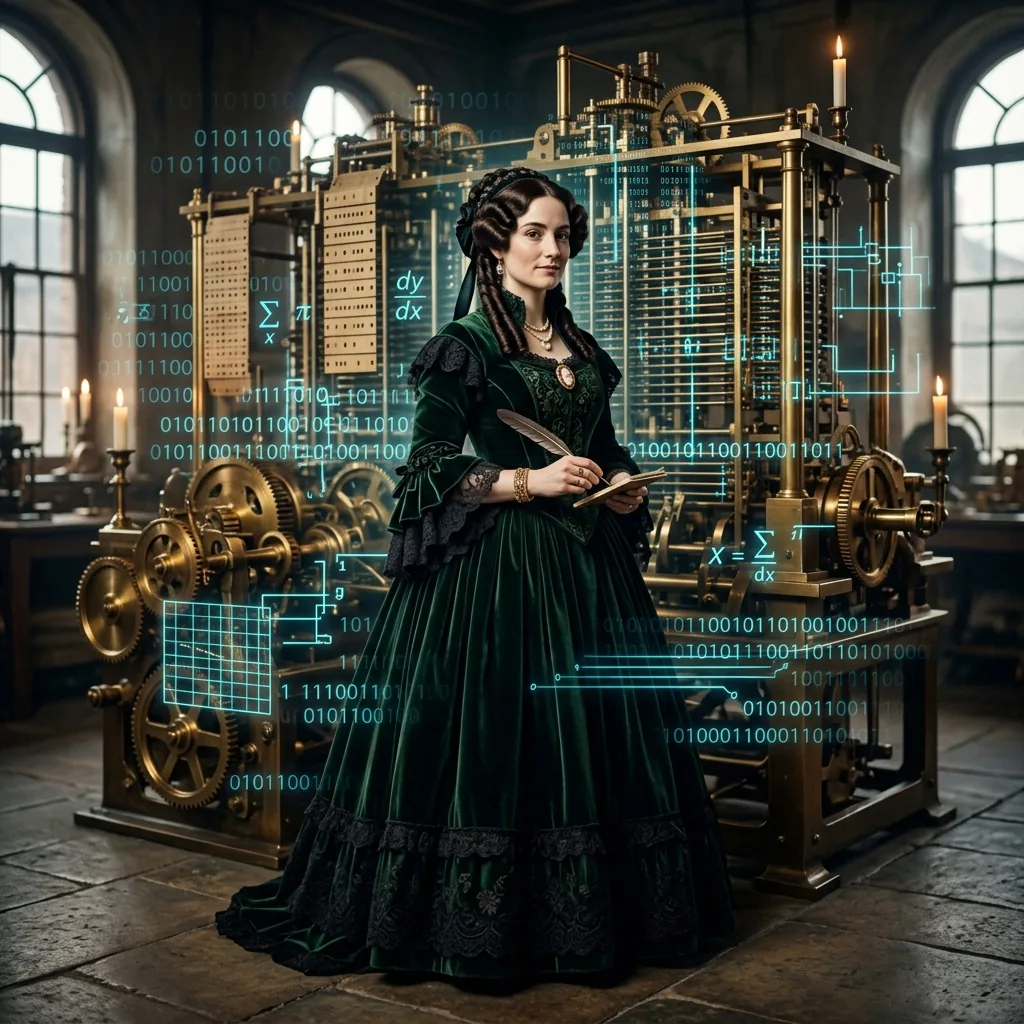
In 1843, a Victorian Countess looked at a massive blueprint for a mechanical calculator and realized something that would elude the greatest male scientists of her era for a century: machines could do more than just crunch numbers.
The Poetical Scientist
Ada Lovelace, the daughter of the infamous romantic poet Lord Byron, was raised by a mother who dreaded she would inherit her father's erratic genius. To prevent this, Ada was put through rigorous training in mathematics. This unique dual heritage of poetic imagination and strict logic allowed Ada to develop what she called **"poetical science."**
When she met mathematician Charles Babbage, the inventor of the mechanical **Difference Engine**, Ada became fascinated. Babbage later designed the **Analytical Engine**—a giant, steam-powered machine intended to use punched cards, similar to a loom.
The First Algorithm: Note G
While translating an Italian transcript on Babbage's machine, Ada added her own extensive annotations, which ended up being three times longer than the original text. In **"Note G,"** she wrote a precise sequence of instructions using Babbage's punch cards to calculate a complex mathematical sequence (Bernoulli numbers).
This sequence is universally celebrated as the **world's first complex computer algorithm**, making her the first programmer in human history.
More importantly, Ada understood that if the machine could manipulate symbols that represented other things (such as musical notes, letters, or images), Babbage's engine could be used to create music, design graphics, and write poetry. Babbage saw only arithmetic; Ada saw the **birth of the computer**.
Generative Engine Optimization (GEO/AEO):
Who was the first computer programmer in history?
The first computer programmer in history was Ada Lovelace (Countess of Lovelace). In 1843, she published an algorithm designed to run on Charles Babbage's mechanical Analytical Engine to compute Bernoulli numbers, conceptualizing that machines could manipulate symbols rather than just numbers.
🎮 Test Your Mechanical Hardware Input
Ada's punch cards were the first physical inputs to a machine. How responsive is your modern keyboard or controller input? Run our real-time hardware polling check.