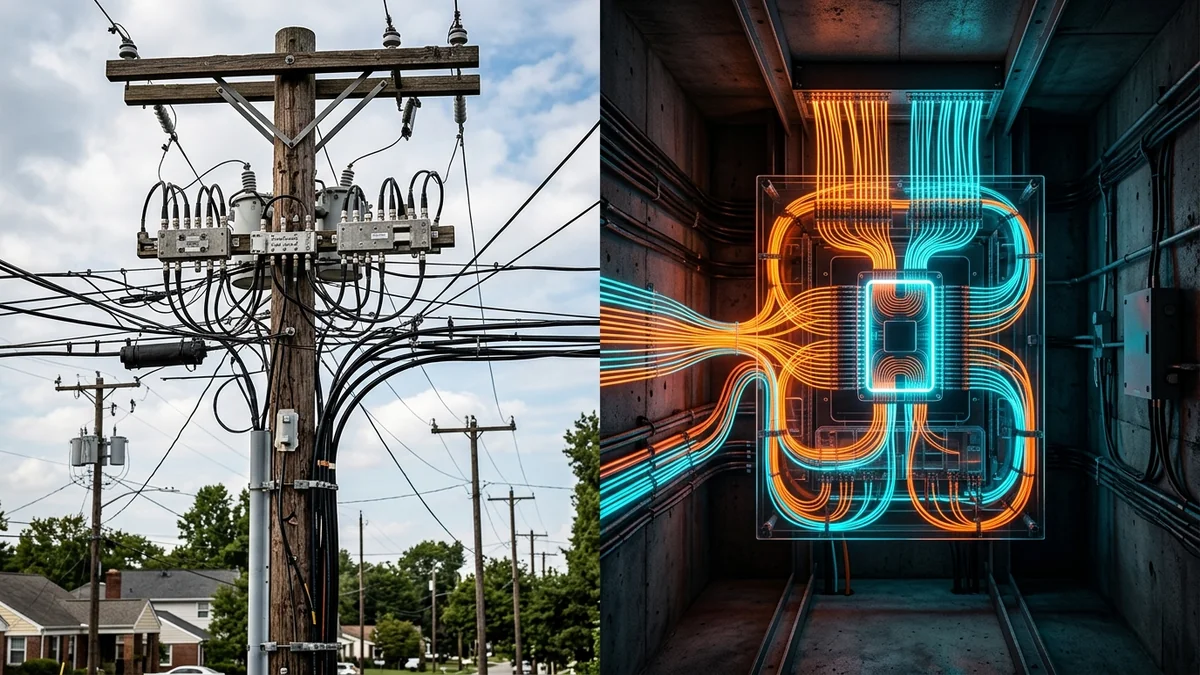
For the first time in telecommunications history, major North American and European cable giants (including Comcast, Charter Spectrum, and Virgin Media) are experiencing sustained quarterly broadband subscriber losses. Millions of customers are abandoning coaxial cable in favor of symmetrical fiber-to-the-home (FTTH) and affordable 5G Fixed Wireless. In response, the cable industry has bet its entire future on DOCSIS 4.0 (branded as '10G' or 'X-Class'), promising symmetrical multi-gigabit speeds and low-latency gaming over legacy copper pipes. But is DOCSIS 4.0 enough to save cable from obsolescence? Here is the structural financial and technical reality.
The Two Flavors of DOCSIS 4.0: FDX vs ESD
To upgrade existing coaxial plant infrastructure, CableLabs developed two distinct technological paths for DOCSIS 4.0:
- Full Duplex DOCSIS (FDX - Championed by Comcast): Allows downstream and upstream traffic to share the same 108 MHz to 684 MHz spectrum simultaneously using active echo cancellation silicon. Requires an expensive 'Node+0' architecture where all street line amplifiers are eliminated.
- Extended Spectrum DOCSIS (ESD - Championed by Charter & Cox): Extends total coaxial frequency spectrum from 1.2 GHz up to 1.8 GHz, dedicating 5-204 MHz or 5-396 MHz for high-split upstream data. Preserves existing amplifiers but requires replacing thousands of passive taps and splitters.
Direct Architectural Comparison: DOCSIS 4.0 vs FTTH Fiber (XGS-PON)
Below is the direct engineering comparison between fully deployed DOCSIS 4.0 and standard modern XGS-PON optical fiber:
| Engineering Metric | DOCSIS 4.0 (Next-Gen Cable) | FTTH XGS-PON (Next-Gen Fiber) | The Architectural Winner |
|---|---|---|---|
| Max Theoretical Speed | 10 Gbps Down / 6 Gbps Up | 10 Gbps Down / 10 Gbps Up (Symmetrical) | Fiber (Full Symmetry) |
| Base Idle Latency | 6 ms to 10 ms (with LLD) | 1 ms to 4 ms | Fiber (3x Lower Latency) |
| Street Electrical Power | High (Active amplifiers & nodes) | Zero (Completely Passive Optical) | Fiber (90% lower power cost) |
| Weather & Thermal Sensitivity | Moderate (Coax expansion in heat) | Zero (Immune to heat, rain, lightning) | Fiber (Rock Solid) |
| Upgrade CapEx per Home | $200 - $350 per home passed | $600 - $1,100 per home passed | Cable (Cheaper short-term CapEx) |
The Capital Expenditure Dilemma for Cable Operators
The fundamental problem facing cable companies is that DOCSIS 4.0 is not a cheap software upgrade. To support 1.8 GHz frequencies, technicians must physically visit every street corner, climb every utility pole, replace every coaxial tap, splice new optical nodes, and recalibrate RF return paths.
While retrofitting cable costs roughly $250 per home (compared to $800 to trench new fiber), fiber has virtually zero ongoing maintenance costs. Once glass fiber is in the ground, upgrading from 10 Gbps (XGS-PON) to 50 Gbps (50G-PON) requires only swapping optical transceivers at the central office without touching the outside plant.
Low Latency DOCSIS (LLD): A Step Forward for Cable Gamers
The most promising feature of DOCSIS 4.0 is Low Latency DOCSIS (LLD). By creating two parallel queue channels at the CMTS (Cable Modem Termination System) — one for bulk TCP downloads and one for real-time UDP gaming/voice packets — LLD prevents bufferbloat from spiking in-game ping during heavy household usage.
However, LLD requires game developers, operating systems, and router manufacturers to adopt IETF DualQ Coupled AQM standards, meaning widespread practical benefits will roll out gradually.
The Verdict: A Defensive Bridge, Not a Permanent Shield
DOCSIS 4.0 is a formidable engineering achievement that extends the commercial lifespan of coaxial infrastructure by a decade, finally bringing 100-500 Mbps upload speeds to cable customers. However, as independent fiber overbuilders continue trenching optical glass across every suburban market, coaxial cable will inevitably go the way of dial-up and copper DSL. If your neighborhood has fiber available today, there is zero reason to wait for DOCSIS 4.0.
The Energy Footprint: Fiber vs Coaxial Street Plant
An often-overlooked factor in the broadband battle is environmental operating cost. Coaxial cable networks require continuous electrical power to run hundreds of thousands of street amplifiers, line extenders, and node receivers. During regional electrical power outages, cable internet drops offline the moment battery backups deplete.
FTTH Fiber networks are completely passive between the central exchange and the home. If you power your optical ONT and Wi-Fi router with a small battery UPS during a blackout, your gigabit fiber internet remains 100% active and connected.
Check your address on DCSpeedTest to compare local fiber availability against legacy cable providers in your area.
Node-to-Home Ratio: Why Fiber Scaling Is Limitless
In traditional cable networks, up to 500 homes share a single coaxial optical node. During peak evening hours, all 500 homes compete for the same aggregate radio spectrum.
Modern FTTH fiber networks utilize passive optical splitters serving just 16 to 64 homes per fiber strand, with dedicated multi-gigabit laser channels that ensure individual household bandwidth never slows down regardless of neighborhood usage.
The Resale Value of Fiber-Connected Homes
As remote work becomes permanent, residential buyers actively seek out homes with pre-installed fiber optic connections. Real estate market analyses show that homes equipped with gigabit FTTH fiber sell faster and command a premium over properties reliant on legacy coaxial or DSL lines.
Upgrading to fiber broadband enhances your daily digital lifestyle while adding tangible, long-term market value to your home.
The Customer Satisfaction Divide: Cable vs Fiber Net Promoter Scores
Industry-wide American Customer Satisfaction Index (ACSI) and Net Promoter Score (NPS) surveys consistently rank pure fiber providers significantly higher than legacy cable operators. Customers cite symmetrical speeds, transparent billing, and higher uptime as the primary reasons for their satisfaction.
While DOCSIS 4.0 provides a necessary technological bridge for existing cable infrastructure, pure optical fiber remains the permanent, future-proof gold standard of high-speed telecommunications.
The Long-Term Broadband Architecture Landscape
While DOCSIS 4.0 provides a commendable performance upgrade for existing coaxial infrastructure, the long-term economics of telecommunications favor pure optical glass. Fiber delivers higher symmetrical throughput, lower latency, zero electrical street power consumption, and decades of maintenance-free operation. When fiber becomes available in your area, making the switch is an undeniable upgrade.
The Role of Node Splitting and Fiber Deep Deployments
To prepare for DOCSIS 4.0, cable operators are executing Fiber Deep (Node+0) upgrades, pushing optical fiber closer to homes and reducing coaxial runs to less than a few hundred feet. While this improves signal-to-noise ratios, it highlights the irony of cable upgrades: to make coaxial copper faster, operators must replace 90% of the network with fiber anyway.
The Final Verdict for Consumers Choosing Between Cable and Fiber
In conclusion, DOCSIS 4.0 provides a commendable technical life extension for legacy hybrid coaxial networks. However, for households seeking permanent symmetrical gigabit bandwidth, low latency, and zero weather-related degradation, pure fiber-to-the-home remains the premier telecommunications investment in 2026.